Solar Battery Calculator
Calculate the battery bank capacity for a solar system with autonomy days.
Step-by-step calculation
- Total energy = 10000 Wh × 2 days = 20000 Wh
- Ah = 20000 Wh ÷ (48 V × 0.8 × 0.9) = 578.70 Ah
Formula
Input definitions
| Symbol | Input | Unit | Meaning & code relevance |
|---|---|---|---|
| E | Daily Load Energy | kWh/day | Engineering input parameter for daily load energy measured in kWh/day, evaluated in real-time by the solver. |
| Days | Days of Autonomy | days | Engineering input parameter for days of autonomy measured in days, evaluated in real-time by the solver. |
| DoD | Max Depth of Discharge | % | Engineering input parameter for max depth of discharge measured in %, evaluated in real-time by the solver. |
| V | Bank Voltage | V | Nominal RMS AC or steady-state DC system potential (e.g., 120V/240V/480V NEC or 230V/400V IEC 60038). |
Worked example
48V LiFePO4 Bank for 2 Days Autonomy
10 kWh/day off-grid cabin with 80% DoD.
- Required kWh = (10 × 2) ÷ 0.80 = 25 kWh
- Amp-hours at 48V = 25,000 ÷ 48 = 521 Ah
Assumptions
- Days of autonomy represent consecutive cloudy days with negligible solar recharging.
- Maximum Depth of Discharge (DoD) is set according to battery chemistry (typically 80–90% for LiFePO4, 50% for AGM/lead-acid).
- Amp-hour capacity is computed at the nominal DC bank voltage (12 V, 24 V, or 48 V).
Limitations
- Sub-freezing temperatures reduce usable battery capacity and block LiFePO4 charging below 0°C (32°F) unless self-heated batteries are used.
- Does not check peak C-rate discharge limits required by high-surge inverters.
How it works
Sizes off-grid or backup solar storage by scaling daily consumption across cloudy autonomy days and dividing by permissible chemistry Depth of Discharge.
When to use it
- Calculating required solar battery bank capacity in Amp-hours (Ah) and Kilowatt-hours (kWh) for a target number of autonomy (cloudy backup) days.
- Comparing usable capacity between LiFePO4 lithium (80%–90% Depth of Discharge) and Lead-Acid AGM/Gel (50% DoD) battery chemistries.
- Sizing 12 V, 24 V, or 48 V DC battery storage banks for off-grid homes, campervans, marine vessels, and hybrid solar-backup systems.
Practical real-world applications
- Off-Grid Homestead Autonomy Sizing: Designing a 48 V LiFePO4 server-rack battery bank to support a 10 kWh/day load across 2 days of cloudy weather with 80% DoD.
- RV & Camper Van 12V/24V Conversion: Determining how many 100 Ah LiFePO4 batteries are needed to replace a heavy 400 Ah AGM lead-acid bank at the same usable Wh capacity.
- Critical Load Backup Planning: Sizing a hybrid home battery to keep refrigerators, well pumps, and internet running through a 24-hour utility outage.
Original Editorial Review & Technical Evaluation
Sizes off-grid and backup energy storage capacity in kilowatt-hours (kWh) and amp-hours (Ah) based on daily load, days of autonomy, battery voltage, and safe Depth of Discharge (DoD).
Off-grid cabin/telecom engineers, hybrid ESS installers, and marine/overland battery bank builders.
- Computes total bank kWh and Ah at 12V, 24V, 48V, or high-voltage DC buses adjusted for Depth of Discharge
- Contrasts usable LiFePO4 (80%–90% DoD) vs. Lead-Acid/AGM (50% DoD) gross capacity requirements
- Incorporates inverter DC-to-AC conversion losses directly into storage sizing
Accuracy & methodology: Scales total daily AC/DC load by autonomy days divided by allowable DoD and inverter efficiency. Cold-weather capacity loss (up to 20%–35% in lead-acid at 0 °C) and high C-rate Peukert capacity reduction are not automatically subtracted. Computational standards →
What to verify independently: Confirm maximum continuous C-rate discharge, BMS current limits, and UL 9540 / NEC Article 706 / IEC 62619 safety compliance on manufacturer datasheets.
Put the numbers to work with the Solar Panel Calculator, Solar Charge Controller Calculator and Battery Runtime Calculator. For the background behind the numbers, read Solar System Sizing: Panels, Batteries and Controllers and How to Choose Batteries & Power Storage.
Common mistakes
- Sizing a lead-acid AGM or flooded battery bank assuming 100% Depth of Discharge (discharging lead-acid below 50% DoD rapidly sulfates plates and ruins cycle life).
- Forgetting to divide AC load watt-hours by inverter conversion efficiency (typically 0.88–0.93) before calculating DC battery capacity.
- Comparing battery Ah ratings without checking system voltage (a 100 Ah battery at 48 V stores 4,800 Wh — four times the energy of a 100 Ah battery at 12 V).
Safety & code notice
Calculator results are planning estimates. Always verify electrical designs against applicable local codes, standards (NEC / IEC), and consult a qualified professional.
Frequently asked questions
Related Calculators
Solar Panel Calculator
Calculate solar PV array wattage and panel count from daily kWh and sun hours.
Solar Charge Controller Calculator
Calculate minimum MPPT or PWM charge controller amps from PV watts and voltage.
Battery Runtime Calculator
Estimate how long a lead-acid or LiFePO4 battery bank will run a DC or AC load.
Battery Capacity Calculator
Calculate required battery bank capacity in Ah and Wh for a target backup time.
Related Unit Converters
Watts to Amps Converter
Convert active power in watts (W) to current in amps (A) for DC and AC circuits.
kW to Watts Converter (Kilowatts to Watts)
Convert kilowatts (kW) to watts (W), megawatts, and mechanical horsepower (HP).
Electrical Energy Converter (kWh, Wh, Joules, kJ, MJ, BTU)
Convert electrical and thermal energy between kWh, Wh, joules, kJ, and BTU.
Electrical & Thermal Power Converter (W, kW, MW, HP, BTU/hr)
Convert between watts, kilowatts, megawatts, horsepower, metric PS, and BTU/hr.
Related Engineering Guides
Solar System Sizing: Panels, Batteries and Controllers
Follow the four-step workflow to size solar PV arrays, batteries, and inverters.
How to Choose Batteries & Power Storage
Compare LiFePO4 and AGM batteries by usable Wh, depth of discharge, and cycle life.
Integrating Renewable Energy: Grid-Tied, Hybrid and Off-Grid Systems
Connect solar PV arrays, battery banks, and hybrid inverters to building panels.
Recommended Solar PV, Inverter & Battery Commissioning Gear
Verify open-circuit PV string voltage and DC bus current with an AC/DC clamp meter, crimp low-resistance battery lugs, and match pure sine wave inverter surge ratings to your battery bank.
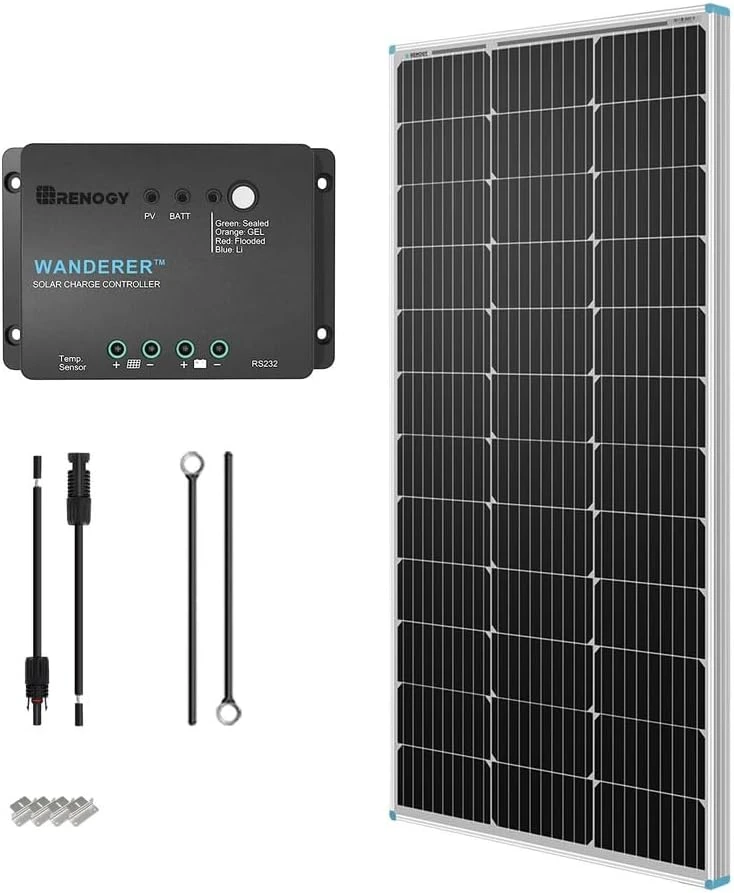
Renogy 100 W Solar Panel Starter Kit
A complete first solar kit — panel, charge controller and mounts — for off-grid and RV use.
- Everything matched in one box — panel, charge controller, mounts and cabling, so nothing is missing on install day.
- Monocrystalline panel — performs better than polycrystalline in low light and overcast conditions.
- Scales by adding identical panels — you can grow the array later without replacing the controller if it has headroom.

NOCO GENIUS5 Battery Charger
A 5 A automatic charger and maintainer that can stay connected long-term without overcharging.
- Safe long-term maintenance — leave it connected through winter without overcharging the battery.
- 6 V and 12 V support — covers cars, motorcycles, ride-on mowers and most small batteries.
- Multiple chemistry profiles — charges lead-acid and lithium correctly, with the right profile for each.
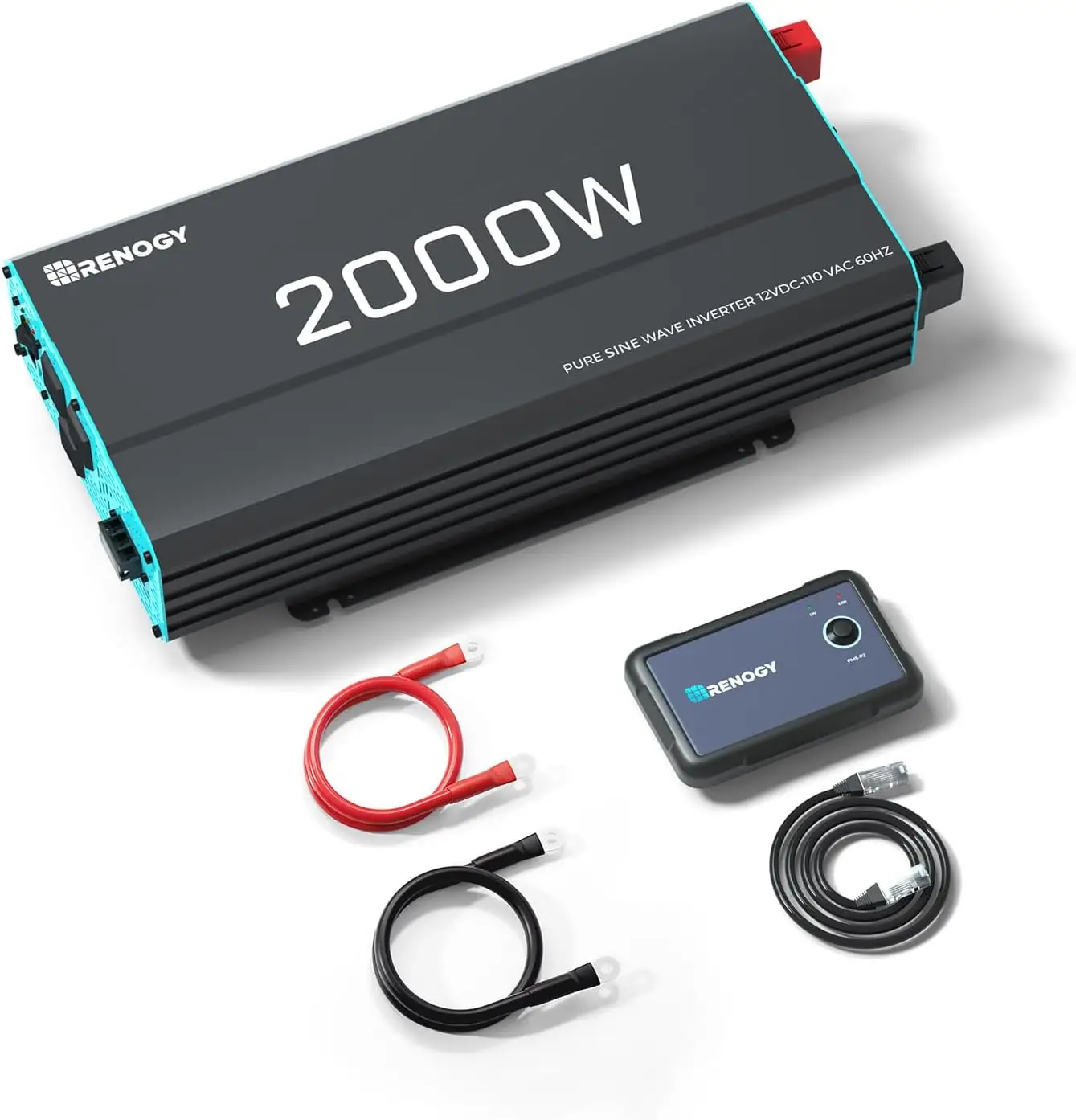
Renogy 2000 W Pure Sine Wave Inverter
Pure sine wave output at 2000 W continuous, with a higher surge rating for motor starting.
- Pure sine wave output — equipment runs as it would on mains, with no buzzing motors or misbehaving supplies.
- 2000 W continuous output — enough for fridges, power tools and a run of household electronics.
- Surge headroom for motor starting — covers the brief inrush a fridge compressor or pump draws on start-up.
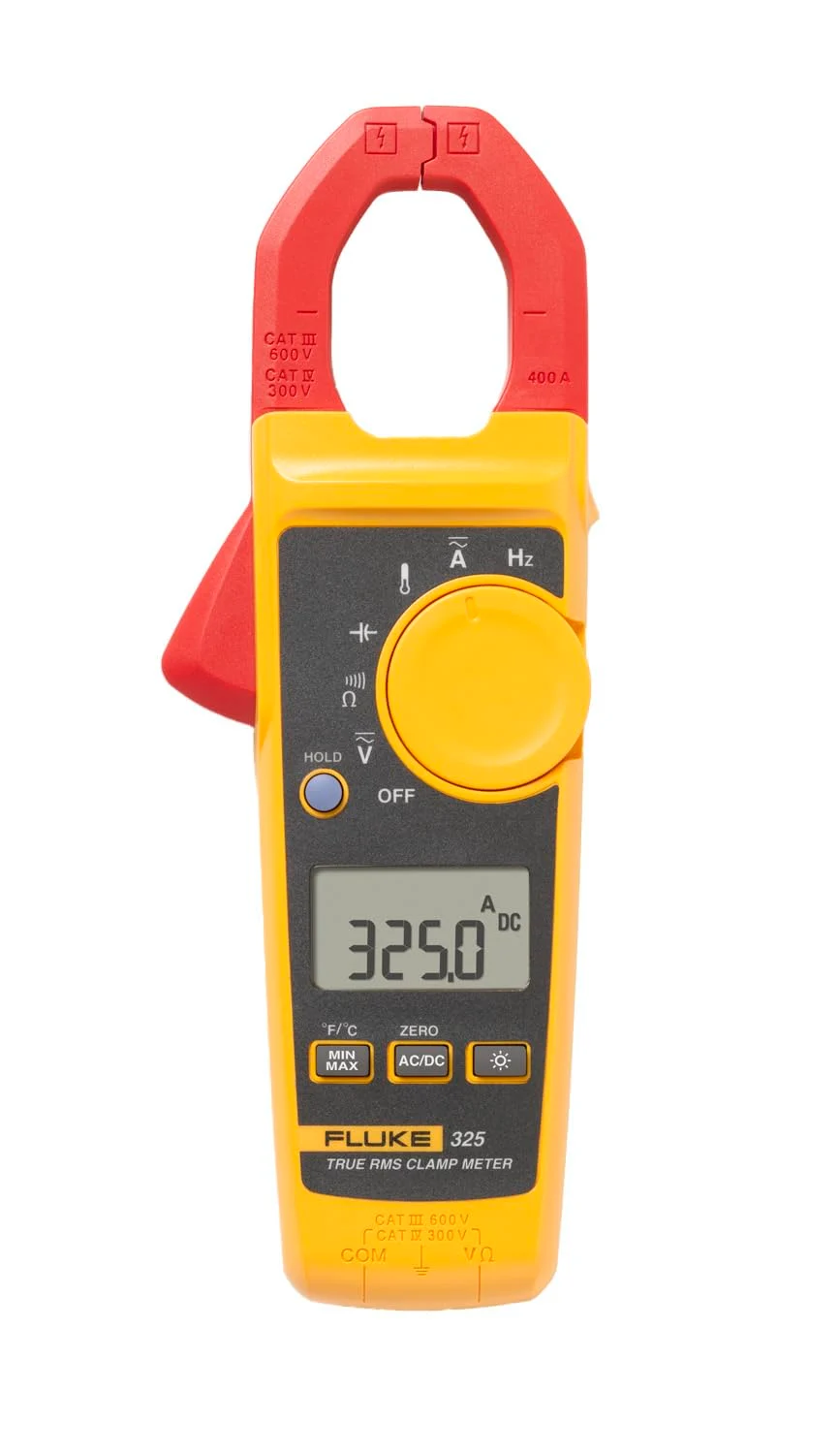
Fluke 325 True-RMS Clamp Meter
Clamp-on AC/DC current measurement in tight panels, with true-RMS accuracy and a CAT III 600 V rating.
- AC and DC current measurement — covers mains circuits, battery banks and solar strings with one tool.
- Clamp-on measurement — read current without disconnecting or disturbing the circuit.
- Slim jaw profile — slides into crowded panels where bulky clamps will not fit.