Skip to content

kW to W

Convert kilowatts to watts in one step — enter a value in kW to get the exact watt figure, with the ×1000 conversion factor shown alongside the result.

kW to W

Enter Power to see the result.

Formula

W = kW × 1000

Input definitions

InputSymbolUnitWhat it means
PowerL / CkWInductance in henries or capacitance in farads, according to the selected component.

Assumptions

  • The displayed formula and selected mode define the simplified model. Only the inputs shown are included; unstated installation conditions are not inferred.
  • Enter each value in the unit printed beside its input. Any conversion needed by the formula is handled as shown in the calculation steps.
  • Entered ratings, efficiencies, loads and component values are treated as constant for the operating point or time period being estimated.

Limitations

  • No code tables are applied: ampacity, derating for grouping, ambient temperature and installation method must be checked separately.
  • Harmonics, non-linear loads, motor starting current and protective-device trip characteristics are not modelled.
  • The result is a planning estimate for a single operating point, not a load study or a design verification.

Safety and code notice

Use this tool for learning and preliminary calculations. Always verify electrical designs against applicable local codes and a qualified professional. VoltCalc provides planning estimates, not code compliance — see the methodology and safety disclaimer.

Explanation

A kilowatt is 1000 watts. Multiply by 1000 to convert to watts.

Examples

  • 2.5 kW = 2500 W.

Frequently asked questions

Why is kW used?
Large loads are easier to express in kilowatts than in thousands of watts.
Is kW the same as kWh?
No — kW is power; kWh is energy over time.
All products →
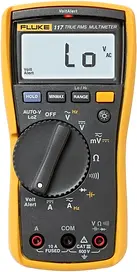
Yellow Fluke 117 multimeter with a black dial, function buttons and red and black test ports
Fluke

Fluke 117 True-RMS Multimeter

A true-RMS digital multimeter built for electrical work in commercial and residential settings, with non-contact voltage detection and a CAT III 600 V safety rating.

  • True-RMS AC measurement — accurate readings on the electronic loads that fool cheaper average-sensing meters.
  • Built-in non-contact voltage detection — confirm a circuit is live before you put a probe anywhere near it.
  • CAT III 600 V safety rating — rated for the transient energy you meet in distribution panels and fixed wiring.
Pros
  • True-RMS readings stay accurate on non-sinusoidal loads
  • Non-contact voltage detection saves time on live circuits
  • Well documented and widely supported, with parts that stay available
Cons
  • No current clamp — a separate accessory is needed for high current
  • Costs noticeably more than entry-level meters
  • No data logging, memory or Bluetooth
Check PriceView details

VoltCalc may earn a commission when you buy through links on this page, at no extra cost to you. Prices and availability are shown as a guide only and may change.
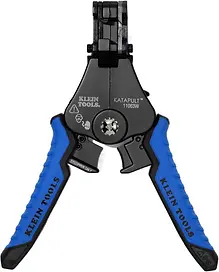
Blue-handled Klein Katapult wire stripper with a black steel cutting head and safety icons
Klein Tools

Klein Tools 11063W Wire Stripper and Cutter

A self-adjusting wire stripper and cutter that handles solid and stranded conductors from 8–18 AWG without nicking the copper.

  • Self-adjusting action — squeeze once and the tool sets itself to the conductor size, so strips are repeatable.
  • Clean strip without nicking — protects the copper, which is what keeps a termination reliable long term.
  • Built-in cutter and plier nose — you can cut, strip and twist without swapping tools.
Pros
  • Self-adjusting action is fast on repetitive work
  • Clean strips without nicking conductors
  • Doubles as a cutter and plier
Cons
  • Bulkier than a simple stripping tool in tight boxes
Check PriceView details

VoltCalc may earn a commission when you buy through links on this page, at no extra cost to you. Prices and availability are shown as a guide only and may change.

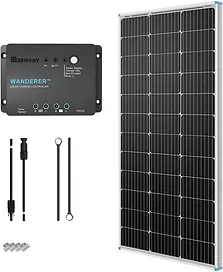
Renogy solar kit with a Wanderer charge controller, framed solar panel, cables and brackets
Renogy

Renogy 100 W Solar Panel Starter Kit

A 100 W monocrystalline solar panel starter kit with a charge controller and mounting hardware for off-grid and RV systems.

  • Everything matched in one box — panel, charge controller, mounts and cabling, so nothing is missing on install day.
  • Monocrystalline panel — performs better than polycrystalline in low light and overcast conditions.
  • Scales by adding identical panels — you can grow the array later without replacing the controller if it has headroom.
Pros
  • Everything needed to start in one box
  • Monocrystalline panel performs well in low light
  • Scales by adding identical panels
Cons
  • Kits are usually cheaper per watt when bought piece by piece at larger sizes
Check PriceView details

VoltCalc may earn a commission when you buy through links on this page, at no extra cost to you. Prices and availability are shown as a guide only and may change.

VoltCalc may earn a commission when you buy through links on this page, at no extra cost to you. Prices and availability are shown as a guide only and may change.