Skip to content

Voltage Drop Calculator

Calculate voltage drop along a conductor run for single or three-phase circuits.

Voltage Drop Calculator

Enter System Voltage, Load Current, One-way conductor length to see the result.

Formula

Single-phase: ΔV = 2 × I × L × ρ ÷ A. Three-phase: ΔV = √3 × I × L × ρ ÷ A. Drop (%) = (ΔV ÷ V) × 100.

Input definitions

InputSymbolUnitWhat it means
System VoltageVVThe potential difference across the circuit or component, in volts.
Load CurrentIAThe current flowing through the circuit, in amperes.
One-way conductor lengthLmOne-way conductor length from the supply to the load; the calculation includes the return path or three-phase multiplier.
Conductor SizeAmm²Cross-sectional area of one conductor, in square millimetres, not its diameter.
Conductor Materialρ—Conductor material used to choose the resistivity in the voltage-drop calculation.
Phase——Select single-phase or balanced three-phase operation; use line-to-line voltage for three-phase calculations.

Worked example

  1. 1.A 20 A load sits 30 m from the supply on a single-phase 120 V circuit, wired in 2.5 mm² copper.
  2. 2.Conductor resistance: 0.0175 × 30 ÷ 2.5 = 0.21 Ω
  3. 3.Voltage drop: 2 × 20 A × 0.21 Ω = 8.4 V
  4. 4.Percentage drop: 8.4 ÷ 120 × 100 = 7.0% — high for a branch circuit, so a larger conductor is indicated.

Assumptions

  • Resistivity is fixed at 20 °C: copper ρ = 0.0175 Ω·mm²/m and aluminium ρ = 0.0282 Ω·mm²/m. No temperature correction is applied.
  • This resistance-only approximation neglects cable reactance and load phase angle. Three-phase mode assumes a balanced load.
  • The length you enter is the one-way distance. The calculator applies the out-and-back factor of 2 for single-phase and √3 for three-phase itself, and says so in the result.
  • Load current is taken as steady. Starting current, inrush and cyclic loads are not modelled.

Limitations

  • A voltage-drop result evaluates the conductor size you selected. It does not select a code-compliant conductor for you, and it does not check ampacity.
  • Voltage-drop limits depend on circuit type, jurisdiction, load type and the code in force. The familiar 3% branch-circuit and 5% total figures are planning references, not universal legal limits.
  • Conduit fill, conductor grouping, ambient temperature and insulation type all affect the real installation and are outside this calculation.

Safety and code notice

Use this tool for learning and preliminary calculations. Always verify electrical designs against applicable local codes and a qualified professional. VoltCalc provides planning estimates, not code compliance — see the methodology and safety disclaimer.

How it works

Every conductor has resistance, so some voltage is lost along a run. Excessive voltage drop causes dim lights, hot motors, and unreliable equipment. The multiplier is 2 for single phase (out and back) and √3 for three phase.

When to use it

Use it whenever a cable run is long relative to its cross-section — especially in outbuildings and long feeders.

Put the numbers to work with the Wire Size Calculator, Current Calculator and Ohm's Law Calculator.

Common mistakes

Doubling the entered one-way conductor length again — the calculator already includes the return path — or mixing mm² and AWG sizes.

Frequently asked questions

What is an acceptable voltage drop?
Many codes and guides recommend no more than 3% for branch circuits and 5% overall.
Does temperature affect voltage drop?
Yes. Resistance rises with temperature, so hot conductors drop slightly more.

Related guides

All products →
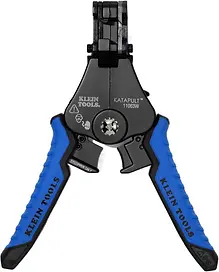
Blue-handled Klein Katapult wire stripper with a black steel cutting head and safety icons
Klein Tools

Klein Tools 11063W Wire Stripper and Cutter

A self-adjusting wire stripper and cutter that handles solid and stranded conductors from 8–18 AWG without nicking the copper.

  • Self-adjusting action — squeeze once and the tool sets itself to the conductor size, so strips are repeatable.
  • Clean strip without nicking — protects the copper, which is what keeps a termination reliable long term.
  • Built-in cutter and plier nose — you can cut, strip and twist without swapping tools.
Pros
  • Self-adjusting action is fast on repetitive work
  • Clean strips without nicking conductors
  • Doubles as a cutter and plier
Cons
  • Bulkier than a simple stripping tool in tight boxes
Check PriceView details

VoltCalc may earn a commission when you buy through links on this page, at no extra cost to you. Prices and availability are shown as a guide only and may change.
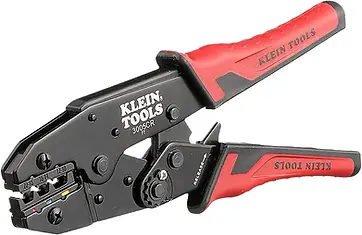
Black Klein crimping pliers with red and black handles and colour-coded crimp slots
Klein Tools

Klein Tools 3005CR Ratcheting Crimper

A ratcheting crimping tool for insulated and non-insulated terminals from 22–10 AWG, with a full-cycle release.

  • Ratcheting mechanism — the tool stays locked until the crimp is fully formed, so a weak grip cannot produce a weak joint.
  • 22–10 AWG range — covers the terminal sizes used in most panel and control wiring.
  • Insulated and non-insulated terminals — one tool handles both, so you are not carrying two.
Pros
  • The ratchet prevents half-formed crimps
  • Handles both insulated and bare terminals
  • Comfortable over long runs
Cons
  • A single tool cannot cover every terminal type — some connectors need dedicated dies
Check PriceView details

VoltCalc may earn a commission when you buy through links on this page, at no extra cost to you. Prices and availability are shown as a guide only and may change.

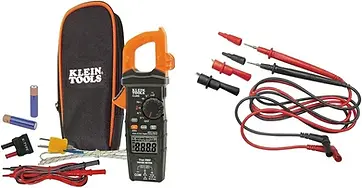
Black and orange Klein CL800 clamp meter with case, test leads, thermocouple and batteries
Klein Tools

Klein Tools CL800 Digital Clamp Meter

An auto-ranging true-RMS clamp meter with a wide jaw, inrush current measurement and a CAT IV 300 V rating.

  • Inrush current capture — see the starting surge that trips breakers, not just the running current.
  • Wide jaw opening — accepts larger conductors and bundled cables that slim clamps cannot.
  • Auto-ranging true-RMS measurement — fast readings you can trust on non-linear loads.
Pros
  • Inrush mode helps diagnose motor starting problems
  • Wide jaw accepts larger conductors
  • Auto-ranging keeps field work quick
Cons
  • Bulkier than a pocket clamp meter
  • Lower CAT IV rating than some competitors
Check PriceView details

VoltCalc may earn a commission when you buy through links on this page, at no extra cost to you. Prices and availability are shown as a guide only and may change.

VoltCalc may earn a commission when you buy through links on this page, at no extra cost to you. Prices and availability are shown as a guide only and may change.