Why voltage drops at all
Every conductor has resistance. When current flows through that resistance, some voltage is lost along the length of the cable — the same I × R relationship that governs any resistor. On a short run the loss is trivial; on a long one it can be the difference between equipment working reliably and failing intermittently.
The formula
For a single-phase circuit, current travels out and back, so the length is effectively doubled:
V_drop = 2 × I × L × ρ ÷ A
For a three-phase circuit the return path is shared, so the factor becomes √3:
V_drop = √3 × I × L × ρ ÷ A
Where I is current, L is the one-way length, ρ (rho) is the resistivity of the conductor material, and A is the cross-sectional area.
- Copper: about 0.0175 Ω·mm²/m
- Aluminium: about 0.0282 Ω·mm²/m
A worked example
A 20 A load sits 40 m from the supply on a single-phase 230 V circuit, wired in 4 mm² copper.
- Resistance of the run: R = (0.0175 × 40) ÷ 4 = 0.175 Ω
- Voltage drop: V_drop = 2 × 20 × 0.175 = 7 V
- As a percentage: (7 ÷ 230) × 100 = 3.0%
That sits right at the usual 3% branch-circuit guideline, so a larger conductor would give a safer margin.
Why it matters
- Motors draw more current as voltage falls, which increases heating and shortens life.
- Lighting visibly dims, and LED drivers may drop out.
- Electronics can reset or misbehave at reduced voltage.
Fixing excessive drop
The practical options are to increase the conductor size, shorten the run, reduce the load, or raise the supply voltage. Increasing conductor size is usually the cheapest fix because resistance is inversely proportional to area.
Use the Voltage Drop Calculator to test your own figures, and the Wire Size Calculator to find the minimum conductor that keeps the drop within your target.
Put the numbers to work with the Voltage Drop Calculator and Wire Size Calculator.
Frequently asked questions
What is an acceptable voltage drop?
Does voltage drop depend on the load?
Related calculators
Voltage Drop Calculator
Calculate voltage drop along a conductor run for single or three-phase circuits.
Wire Size Calculator
Find the minimum conductor cross-section for a given current, length, and allowable drop.
Circuit Breaker Size Calculator
Calculate the recommended circuit breaker rating for a load.
Products mentioned in this guide
All products →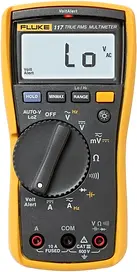
Fluke 117 True-RMS Multimeter
A true-RMS digital multimeter built for electrical work in commercial and residential settings, with non-contact voltage detection and a CAT III 600 V safety rating.
- True-RMS AC measurement — accurate readings on the electronic loads that fool cheaper average-sensing meters.
- Built-in non-contact voltage detection — confirm a circuit is live before you put a probe anywhere near it.
- CAT III 600 V safety rating — rated for the transient energy you meet in distribution panels and fixed wiring.
- True-RMS readings stay accurate on non-sinusoidal loads
- Non-contact voltage detection saves time on live circuits
- Well documented and widely supported, with parts that stay available
- No current clamp — a separate accessory is needed for high current
- Costs noticeably more than entry-level meters
- No data logging, memory or Bluetooth
VoltCalc may earn a commission when you buy through links on this page, at no extra cost to you. Prices and availability are shown as a guide only and may change.
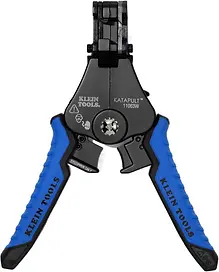
Klein Tools 11063W Wire Stripper and Cutter
A self-adjusting wire stripper and cutter that handles solid and stranded conductors from 8–18 AWG without nicking the copper.
- Self-adjusting action — squeeze once and the tool sets itself to the conductor size, so strips are repeatable.
- Clean strip without nicking — protects the copper, which is what keeps a termination reliable long term.
- Built-in cutter and plier nose — you can cut, strip and twist without swapping tools.
- Self-adjusting action is fast on repetitive work
- Clean strips without nicking conductors
- Doubles as a cutter and plier
- Bulkier than a simple stripping tool in tight boxes
VoltCalc may earn a commission when you buy through links on this page, at no extra cost to you. Prices and availability are shown as a guide only and may change.
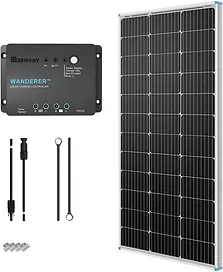
Renogy 100 W Solar Panel Starter Kit
A 100 W monocrystalline solar panel starter kit with a charge controller and mounting hardware for off-grid and RV systems.
- Everything matched in one box — panel, charge controller, mounts and cabling, so nothing is missing on install day.
- Monocrystalline panel — performs better than polycrystalline in low light and overcast conditions.
- Scales by adding identical panels — you can grow the array later without replacing the controller if it has headroom.
- Everything needed to start in one box
- Monocrystalline panel performs well in low light
- Scales by adding identical panels
- Kits are usually cheaper per watt when bought piece by piece at larger sizes
VoltCalc may earn a commission when you buy through links on this page, at no extra cost to you. Prices and availability are shown as a guide only and may change.
VoltCalc may earn a commission when you buy through links on this page, at no extra cost to you. Prices and availability are shown as a guide only and may change.