Skip to content

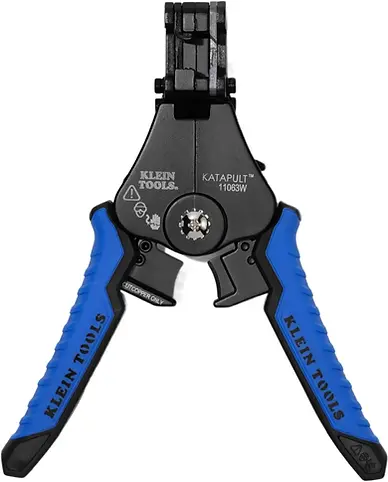
Klein Tools 11063W Wire Stripper and Cutter

Nicked copper is a hidden defect. The conductor looks fine, the joint goes together, and months later a strand breaks at the termination because a stripper scored it. Doing hundreds of terminations by hand with a knife or a fixed-gauge tool makes that outcome more likely, not less. The 11063W is self-adjusting: it grips the insulation, strips it in one squeeze and leaves the copper untouched, which is both faster and more consistent.

Blue-handled Klein Katapult wire stripper with a black steel cutting head and safety icons
Klein ToolsWire Strippers & Cutters

Self-adjusting stripper that grips, strips and cuts common building wire in one motion.

Check the current price

The retailer sets the price and it changes often, so we link straight to the live listing rather than show a number that may be out of date.

Type
Self-adjusting wire stripper / cutter
Capacity
8–18 AWG solid, 10–20 AWG stranded
Handles
Dual-material, slip-resistant

VoltCalc may earn a commission when you buy through links on this page, at no extra cost to you. Prices and availability are shown as a guide only and may change.

Key features and what they mean for you

  • Self-adjusting action — squeeze once and the tool sets itself to the conductor size, so strips are repeatable.
  • Clean strip without nicking — protects the copper, which is what keeps a termination reliable long term.
  • Built-in cutter and plier nose — you can cut, strip and twist without swapping tools.
  • Hardened steel jaws — stays sharp through thousands of terminations.

Real-world performance

On repetitive panel work the self-adjusting mechanism genuinely saves time — you stop measuring and stop thinking about gauge. Strips come off cleanly and, importantly, without the scoring that a fixed-notch tool leaves on stranded wire. The compromise is size: the body is bulkier than a simple stripping tool, which can be awkward in a crowded back box where space is tight.

Technical specifications

The specifications that matter when you compare the Klein Tools 11063W Wire Stripper and Cutter against the alternatives.

TypeSelf-adjusting wire stripper / cutter
Capacity8–18 AWG solid, 10–20 AWG stranded
HandlesDual-material, slip-resistant

Pros and cons

Pros
  • Self-adjusting action is fast on repetitive work
  • Clean strips without nicking conductors
  • Doubles as a cutter and plier
Cons
  • Bulkier than a simple stripping tool in tight boxes

Who should buy it

Electricians terminating lots of conductors on panels and devices.

Who should skip it

You only work with very small electronics wire.

How it compares

Pairs naturally with the Klein 3005CR crimper — strip with one, terminate with the other, and keep a multimeter for verification.

Our verdict

If you make up lots of terminations, this tool pays for itself in time and in fewer rework call-backs. The self-adjusting action is the reason to buy it, and the clean strip is the reason to keep it. If you mostly work with small electronics wire or inside cramped boxes, a slimmer dedicated tool may suit you better.

Frequently asked questions

Why does nicking a conductor matter if it still works?
A nick reduces the conductor cross-section at its most stressed point. Under load, heat cycling and vibration, that becomes where the wire eventually fails — often long after the install.
Will it strip stranded wire as cleanly as solid?
Yes, within its rated range. Stranded wire is where a self-adjusting tool has the biggest advantage, because a fixed-notch stripper is far more likely to cut strands.

Alternatives to consider

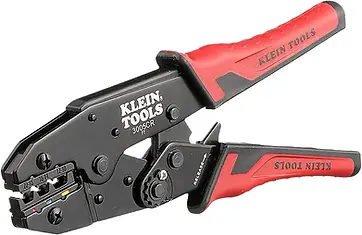
Black Klein crimping pliers with red and black handles and colour-coded crimp slots
Klein Tools

Klein Tools 3005CR Ratcheting Crimper

A ratcheting crimping tool for insulated and non-insulated terminals from 22–10 AWG, with a full-cycle release.

  • Ratcheting mechanism — the tool stays locked until the crimp is fully formed, so a weak grip cannot produce a weak joint.
  • 22–10 AWG range — covers the terminal sizes used in most panel and control wiring.
  • Insulated and non-insulated terminals — one tool handles both, so you are not carrying two.
Pros
  • The ratchet prevents half-formed crimps
  • Handles both insulated and bare terminals
  • Comfortable over long runs
Cons
  • A single tool cannot cover every terminal type — some connectors need dedicated dies
Check PriceView details

VoltCalc may earn a commission when you buy through links on this page, at no extra cost to you. Prices and availability are shown as a guide only and may change.