Skip to content

Ohm's Law Calculator

Ohm's Law relates voltage, current, and resistance in a circuit. Choose the value you want to find and enter the other two.

Ohm's Law Calculator

Solve for
Enter Current, Resistance to see the result.

Formula

V = I × R

Input definitions

InputSymbolUnitWhat it means
CurrentIAThe current flowing through the circuit, in amperes.
ResistanceRΩThe resistance opposing the current, in ohms.
VoltageVVThe potential difference across the circuit or component, in volts.

Worked example

  1. 1.A 12 V supply is connected across a 6 Ω resistor.
  2. 2.I = V ÷ R = 12 V ÷ 6 Ω = 2 A
  3. 3.P = V × I = 12 V × 2 A = 24 W

Assumptions

  • The relationship is applied to a simple DC circuit, or to a purely resistive AC load.
  • Resistance is treated as constant. Components such as lamp filaments and thermistors change resistance with temperature and do not follow Ohm's law linearly.
  • For AC circuits containing motors, transformers or capacitors, impedance (Z) must replace resistance, with power factor and phase taken into account.

Limitations

  • Entering more than two values can describe a physically impossible circuit; the calculator will report the conflict rather than silently choosing a pair.
  • A resistance of zero ohms describes a short circuit, and the current is then limited by the rest of the circuit, which this tool does not model.

Safety and code notice

Use this tool for learning and preliminary calculations. Always verify electrical designs against applicable local codes and a qualified professional. VoltCalc provides planning estimates, not code compliance — see the methodology and safety disclaimer.

How it works

Ohm's Law is the foundation of electrical calculations. It states that the current through a conductor is directly proportional to the voltage across it and inversely proportional to its resistance. If you know any two of the three quantities, the third can always be found.

When to use it

Use it to size resistors, check expected current draw, or estimate voltage across a component.

Put the numbers to work with the Voltage Calculator, Current Calculator and Resistance Calculator.

Common mistakes

Mixing units (mA vs A, kΩ vs Ω) is the most common error. Convert everything to base SI units (volts, amps, ohms) before calculating.

Frequently asked questions

What is the Ohm's Law triangle?
A visual aid where V sits on top of I and R. Cover the quantity you want to find: V = I × R, I = V ÷ R, R = V ÷ I.
Does Ohm's Law apply to AC circuits?
Yes, for resistive loads. For AC with reactance, use impedance (Z) in place of resistance so V = I × Z.

Related guides

All products →
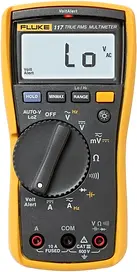
Yellow Fluke 117 multimeter with a black dial, function buttons and red and black test ports
Fluke

Fluke 117 True-RMS Multimeter

A true-RMS digital multimeter built for electrical work in commercial and residential settings, with non-contact voltage detection and a CAT III 600 V safety rating.

  • True-RMS AC measurement — accurate readings on the electronic loads that fool cheaper average-sensing meters.
  • Built-in non-contact voltage detection — confirm a circuit is live before you put a probe anywhere near it.
  • CAT III 600 V safety rating — rated for the transient energy you meet in distribution panels and fixed wiring.
Pros
  • True-RMS readings stay accurate on non-sinusoidal loads
  • Non-contact voltage detection saves time on live circuits
  • Well documented and widely supported, with parts that stay available
Cons
  • No current clamp — a separate accessory is needed for high current
  • Costs noticeably more than entry-level meters
  • No data logging, memory or Bluetooth
Check PriceView details

VoltCalc may earn a commission when you buy through links on this page, at no extra cost to you. Prices and availability are shown as a guide only and may change.
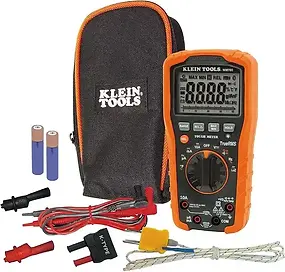
Orange Klein MM700 multimeter with black case, red and black leads, thermocouple and batteries
Klein Tools

Klein Tools MM700 Auto-Ranging Multimeter

An auto-ranging true-RMS multimeter with a CAT IV 600 V rating, aimed at electricians who want a rugged meter for field work.

  • Auto-ranging — connect the probes and read the value, with no range dial to set first.
  • True-RMS AC measurement — trustworthy numbers on drives, supplies and electronic lighting.
  • CAT IV 600 V rating — the highest common safety category, covering outdoor and service-entrance work.
Pros
  • Auto-ranging speeds up repetitive testing
  • CAT IV rating suits outdoor and service-entrance work
  • Rugged housing survives job-site knocks
Cons
  • Fewer measurement functions than a full bench meter
  • No data logging or export
Check PriceView details

VoltCalc may earn a commission when you buy through links on this page, at no extra cost to you. Prices and availability are shown as a guide only and may change.
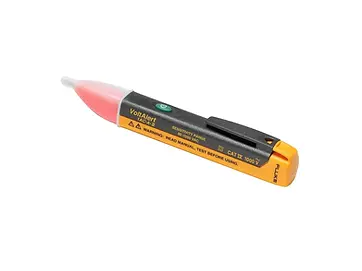
Yellow pen-shaped Fluke VoltAlert voltage tester with a glowing red tip and black clip
Fluke

Fluke 1AC-II VoltAlert Non-Contact Voltage Tester

A pocket-sized non-contact voltage detector that glows and beeps near live conductors, rated CAT IV 1000 V.

  • Non-contact detection — confirms voltage is present without any contact or exposed metal.
  • Audible and visual indication — clear beep and bright glow, so you can confirm while looking elsewhere.
  • CAT IV 1000 V rating — safety category suited to service entrances and outdoor conductors.
Pros
  • Fast way to confirm a circuit is live before touching it
  • High safety rating for a small tester
  • No battery drain while idle
Cons
  • Only tells you voltage is present — not the value
  • No built-in light for dark enclosures
Check PriceView details

VoltCalc may earn a commission when you buy through links on this page, at no extra cost to you. Prices and availability are shown as a guide only and may change.

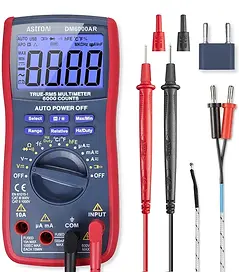
Red AstroAI DM6000AR multimeter with a blue faceplate, test leads, caps and thermocouple probe
AstroAI

AstroAI DM6000AR True-RMS Digital Multimeter

A true-RMS 6000-count digital multimeter with a CAT III 600 V rating, temperature and capacitance measurement, transistor testing and a backlit display.

  • True-RMS AC measurement — accurate readings on the distorted, non-sinusoidal waveforms that switch-mode supplies, dimmers and inverters produce, which is where average-sensing meters quietly mislead.
  • 6000-count display with 0.1 mV and 0.1 µA resolution — more resolution on low-voltage and low-current work than a typical 2000-count budget meter, so small changes are visible rather than rounded away.
  • CAT III 600 V and CAT II 1000 V safety rating — rated for the transient energy of distribution panels and fixed wiring, not just bench work.
Pros
  • True-RMS AC measurement at a budget price
  • 6000-count resolution with 0.1 mV and 0.1 µA resolution
  • Temperature, capacitance, frequency, duty cycle and transistor hFE testing
Cons
  • Not CAT IV rated, so not suited to outdoor service entrances or industrial distribution
  • No data logging, memory or Bluetooth connectivity
  • Accuracy and build are pitched at DIY and educational use, not regulated verification
Check PriceView details

VoltCalc may earn a commission when you buy through links on this page, at no extra cost to you. Prices and availability are shown as a guide only and may change.

VoltCalc may earn a commission when you buy through links on this page, at no extra cost to you. Prices and availability are shown as a guide only and may change.