Amperage Calculator
Calculate current in amps from watts and volts, or from volts and resistance.
Step-by-step calculation
- I = 1800 W ÷ 120 V
- I = 15 A
Formula
Input definitions
| Symbol | Input | Unit | Meaning & code relevance |
|---|---|---|---|
| P | Power | W | Active electrical or mechanical power transfer (W) dissipated or delivered to the load. |
| V | Voltage | V | Nominal RMS AC or steady-state DC system potential (e.g., 120V/240V/480V NEC or 230V/400V IEC 60038). |
| PF | Power Factor | — | Ratio of real power (kW) to apparent power (kVA), ranging from 0.01 to 1.00 for inductive/capacitive AC loads. |
| φ | System Phase | — | Electrical supply configuration: Single-Phase (2-wire) or balanced Three-Phase (3-wire/4-wire with √3 factor). |
Worked example
1800 W Space Heater on 120 V Circuit
Find operating amperage.
- I = 1800 ÷ 120 = 15 A
Assumptions
- The watts mode assumes unity power factor — a purely resistive load, or DC.
- Voltage is taken as the RMS value for AC and as a steady value for DC.
- The resistance mode applies Ohm's Law, so the resistance is assumed constant at the operating current.
Limitations
- Reactive and motor loads draw more current than W ÷ V at unity power factor; power factor and efficiency must be included separately.
- Starting and inrush currents are several times the running current and are not modelled.
- No conductor or protective-device sizing is applied — the amperage result is an input to that selection, not the selection itself.
How it works
Divides load wattage by voltage (and √3 and power factor for AC multiphase loads) to compute continuous amperage.
When to use it
- Converting appliance or equipment wattage (W or kW) and system voltage into operating amperage for branch-circuit and breaker planning.
- Comparing current draw of the same wattage load across 12 V DC, 120 V AC, 208 V AC, 230 V AC, 240 V AC, or 400 V / 480 V circuits.
- Evaluating whether an existing receptacle circuit can handle portable heaters, commercial kitchen appliances, or workshop tools.
Practical real-world applications
- Determining that a 1,800 W commercial heat gun draws 15.0 A on a 120 V North American circuit (maxing out an 80% continuous 15 A breaker) vs. 7.83 A on a 230 V IEC circuit.
- Sizing 12 V vs. 24 V vs. 48 V DC battery cables for an off-grid solar cabin by comparing how higher voltage slashes cable amperage by 2× or 4×.
- Checking total connected amperage across a multi-outlet power distribution unit (PDU) in a server rack or AV booth.
Original Editorial Review & Technical Evaluation
Calculates line and load current in amperes (A) across DC, single-phase AC, and balanced three-phase AC distribution systems accounting for voltage, wattage, and power factor.
Electrical estimators, facility engineers balancing three-phase panels, and commercial contractors converting equipment kW/W into feeder amps.
- Switches seamlessly between DC (I = P ÷ V), 1φ AC (I = P ÷ (V × PF)), and 3φ AC (I = P ÷ (√3 × V × PF))
- Computes apparent power (VA / kVA) alongside design line current for transformer and UPS capacity checks
- Accepts watts or kilowatts with automatic power-factor derating impact
Accuracy & methodology: Models balanced sinusoidal loads using nominal line-to-line voltage on three-phase circuits and steady-state power factor between 0.10 and 1.00. Phase unbalance, neutral harmonic currents, and motor mechanical efficiency losses are excluded unless pre-factored into input power. Computational standards →
What to verify independently: Verify nameplate full-load amperes (FLA) directly on equipment labels and confirm phase balance across L1/L2/L3 against NEC Article 220 or IEC 60364-5-52.
Put the numbers to work with the Current Calculator, Power Calculator and Wire Size Calculator (Dual-Criteria Solver). For the background behind the numbers, read How to Choose a Clamp Meter and How to Size a Circuit Breaker Correctly.
Common mistakes
- Loading a standard 15 A or 20 A North American branch circuit to 100% of its rating for continuous loads (> 3 hours), violating the 80% continuous limit (12 A on 15 A; 16 A on 20 A).
- Using nominal 240 V instead of actual 208 V when calculating amperage for three-phase wye-connected commercial building panels.
- Ignoring inverter efficiency losses (typically 88%–94%) when calculating DC battery amperage from an AC appliance’s watt rating.
Safety & code notice
Calculator results are planning estimates. Always verify electrical designs against applicable local codes, standards (NEC / IEC), and consult a qualified professional.
Frequently asked questions
Related Calculators
Current Calculator
Calculate circuit current in amps from voltage and resistance or load wattage.
Power Calculator
Calculate active, apparent, and reactive power from voltage, current, or PF.
Wire Size Calculator (Dual-Criteria Solver)
Size copper and aluminum conductors in AWG or mm² for ampacity and voltage drop.
Circuit Breaker Size Calculator
Select circuit breaker and MCB ratings for continuous loads and cable ampacity.
Related Unit Converters
Watts to Amps Converter
Convert active power in watts (W) to current in amps (A) for DC and AC circuits.
Amps to Watts Converter
Convert current in amps (A) to active power in watts (W) for DC and AC systems.
Volts to Watts Converter
Convert voltage (V) and current (A) into real power in watts for DC and AC loads.
Related Engineering Guides
Recommended Clamp Meters & Voltage Testers for This Task
Verify live load current with a CAT III/IV True-RMS clamp meter, prove de-energized status with a non-contact voltage detector, and compare source vs. load terminal voltage under full operating current.
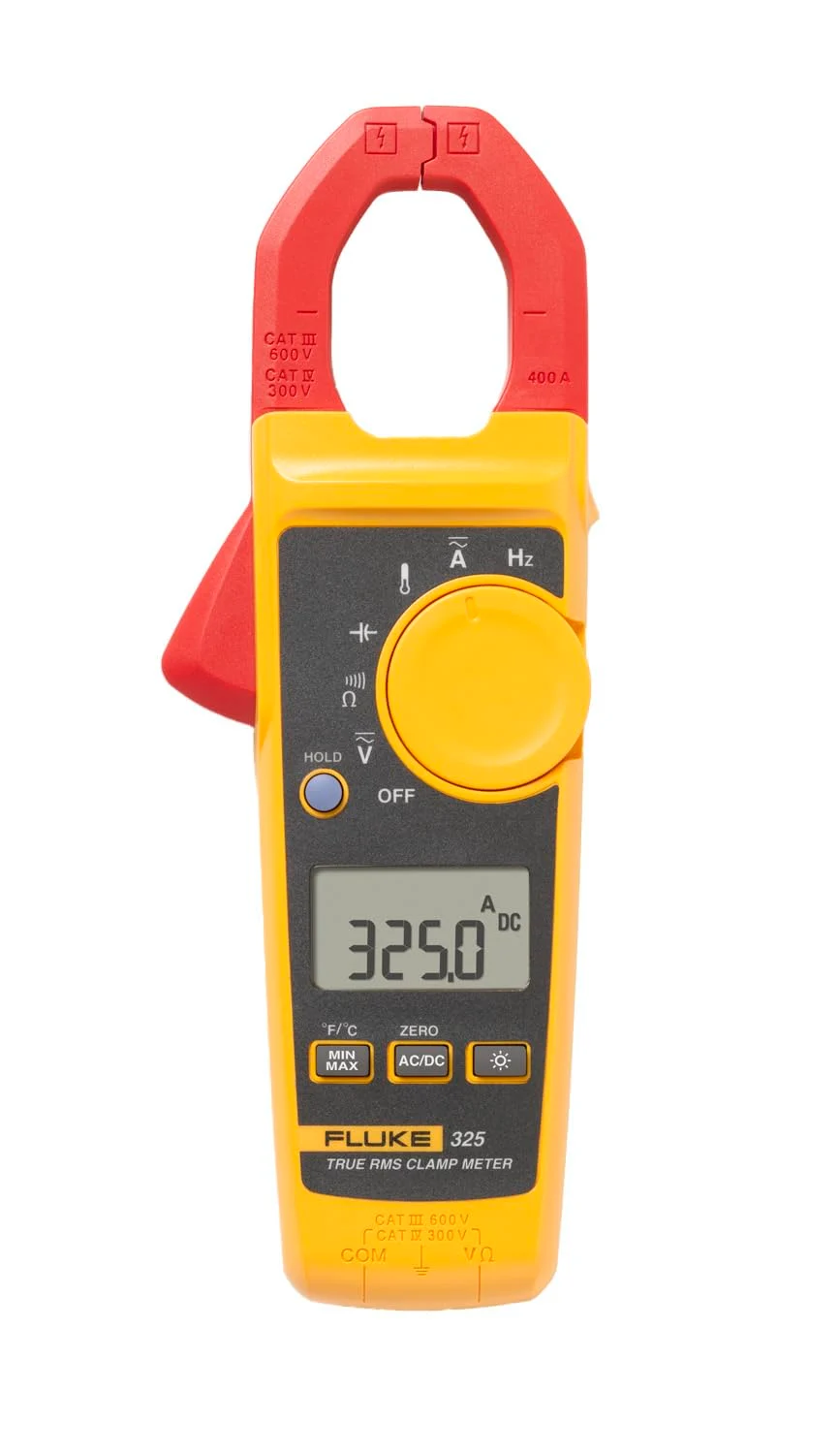
Fluke 325 True-RMS Clamp Meter
Clamp-on AC/DC current measurement in tight panels, with true-RMS accuracy and a CAT III 600 V rating.
- AC and DC current measurement — covers mains circuits, battery banks and solar strings with one tool.
- Clamp-on measurement — read current without disconnecting or disturbing the circuit.
- Slim jaw profile — slides into crowded panels where bulky clamps will not fit.
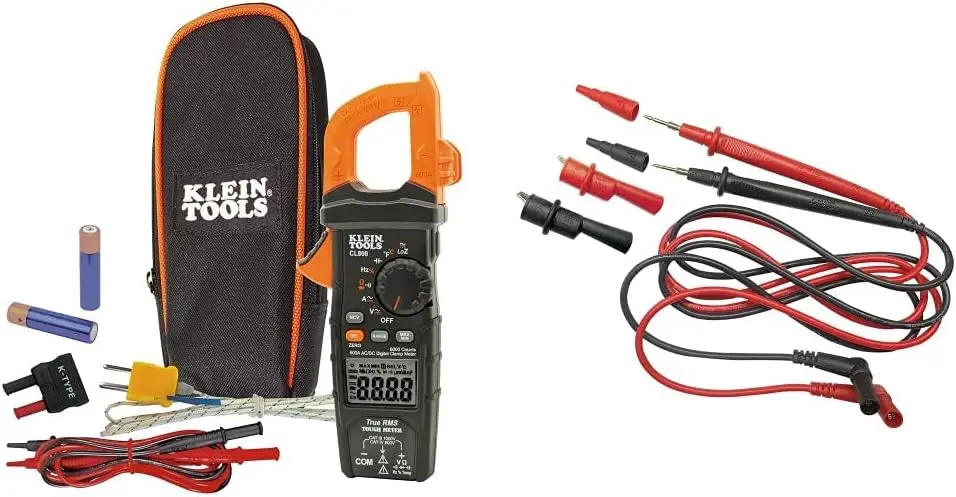
Klein Tools CL800 Digital Clamp Meter
Wide-jaw auto-ranging clamp meter with inrush capture for motor and compressor starting currents.
- Inrush current capture — see the starting surge that trips breakers, not just the running current.
- Wide jaw opening — accepts larger conductors and bundled cables that slim clamps cannot.
- Auto-ranging true-RMS measurement — fast readings you can trust on non-linear loads.
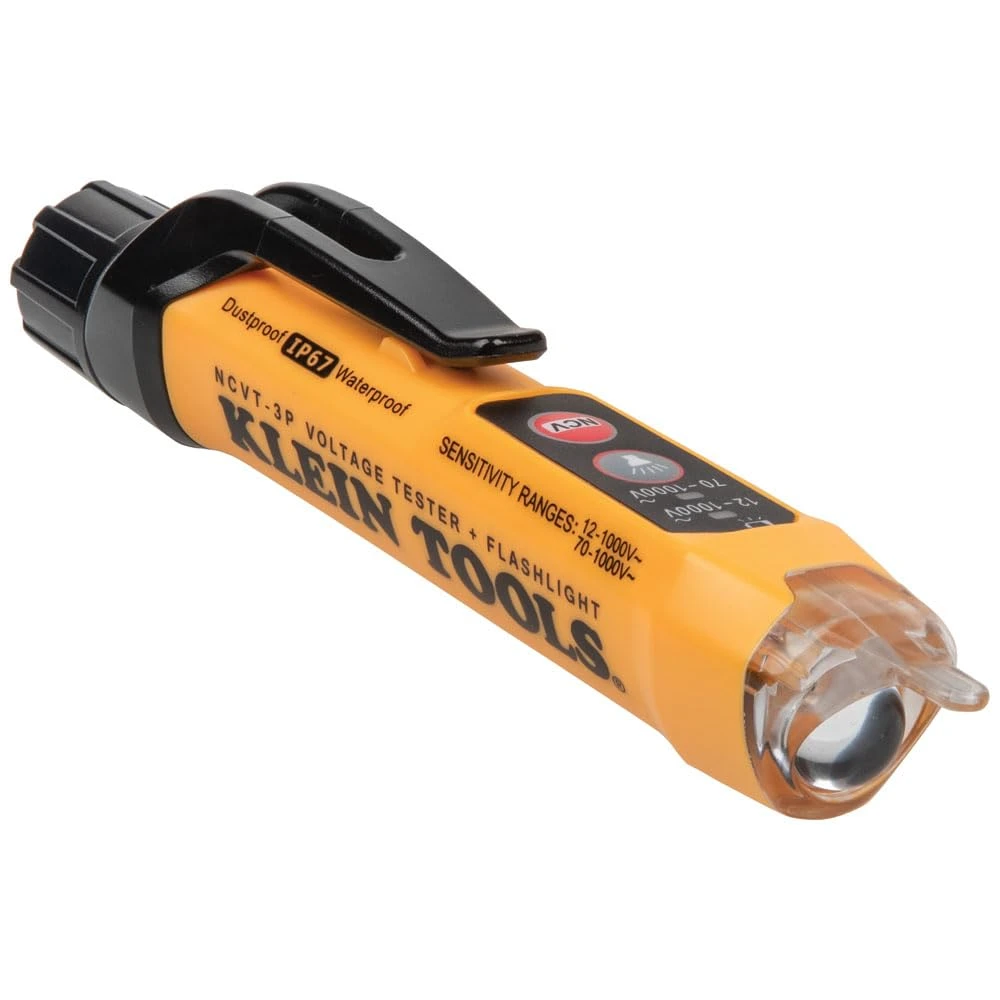
Klein Tools NCVT-3P Non-Contact Voltage Tester
Dual-range voltage tester with an integrated flashlight for working in dark panels.
- Built-in flashlight — no separate torch needed when you are working inside a dark enclosure.
- Dual sensitivity ranges — narrows detection so adjacent wiring causes fewer false positives.
- 12–1000 V AC detection — covers everything from control circuits up to mains voltage.
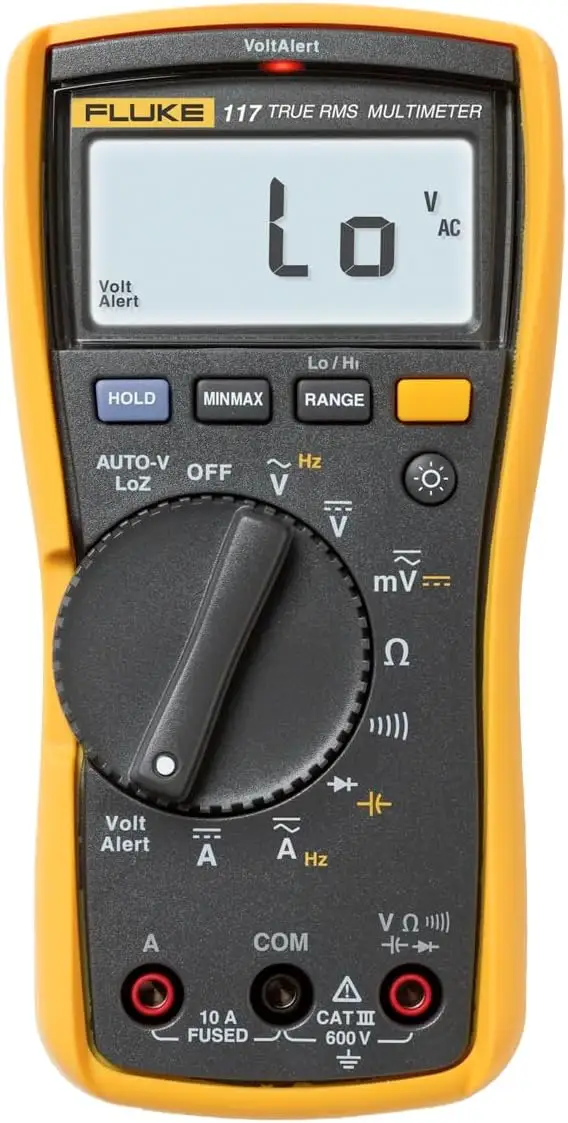
Fluke 117 True-RMS Multimeter
The everyday electrician's meter: true-RMS AC measurement, non-contact voltage detection and a CAT III 600 V rating in a compact body.
- True-RMS AC measurement — accurate readings on the electronic loads that fool cheaper average-sensing meters.
- Built-in non-contact voltage detection — confirm a circuit is live before you put a probe anywhere near it.
- CAT III 600 V safety rating — rated for the transient energy you meet in distribution panels and fixed wiring.