How to Choose a Clamp Meter
The right tool for one specific job
A clamp meter does one thing a multimeter cannot do safely: measure current in a live conductor without breaking the circuit. That makes it the instrument for load surveys, checking that a circuit is actually carrying what the schedule says, and finding an unbalanced phase — all without opening a terminal.
Everything else it does, a multimeter does as well or better. Judge a clamp meter on its current measuring, not on how many extra functions the box lists.
AC only, or AC and DC
The sensing element is the decision. A current transformer responds to AC only; a Hall-effect or fluxgate sensor responds to DC as well, and costs more. Choose by what you work on:
- Mains distribution, motors, lighting circuits — AC-only is all you need.
- Battery banks, solar strings, DC drives, vehicle electrics — you need a DC-capable meter, and a true-RMS one at that, because DC ripple and distorted AC both mislead a cheap instrument.
Note the polarity and the zero offset on DC: a DC clamp needs zeroing before use, away from any magnetic field, or every reading carries a constant error.
Jaw size and shape
Measure the largest conductor in the panels you open before choosing. A slim jaw reaches into crowded distribution boards; a large round jaw closes around a busbar or a bundled feeder. Some meters combine a small jaw with a flexible probe, which covers both. The jaw must close fully — a partly closed jaw reads low, silently.
Category rating and where you may use it
The same CAT rating logic applies as for any meter: the clamp is a measuring instrument connected to a live system, and the transient energy at the point of measurement decides what it must withstand. Check the rating on the meter and on the leads, and stay within it.
Functions worth having
- True RMS on distorted loads, inverters and drives.
- Inrush capture for motor starting currents, where the peak is the number you need.
- A hold and a backlight, because you will be reading it one-handed in a dark panel.
- Frequency and duty cycle are cheap additions that occasionally explain a strange reading.
- A slim, well-lit jaw tip for cramped boards.
For quick sense-checks before you measure, the Current Calculator and the Three-Phase Power Calculator give the figure you should expect — a reading wildly different from the calculation usually means the wrong conductor or the wrong range.
What to look for when buying
- Sensing type stated clearly: AC only, or AC and DC.
- True RMS if any load is non-linear.
- Jaw dimensions that fit your largest conductor.
- Category rating at or above the installation.
- A zero function for DC measurement.
- Leads rated to the same category as the meter.
Our verdict
Pick the sensing type from the systems you work on, then the jaw size from the panels you open, then the category rating from the installation. Everything beyond that is convenience. For mains work a true-RMS AC clamp with a slim jaw and inrush capture is the practical choice; add DC only when you have DC to measure.
VoltCalc provides educational information only and does not publish invented ratings or reviews.
IEC 61010 CAT Ratings & Safety Verification Notes
When clamping inside live switchboards, select CAT III 600 V or CAT IV 600 V (IEC 61010) clamp meters rated for the service origin, prove dead with a two-pole voltage tester (Live-Dead-Live) before opening terminals, and verify insulation resistance (MΩ), earth-fault loop impedance (Z_s), and RCD/GFCI disconnection with dedicated test gear.
Side-by-Side Worked Examples: North America (NEC) vs. International (IEC 60364 / BS 7671)
North American (NEC) Field Measurement Example
Auditing a 480 V 3-phase, 60 Hz commercial pump feeder and checking a 48 V DC solar string combiner.
- Clamp each ungrounded phase individually with a True-RMS AC/DC CAT IV 600 V clamp meter: readings of 34.2 A, 34.8 A, 34.1 A match a 25 HP motor running at ~85% load (~28.4 kVA at 0.85 PF).
- Switch to DC Amps, zero the Hall sensor away from steel conduit, and verify 18.4 A DC on PV String 1 vs 0.2 A DC on String 2 — immediately flagging an open string fuse (NEC 690.9).
International (IEC 60364 / BS 7671) Field Measurement Example
Checking neutral current & phase balance on a 400Y/230 V, 50 Hz commercial distribution board protected by a 300 mA fire-protection RCD.
- Measure L1 = 46 A, L2 = 28 A, L3 = 31 A around single conductors; calculate expected fundamental neutral current: I_N ≈ √(46² + 28² + 31² − 46×28 − 28×31 − 31×46) = 16.6 A (higher if 3rd-harmonic LED/IT loads dominate).
- Use an earth-leakage clamp around all live + neutral conductors together (excluding PE) to verify standing residual leakage is <9 mA, preventing nuisance 30 mA RCD trips.
Related Calculators
Current Calculator
Calculate circuit current in amps from voltage and resistance or load wattage.
Three Phase Power Calculator
Calculate real, apparent, and reactive power or line current in 3-phase systems.
Electrical Load Calculator
Calculate residential and commercial service demand loads and feeder current.
Related Unit Converters
Watts to Amps Converter
Convert active power in watts (W) to current in amps (A) for DC and AC circuits.
Amps to Watts Converter
Convert current in amps (A) to active power in watts (W) for DC and AC systems.
AWG to mm² Converter (American Wire Gauge to Metric)
Convert American Wire Gauge (AWG) to metric mm² area, diameter, and resistance.
Frequently Asked Questions
Recommended Tools & Equipment for This Guide
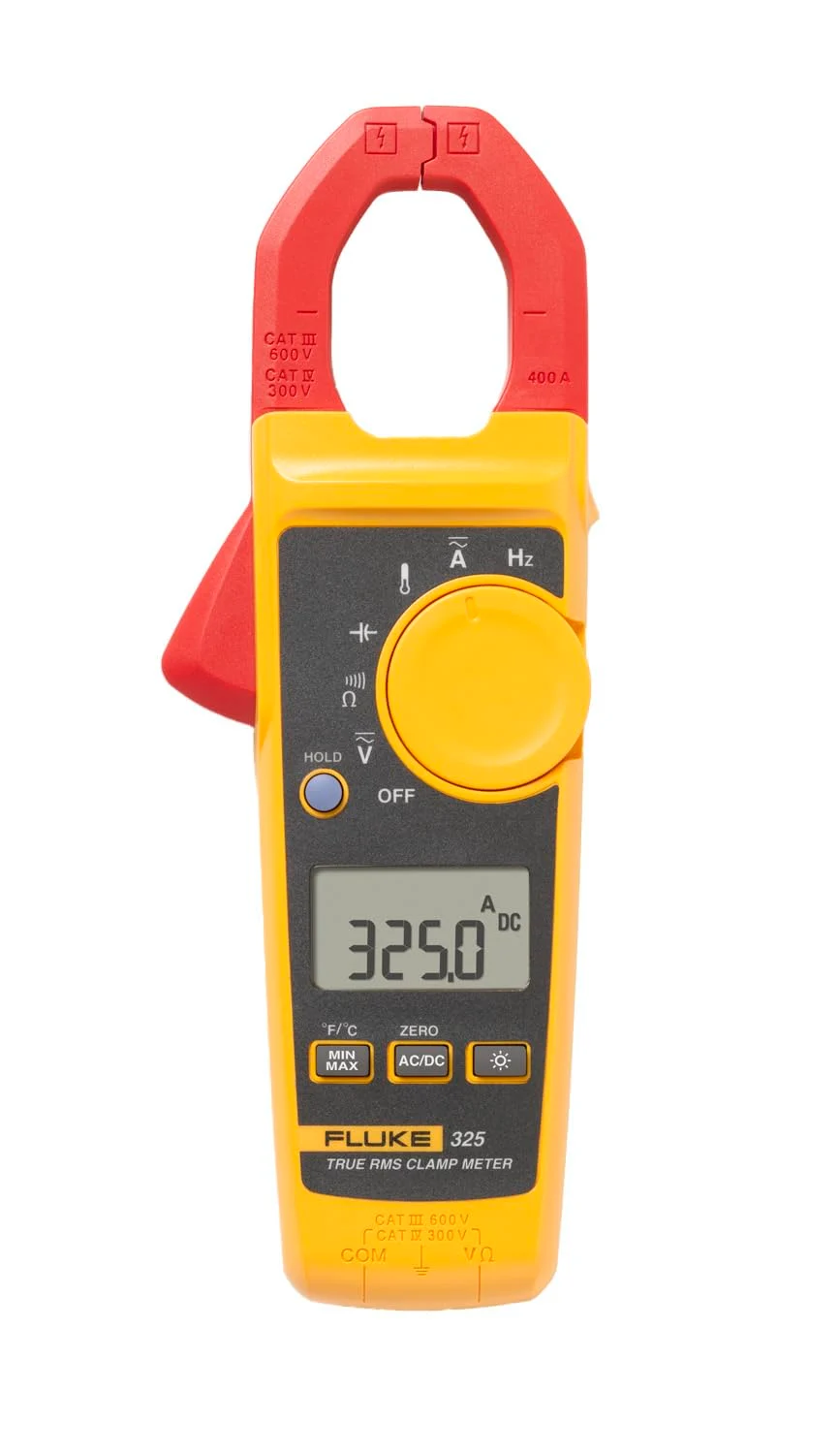
Fluke 325 True-RMS Clamp Meter
Clamp-on AC/DC current measurement in tight panels, with true-RMS accuracy and a CAT III 600 V rating.
- AC and DC current measurement — covers mains circuits, battery banks and solar strings with one tool.
- Clamp-on measurement — read current without disconnecting or disturbing the circuit.
- Slim jaw profile — slides into crowded panels where bulky clamps will not fit.
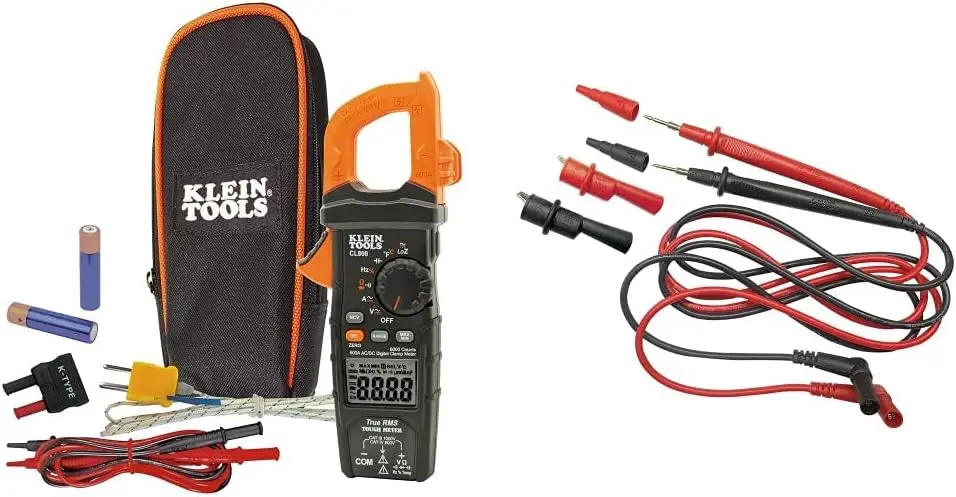
Klein Tools CL800 Digital Clamp Meter
Wide-jaw auto-ranging clamp meter with inrush capture for motor and compressor starting currents.
- Inrush current capture — see the starting surge that trips breakers, not just the running current.
- Wide jaw opening — accepts larger conductors and bundled cables that slim clamps cannot.
- Auto-ranging true-RMS measurement — fast readings you can trust on non-linear loads.
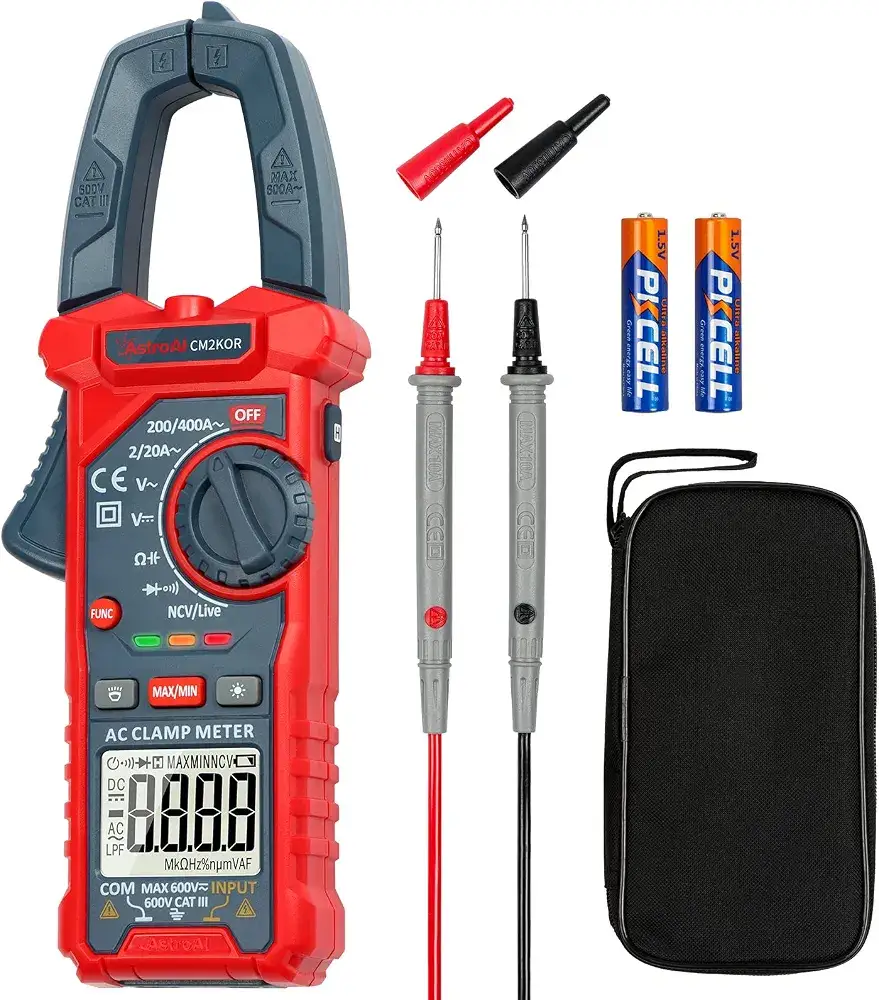
AstroAI CM2KOR AC Clamp Meter
A 600 A AC clamp with a CAT III 600 V rating and an NCV indicator — current measurement without breaking the circuit.
- 600 A AC clamp — read the current in a live conductor by closing the jaws around it, without breaking the circuit or touching anything metal.
- CAT III 600 V safety rating — rated for measurement on fixed installation wiring and at the distribution board, not just at a socket.
- NCV live-wire indicator with coloured lights — sweep the jaw past a cable and a red, orange or green indicator plus a buzzer tells you whether it is live before you commit to touching it.
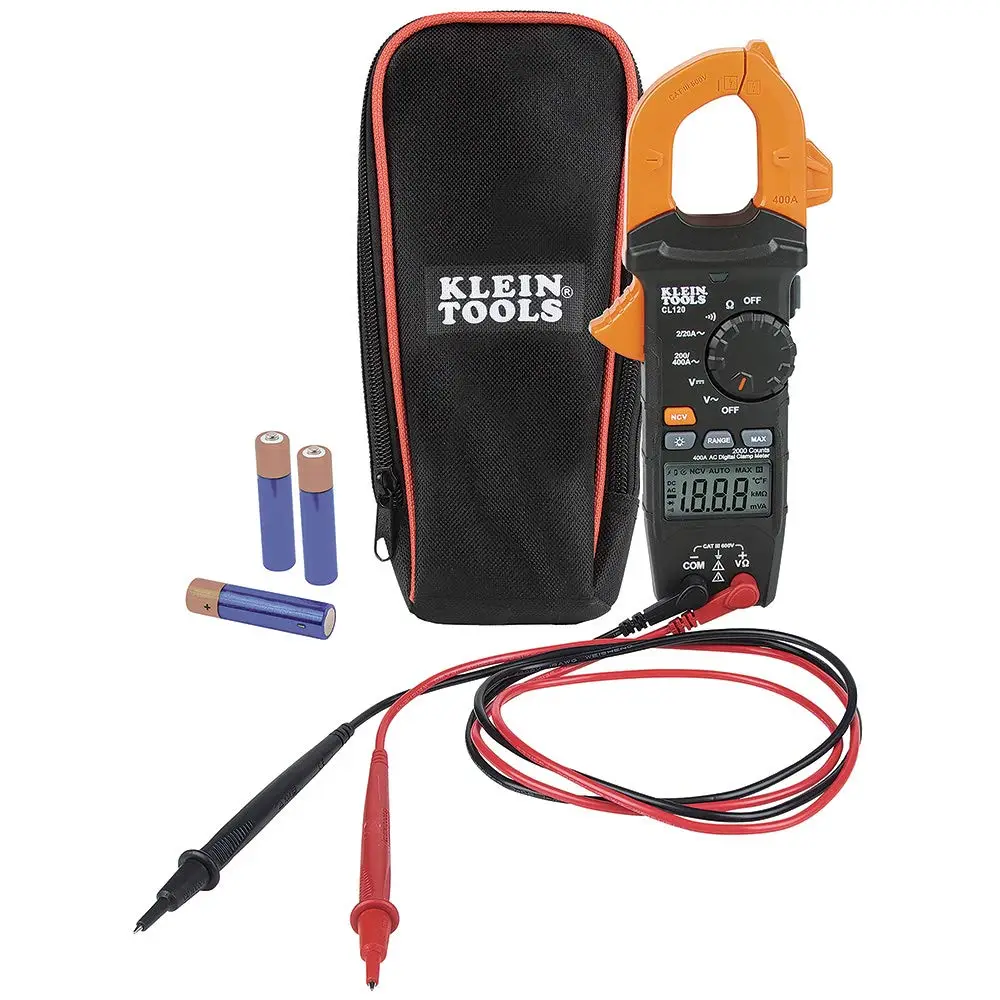
Klein Tools CL120 Auto-Ranging Clamp Meter
Auto-ranging 400 A AC clamp with NCV detection — choose the function and let the meter pick the range.
- Auto-ranging — select the measurement type and the meter picks the range, so no overload indications and no dial-fiddling at the top of a ladder.
- 400 A AC clamp — covers domestic and light commercial circuit current, measured without breaking the circuit.
- 2000-count display with backlight — resolution fine enough for small loads, and readable in a dark consumer unit.