AstroAI CM2KOR AC Clamp Meter
A 600 A AC clamp with a CAT III 600 V rating and an NCV indicator — current measurement without breaking the circuit.
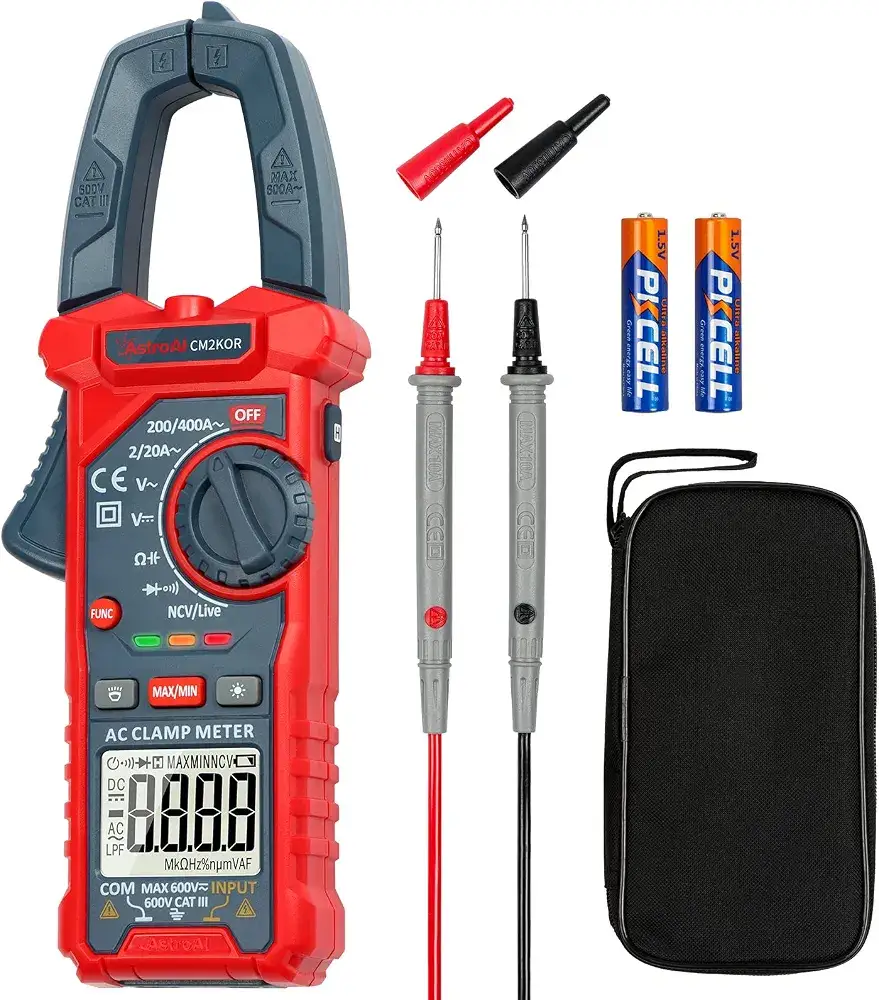
A 600 A AC clamp meter with CAT III 600 V rating, an NCV live-wire indicator, HOLD/MAX/MIN and a backlight, supplied with leads, batteries and a carry case.
- 400 A AC non-intrusive current clamp
- Built-in NCV detector and flashlight
- Continuity, resistance & diode tests
Affiliate Disclosure: VoltCalc may earn a commission from qualifying purchases made through product links at no extra cost to you. Product specs and availability are for reference and may change.
Field Overview
The reason a clamp meter exists is simple: to measure current you normally have to break the circuit and put the meter in series with the load. On a live installation that is slow, awkward and unnecessary. A clamp meter measures the magnetic field around a conductor instead, so you close the jaws around an insulated cable and read the current — no disconnection, no risk of forgetting to put the leads back. The AstroAI CM2KOR is built around that idea: a 600 A AC clamp for checking circuits at the panel, plus a CAT III 600 V safety rating that makes it legitimate for the work rather than merely capable of displaying a number. Add an NCV live-wire indicator, a backlight and a carry case, and it is a practical first clamp meter for DIY and apprentice use.
Detailed Feature Breakdown
- 600 A AC clamp — read the current in a live conductor by closing the jaws around it, without breaking the circuit or touching anything metal.
- CAT III 600 V safety rating — rated for measurement on fixed installation wiring and at the distribution board, not just at a socket.
- NCV live-wire indicator with coloured lights — sweep the jaw past a cable and a red, orange or green indicator plus a buzzer tells you whether it is live before you commit to touching it.
- Multiple clamp ranges — 200/400 A and 2/20 A AC ranges, so small loads like a lamp circuit read meaningfully rather than disappearing at the bottom of a 600 A scale.
- Voltage, resistance, diode and continuity via the test leads — covers the everyday checks you would otherwise need a second meter for.
- HOLD, MAX and MIN — freeze a reading on screen, or capture the highest and lowest values while you watch a load cycle.
- Backlight and flashlight — read the display and see the terminals in a dark consumer unit or under a floorboard.
- Carrying case, leads and batteries included — working kit out of the box, with two AA batteries supplied.
Performance & Practical Use
For the job it is designed for, it works well. Clamping around a live cable gives a stable reading without disturbing anything, and the 2/20 A range is the detail that makes it useful for domestic circuits — a lighting circuit drawing a couple of amps is legible instead of being a tiny movement on a 600 A scale. The NCV indicator is a genuinely useful safety habit rather than a gimmick: sweep it along a wall before drilling and it will tell you if something is live behind the plaster. The honest limits are the usual ones for this class of meter. It measures AC current only, so there is no DC clamp and you cannot read the current from a solar string or a car battery with the jaws. It is not a true-RMS meter, so distorted loads from dimmers and switch-mode supplies read approximately. And as with every clamp meter, accuracy depends on clamping around one conductor only; put both live and neutral inside the jaws and the fields cancel and you read nothing.
How It Compares
Against the Klein CL120, both are CAT III 600 V AC clamps — the Klein is auto-ranging with a 400 A jaw, the AstroAI goes to 600 A with a separate 2/20 A range for small loads. Against the FNIRSI, the FNIRSI adds a colour display, rechargeable battery and temperature measurement for more money.
Pros
- 600 A AC clamp range with 2/20 A ranges for small loads
- CAT III 600 V safety rating
- NCV live-wire indicator with audible warning
- HOLD, MAX and MIN functions
- Backlight and built-in flashlight
- Leads, batteries and carry case included
Cons
- AC current only — no DC clamp measurement
- Average-sensing, not true-RMS
- No temperature, capacitance or frequency measurement
- Accuracy depends on clamping one conductor only
VoltCalc Verdict
Buy the CM2KOR if you want to check current on live circuits without disconnecting anything, and you want a meter rated for work at the panel rather than only at the socket. The 600 A ceiling covers domestic and most light commercial circuits, the 2/20 A range keeps small loads readable, and the NCV indicator is the kind of feature you end up using on every job. Skip it if you need DC current measurement, true-RMS accuracy on distorted loads, or a jaw wide enough for heavy busbar — those are jobs for a more expensive instrument.