Skip to content

Fluke 117 True-RMS Multimeter

If you do service work, you already know the problem: a meter that reads the wrong number on a modern load is worse than no meter at all. Switch-mode supplies, LED drivers and VFDs all distort the waveform, and an average-sensing meter quietly gives you a figure that is simply not true. The Fluke 117 is built to solve exactly that. It measures true-RMS AC, so the reading you get matches what the circuit is actually doing — and you stop second-guessing the instrument.

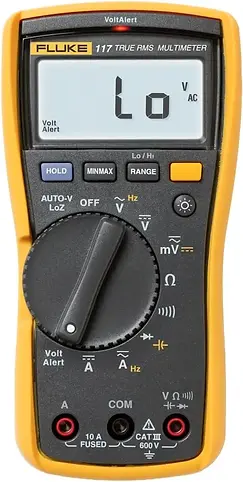
Yellow Fluke 117 multimeter with a black dial, function buttons and red and black test ports
FlukeDigital Multimeters

The everyday electrician's meter: true-RMS AC measurement, non-contact voltage detection and a CAT III 600 V rating in a compact body.

Check the current price

The retailer sets the price and it changes often, so we link straight to the live listing rather than show a number that may be out of date.

Type
True-RMS digital multimeter
Safety rating
CAT III 600 V
Measures
Voltage, resistance, continuity, capacitance, frequency
Non-contact voltage
Yes

VoltCalc may earn a commission when you buy through links on this page, at no extra cost to you. Prices and availability are shown as a guide only and may change.
Key features and what they mean for you

  • True-RMS AC measurement — accurate readings on the electronic loads that fool cheaper average-sensing meters.
  • Built-in non-contact voltage detection — confirm a circuit is live before you put a probe anywhere near it.
  • CAT III 600 V safety rating — rated for the transient energy you meet in distribution panels and fixed wiring.
  • Capacitance, resistance, continuity and frequency — one meter covers the checks you make on almost every call.

Real-world performance

In day-to-day fault-finding the 117 settles fast and the display stays readable in poor light. The non-contact detector is sensitive enough to trace a live conductor through a cable, but not so twitchy that it screams at every adjacent wire — the usual complaint with cheaper detectors. What it does not do is record: there is no Bluetooth, no memory and no min/max trending, so if you need a maintenance trail you will want the 1587 FC instead. For straightforward diagnosis it is quick, predictable and hard to misread.

Technical specifications

The specifications that matter when you compare the Fluke 117 True-RMS Multimeter against the alternatives.

TypeTrue-RMS digital multimeter
Safety ratingCAT III 600 V
MeasuresVoltage, resistance, continuity, capacitance, frequency
Non-contact voltageYes

Pros and cons

Pros
  • True-RMS readings stay accurate on non-sinusoidal loads
  • Non-contact voltage detection saves time on live circuits
  • Well documented and widely supported, with parts that stay available
Cons
  • No current clamp — a separate accessory is needed for high current
  • Costs noticeably more than entry-level meters
  • No data logging, memory or Bluetooth

Who should buy it

Electricians doing commercial and residential service work who need one dependable meter.

Who should skip it

You only need occasional continuity checks around the house.

How it compares

Against the Klein Tools MM700 you give up the CAT IV rating and auto-ranging, but you gain wider accessory support, better documentation and service parts that stay available for years.

Our verdict

If you want one meter that will still be accurate and supported a decade from now, the Fluke 117 earns its price. The honest trade-off is that a cheaper meter reads the same on a plain resistive circuit — you are paying for true-RMS accuracy, a genuine safety rating and long-term calibration support. For panel and commercial electricians, that is money well spent.

Frequently asked questions

Is the Fluke 117 worth the price over a cheaper multimeter?
If you test electronic loads, yes. True-RMS accuracy, a genuine CAT III rating and long-term calibration support are what the extra money buys. On simple resistive circuits a budget meter reads the same number.
Does the Fluke 117 measure current?
It measures current through the test leads up to 10 A. For higher currents, or for reading current without breaking the circuit, you need a clamp meter such as the Fluke 325.

Alternatives to consider

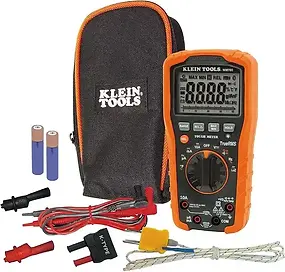
Orange Klein MM700 multimeter with black case, red and black leads, thermocouple and batteries
Klein Tools

Klein Tools MM700 Auto-Ranging Multimeter

An auto-ranging true-RMS multimeter with a CAT IV 600 V rating, aimed at electricians who want a rugged meter for field work.

  • Auto-ranging — connect the probes and read the value, with no range dial to set first.
  • True-RMS AC measurement — trustworthy numbers on drives, supplies and electronic lighting.
  • CAT IV 600 V rating — the highest common safety category, covering outdoor and service-entrance work.
Pros
  • Auto-ranging speeds up repetitive testing
  • CAT IV rating suits outdoor and service-entrance work
  • Rugged housing survives job-site knocks
Cons
  • Fewer measurement functions than a full bench meter
  • No data logging or export
Check PriceView details

VoltCalc may earn a commission when you buy through links on this page, at no extra cost to you. Prices and availability are shown as a guide only and may change.

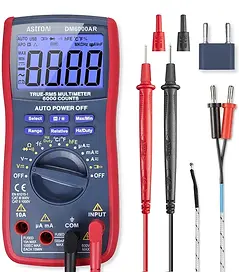
Red AstroAI DM6000AR multimeter with a blue faceplate, test leads, caps and thermocouple probe
AstroAI

AstroAI DM6000AR True-RMS Digital Multimeter

A true-RMS 6000-count digital multimeter with a CAT III 600 V rating, temperature and capacitance measurement, transistor testing and a backlit display.

  • True-RMS AC measurement — accurate readings on the distorted, non-sinusoidal waveforms that switch-mode supplies, dimmers and inverters produce, which is where average-sensing meters quietly mislead.
  • 6000-count display with 0.1 mV and 0.1 µA resolution — more resolution on low-voltage and low-current work than a typical 2000-count budget meter, so small changes are visible rather than rounded away.
  • CAT III 600 V and CAT II 1000 V safety rating — rated for the transient energy of distribution panels and fixed wiring, not just bench work.
Pros
  • True-RMS AC measurement at a budget price
  • 6000-count resolution with 0.1 mV and 0.1 µA resolution
  • Temperature, capacitance, frequency, duty cycle and transistor hFE testing
Cons
  • Not CAT IV rated, so not suited to outdoor service entrances or industrial distribution
  • No data logging, memory or Bluetooth connectivity
  • Accuracy and build are pitched at DIY and educational use, not regulated verification
Check PriceView details

VoltCalc may earn a commission when you buy through links on this page, at no extra cost to you. Prices and availability are shown as a guide only and may change.

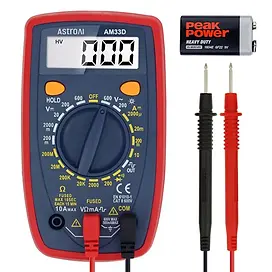
Red and blue AstroAI AM33D multimeter with black and red probes and a 9 V battery
AstroAI

AstroAI AM33D Digital Multimeter

A low-cost manual-ranging digital multimeter measuring voltage, current, resistance, continuity and diodes, supplied with test leads and a 9 V battery.

  • Measures the basics properly — DC and AC voltage, DC current, resistance, continuity with a buzzer, and diode test, which covers household and hobby fault-finding.
  • Manual ranging with 200 Ω to 200 MΩ resistance ranges — you select the range yourself, so the meter is simple and predictable rather than guessing at an auto-range setting.
  • Fused 10 A current range — measures DC current up to 10 A, with the fuse and time limit protecting the meter if you overdo it.
Pros
  • Very low cost for a working starter meter
  • Measures voltage, current, resistance, continuity and diodes
  • HOLD and backlight buttons
Cons
  • Manual ranging — you must select the range yourself
  • Average-sensing, not true-RMS, so distorted AC loads read approximately
  • No temperature or capacitance measurement
Check PriceView details

VoltCalc may earn a commission when you buy through links on this page, at no extra cost to you. Prices and availability are shown as a guide only and may change.