AstroAI AM33D Digital Multimeter
A cheap, manual-ranging starter meter — fine for battery, continuity and mains checks, honest about what it cannot do.
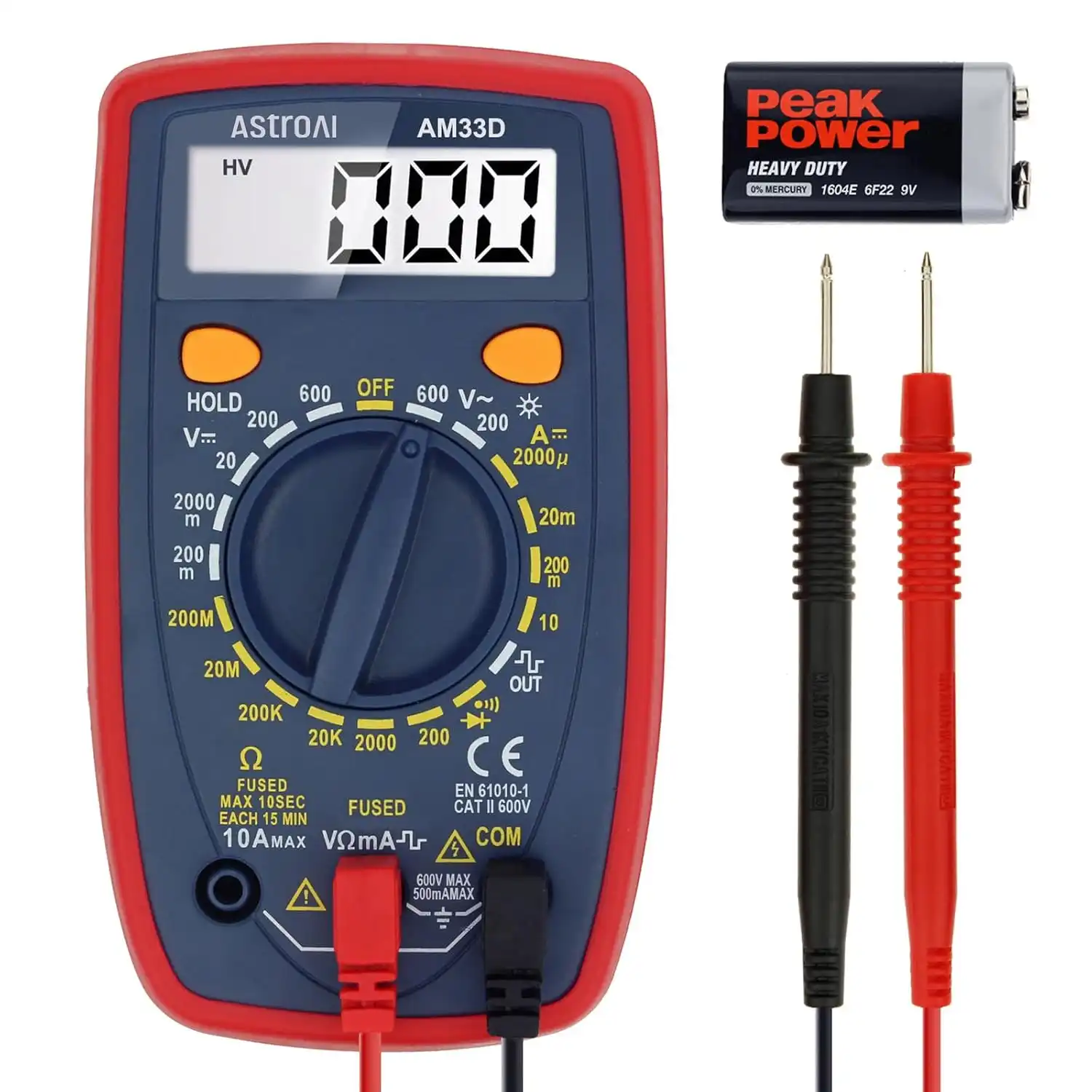
A low-cost manual-ranging digital multimeter measuring voltage, current, resistance, continuity and diodes, supplied with test leads and a 9 V battery.
- 2000-count backlit LCD screen
- 1.5 V, 9 V, and 12 V battery load test
- Double ceramic fuse protection
Affiliate Disclosure: VoltCalc may earn a commission from qualifying purchases made through product links at no extra cost to you. Product specs and availability are for reference and may change.
Field Overview
The first multimeter is usually bought for one specific question: is this socket live, is this fuse blown, is this battery flat? You do not need an expensive instrument to answer any of those, and paying trade prices for a tool you use twice a year is money wasted. The AstroAI AM33D is built for exactly that job — a compact manual-ranging meter that arrives with test leads and a 9 V battery, costs about the price of a takeaway, and does the basic checks properly. What matters is being clear about which checks those are. This is an average-sensing, manually ranged meter: it is genuinely useful for continuity, resistance, battery and mains presence testing, and it is not the tool for measuring distorted AC waveforms or reading a low-voltage logic rail with any precision.
Detailed Feature Breakdown
- Measures the basics properly — DC and AC voltage, DC current, resistance, continuity with a buzzer, and diode test, which covers household and hobby fault-finding.
- Manual ranging with 200 Ω to 200 MΩ resistance ranges — you select the range yourself, so the meter is simple and predictable rather than guessing at an auto-range setting.
- Fused 10 A current range — measures DC current up to 10 A, with the fuse and time limit protecting the meter if you overdo it.
- HOLD and backlight buttons — freeze a reading you cannot reach to write down, and light the display for work in a dark cupboard or panel.
- Continuity buzzer — an audible tone makes checking fuses, switches and cable runs quick, without looking at the display.
- Square wave output — a simple signal generator for basic audio and logic testing, an unusual extra at this price.
- Comes ready to use — test leads and a 9 V battery are in the box, so nothing else has to be ordered before the first job.
- CAT II 600 V rating with a protective holster — appropriate for the appliance and socket-level testing this meter is designed for.
Performance & Practical Use
For the checks most people actually buy a first meter to make, the AM33D is quick and adequate: continuity beeps clearly, resistance readings are stable enough to spot an open element or a shorted switch, and DC voltage on a battery or a car circuit reads reliably. The HOLD button and backlight are genuinely useful rather than decorative, and having the battery and leads included means it works the moment it arrives. The honest limitations are the ones that come with the price. Ranging is manual, so you have to pick the right range yourself — set it wrong and you get an overload indication rather than a reading, which is confusing the first time. It is average-sensing rather than true-RMS, so AC readings on distorted loads are approximate. There is no temperature or capacitance measurement, and the CAT II 600 V rating is suited to appliance and socket testing rather than the inside of a distribution board. Treat it as a dependable basic meter, not as a substitute for a trade instrument.
How It Compares
The AstroAI DM6000AR is the step up: true-RMS, 6000 counts, auto ranging, temperature and capacitance, for noticeably more money. If you are learning electronics rather than just checking batteries and sockets, the DM6000AR is the better buy; if you want a cheap meter for basic checks, the AM33D does that job.
Pros
- Very low cost for a working starter meter
- Measures voltage, current, resistance, continuity and diodes
- HOLD and backlight buttons
- Continuity buzzer for fast fuse and switch checks
- Test leads and a 9 V battery included
- Square wave output for basic signal testing
Cons
- Manual ranging — you must select the range yourself
- Average-sensing, not true-RMS, so distorted AC loads read approximately
- No temperature or capacitance measurement
- CAT II 600 V only — not for the inside of distribution boards
- Not a substitute for a trade-grade meter on professional work
VoltCalc Verdict
Buy the AM33D if you want a cheap, straightforward meter for batteries, fuses, continuity and confirming a socket is live — it does all of that reliably, arrives ready to use, and costs little enough to keep in a drawer. Buy the DM6000AR instead if you are learning electronics, need true-RMS accuracy on distorted waveforms, or want temperature and capacitance measurement. And if your work is inside panels or on industrial equipment, neither is the right choice: you need a trade-grade CAT III or CAT IV instrument.