How to Choose a Multimeter
Safety rating comes first
The category rating — CAT II, CAT III or CAT IV — describes the transient energy the meter is designed to survive and, just as importantly, where it is allowed to be used. A CAT III meter belongs on distribution circuits; the supply side and outdoor origin need CAT IV. Everything else on the spec sheet is a preference. This one is a requirement.
Check that the rating is marked on the meter and repeated on the leads. A meter rated for the work with unbranded leads of unknown category has been downgraded by its accessories.
Accuracy, resolution and counts
Three numbers get confused with each other:
- Accuracy is how close the reading is to the truth — stated as a percentage plus a count, for example ±0.5% + 2.
- Resolution is the smallest step the display can show.
- Counts describe the display range — a 6,000-count meter shows 5,999 before it rolls over.
A higher count figure is easy to market and rarely changes a decision. Accuracy on the ranges you actually use, and a display you can read outdoors, matter far more. If you work to tolerances, look at the DC volts and resistance accuracy lines specifically.
True RMS: when it changes the answer
An averaging meter assumes the waveform is a clean sine wave. On a variable-speed drive, an inverter output, a dimmer circuit or a switch-mode supply, it is not — and the reading will be wrong, typically low. True RMS measures the heating equivalent of the waveform and stays correct on distorted loads. If your work includes any of those, it is not optional. See the true-RMS multimeter for a typical general-purpose example.
The functions worth paying for
- Auto-ranging speeds up work considerably and reduces the chance of reading the wrong range.
- A continuity beeper that responds instantly is used more than any other function.
- A diode and capacitance test are cheap to include and occasionally save a trip.
- Min/max and hold catch intermittent faults and let you work one-handed.
- A backlight and a bar graph make a difference in a plant room.
- A magnetic hanger or a stand sounds trivial until you have tried to hold a probe on a live terminal and read the display at the same time.
Insulation testing and current measurement are better handled by dedicated instruments — a clamp meter for current, an insulation tester for resistance to earth.
The kit around the meter
A meter is only as good as what you clip to it. Fused leads, a set of clip-on probes so you can work alone, a fused current shunt or clamp adapter, and a case that keeps it away from impact and moisture. Where the circuit needs it, follow the arithmetic first: the Ohm's Law Calculator and the Current Calculator will tell you what to expect before you go looking for it.
What to look for when buying
- Category rating marked on the meter, at or above the installation you work on.
- Stated accuracy you can find in the manual, not just on the box.
- True RMS if any of your work involves drives, inverters or electronics.
- Leads with the same category rating and finger guards.
- A display you can read in daylight and a beeper you can hear on a site.
- Serviceable fuses and a battery you can replace without tools.
Our verdict
Buy the category rating your work demands, then true RMS if your circuits are anything but clean sine waves, then the functions you will genuinely use. A mid-range true-RMS meter with good fused leads will out-serve a flagship meter with the leads that came in the box.
VoltCalc provides educational information only and does not publish invented ratings or reviews.
Proving Dead, Insulation Resistance, Loop Impedance & RCD/GFCI Context
- IEC 61010 CAT II / III / IV: Match the meter and its fused probes to the panel boundary (CAT III for distribution boards, CAT IV for utility service origins).
- Live-Dead-Live Proving: Test the meter on a known live source, measure across all conductors of the isolated circuit to prove zero volts, and re-verify on the live source (prefer a dedicated two-pole CAT III/IV tester for safety-critical isolation).
- Companion Diagnostics: Use an insulation resistance tester (MΩ) for cable health and a multifunction tester for earth-fault loop impedance (Z_s) plus GFCI (4–6 mA) vs. RCD (30 mA) trip timing.
Side-by-Side Worked Examples: North America (NEC) vs. International (IEC 60364 / BS 7671)
North American (NEC) Field Measurement Example
Troubleshooting a 120/208 V commercial lighting relay feeding a 277 V ballast bank with distorted switching current:
- Select a True-RMS CAT III 600 V / CAT IV 600 V multimeter; verify L1-N = 277 V, L1-L2 = 480 V (if 480Y/277 V system) or 120/208 V on the control side, and test continuity/ohms only after locking off and proving dead.
- Expected heating resistance vs. measured: For a 1,500 W 120 V resistive heater, R_expected = V² ÷ P = 120² ÷ 1,500 = 9.60 Ω (hot; cold resistance reads ~5–10% lower).
International (IEC 61010 / BS 7671) Field Measurement Example
Diagnostic check on a 230 V / 400 V TN-S distribution feeder prior to MFT testing:
- Prove dead across L1-L2-L3-N-PE using CAT III / CAT IV GS38 fused leads on a known proving unit before and after.
- Confirm low-ohm continuity (<0.5 Ω end-to-end CPC bond) on the multimeter, then switch to an insulation/loop tester for 500 V DC insulation resistance (>1 MΩ), Z_s, and 30 mA RCD verification.
Related Calculators
Related Unit Converters
Watts to Amps Converter
Convert active power in watts (W) to current in amps (A) for DC and AC circuits.
Amps to Watts Converter
Convert current in amps (A) to active power in watts (W) for DC and AC systems.
AWG to mm² Converter (American Wire Gauge to Metric)
Convert American Wire Gauge (AWG) to metric mm² area, diameter, and resistance.
Frequently Asked Questions
Recommended Tools & Equipment for This Guide
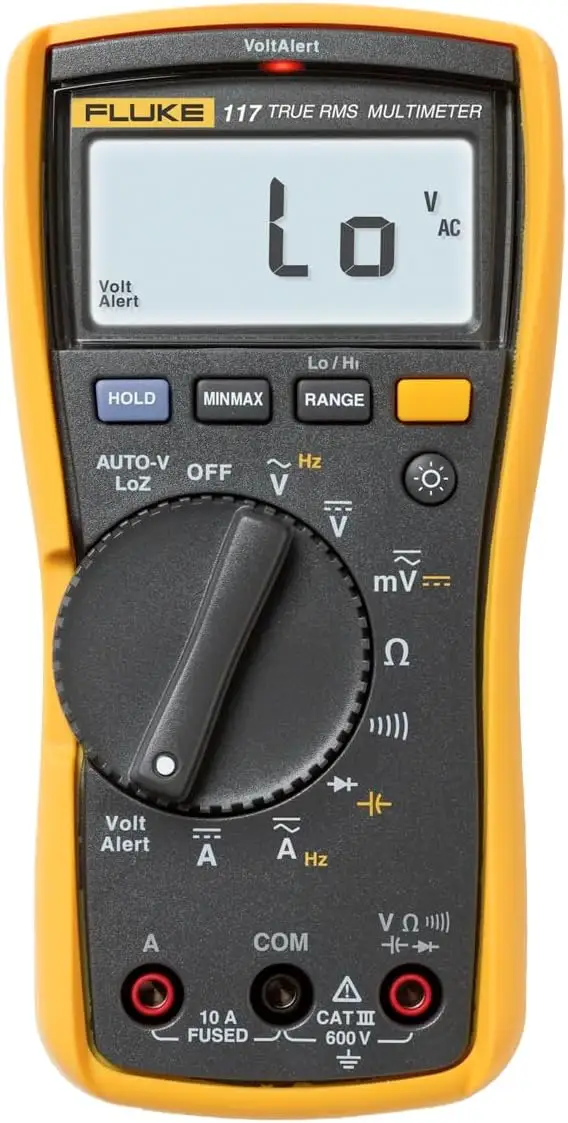
Fluke 117 True-RMS Multimeter
The everyday electrician's meter: true-RMS AC measurement, non-contact voltage detection and a CAT III 600 V rating in a compact body.
- True-RMS AC measurement — accurate readings on the electronic loads that fool cheaper average-sensing meters.
- Built-in non-contact voltage detection — confirm a circuit is live before you put a probe anywhere near it.
- CAT III 600 V safety rating — rated for the transient energy you meet in distribution panels and fixed wiring.
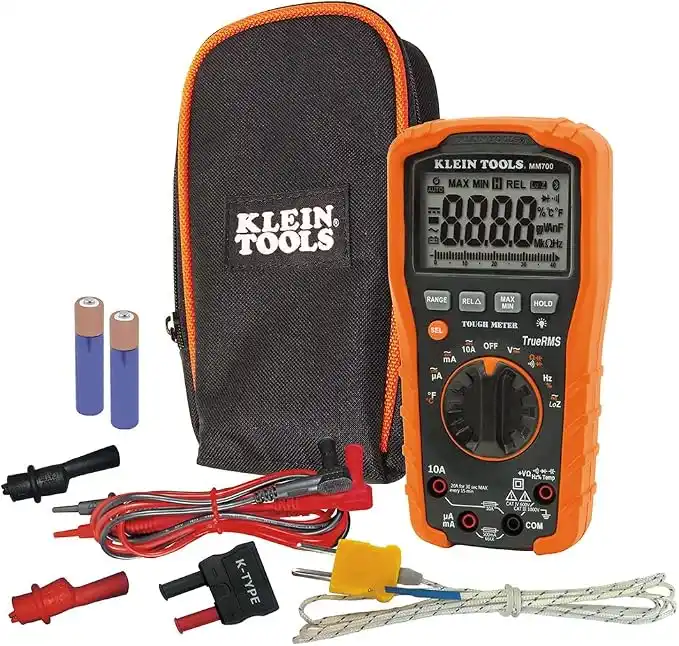
Klein Tools MM700 Auto-Ranging Multimeter
Auto-ranging true-RMS meter with a CAT IV 600 V rating and a tough, drop-tested housing.
- Auto-ranging — connect the probes and read the value, with no range dial to set first.
- True-RMS AC measurement — trustworthy numbers on drives, supplies and electronic lighting.
- CAT IV 600 V rating — the highest common safety category, covering outdoor and service-entrance work.
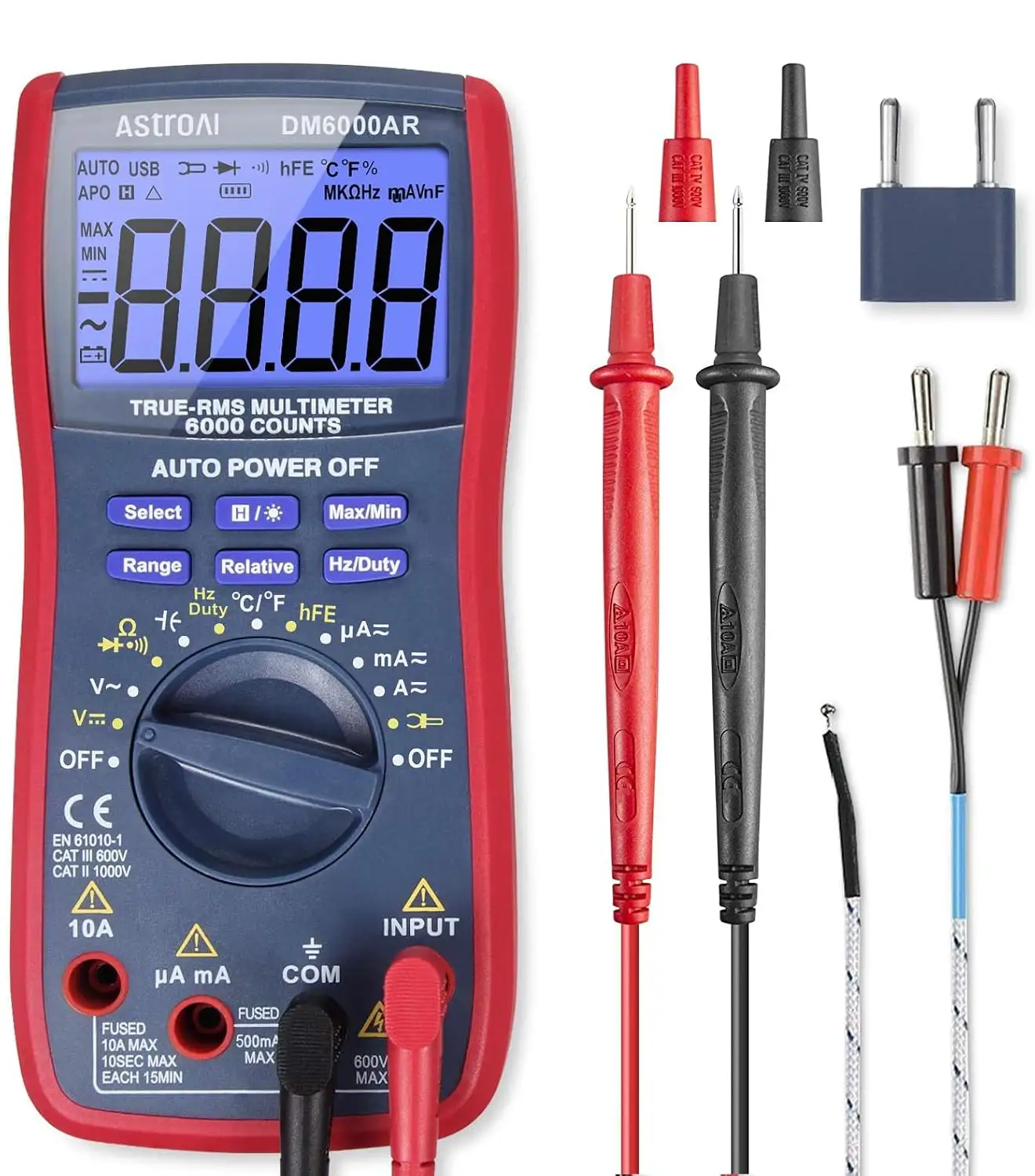
AstroAI DM6000AR True-RMS Digital Multimeter
A true-RMS 6000-count meter with temperature, capacitance and a CAT III 600 V rating — the budget option for DIY, hobby and student work.
- True-RMS AC measurement — accurate readings on the distorted, non-sinusoidal waveforms that switch-mode supplies, dimmers and inverters produce, which is where average-sensing meters quietly mislead.
- 6000-count display with 0.1 mV and 0.1 µA resolution — more resolution on low-voltage and low-current work than a typical 2000-count budget meter, so small changes are visible rather than rounded away.
- CAT III 600 V and CAT II 1000 V safety rating — rated for the transient energy of distribution panels and fixed wiring, not just bench work.
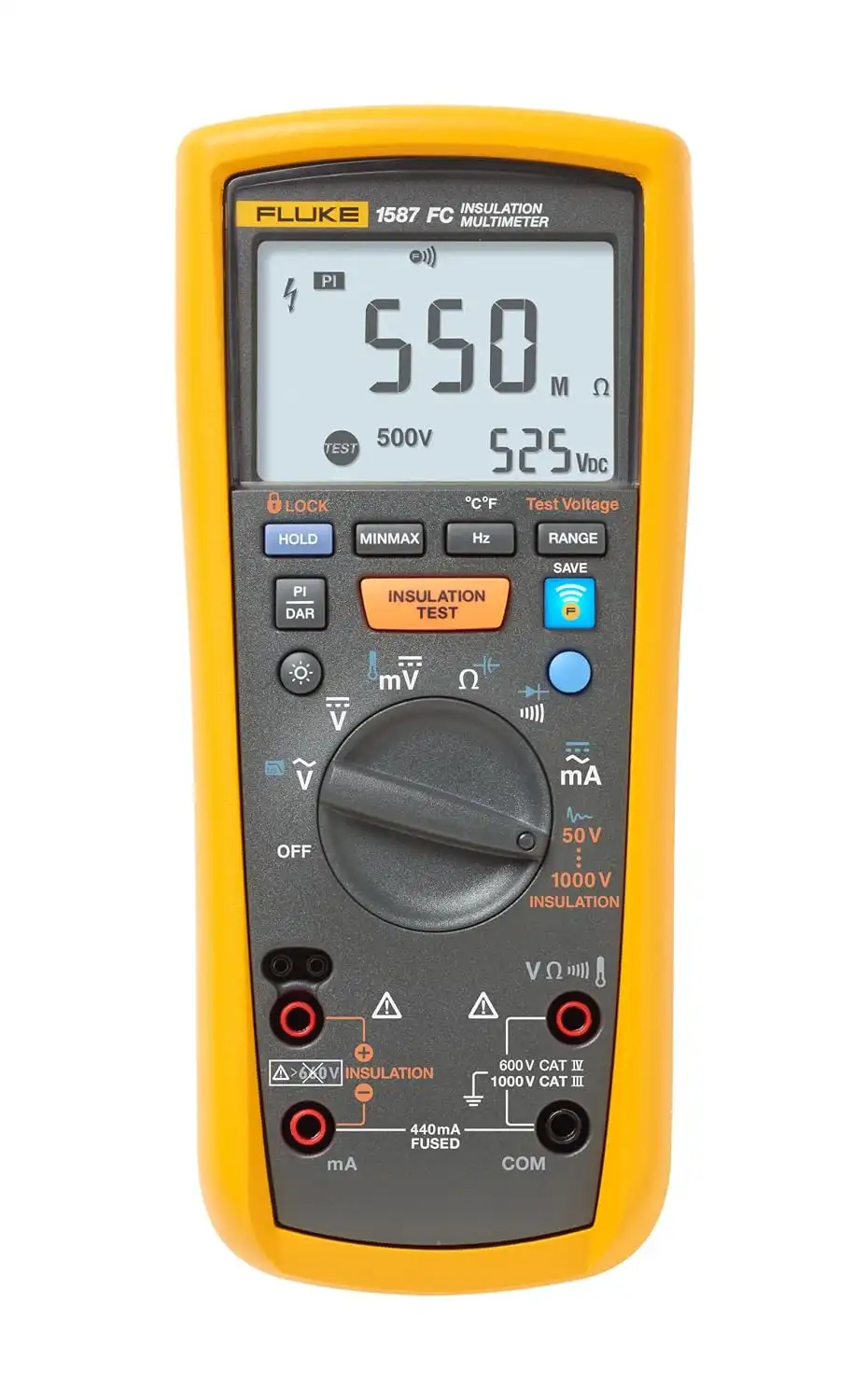
Fluke 1587 FC Insulation Multimeter
Insulation testing and full multimeter functions in one instrument, with selectable test voltages up to 1000 V.
- Insulation test voltages from 50 V to 1000 V — matches the test voltage to the equipment instead of using one fixed setting.
- Full true-RMS multimeter functions — voltage, current, resistance and continuity without a second instrument.
- Wireless result logging — builds a trend over time so you can see insulation degrading before it fails.