How to Choose Bench Equipment & Soldering Gear
The soldering station
The two things that make a station usable are temperature control and a tip you can change. A controlled station holds its setpoint as heat flows into the joint, which is what produces a joint in a second or two rather than cooking the pad.
Look for:
- A stated wattage high enough to recover quickly — around 50–70 W suits most through-hole and light SMD work.
- A temperature range that reaches about 350–400 °C for lead-free work, with a stable controller.
- A range of tip shapes available, and tips that are cheap enough to keep a few.
- A stand and a sponge or brass wool, so the tip stays clean between joints.
Solder and flux are part of the tool. Lead-free alloy with a no-clean flux core, plus extra flux for rework, will do more for your joints than a more expensive station with the wrong consumables.
Flux fumes are an irritant
Extract them at the bench or move them away from your face; that is a health requirement, not a preference.
Bench power supply
Adjustable voltage and adjustable current limit, with both shown on a display. The current limit is the feature you will use most: set it just above what the circuit should draw and a mistake becomes a current-limited rail instead of a destroyed board.
A single-output 0–30 V, 0–5 A unit covers most work. Check the ripple figure and the resolution of the current setting — a supply that cannot be set finely is awkward for small circuits. The Power Calculator and Ohm's Law Calculator tell you what the load should draw, so you know where to set the limit.
Measurement
A multimeter is the first instrument on any bench; a scope is the second. For a scope, bandwidth should be at least five times the fastest signal you care about, with a sample rate several times the bandwidth. Two channels, a decent trigger and good probes matter more than a large screen.
Measure before you trust a design: the Resistance Calculator gives the value a network should present, and a meter confirms it in seconds.
Rework, ESD and comfort
- Hot air or a desoldering tool for removing parts cleanly, once you work on anything multi-layer.
- An ESD mat and a wrist strap when handling boards with sensitive devices — cheap insurance.
- Good light and a magnifier prevent most of the joints you would otherwise have to redo.
- Tidy storage for parts, tips and consumables: a bench you can clear in a minute gets used more.
What to look for when buying
- Soldering station: controlled temperature, quick recovery, available tips.
- Consumables: lead-free alloy with flux core, plus extra flux.
- Fume extraction or a filtered extractor at the bench.
- Power supply: adjustable voltage and current limit, both displayed.
- Scope: bandwidth and sample rate stated, with probes included.
- ESD protection if you handle bare boards.
VoltCalc provides educational information only and does not publish invented ratings or reviews.
Side-by-Side Worked Examples: North America (UL / NEC) vs. International (IEC / CE)
North American (120 V 60 Hz Bench & ESD) Worked Example
Setting up a protected 120 V 60 Hz electronics prototyping bench powering a 70 W soldering station, a 150 W (0–30 V, 5 A) DC bench supply, and an oscilloscope.
- Branch & current limit: Total mains load ≈ 250 W (2.08 A at 120 V), easily served by a 15 A 120 V GFCI bench strip. On the DC supply feeding a prototype 12 V / 1.2 A board, set the CC limit to 1.50 A so a solder bridge clamps safely at 18 W instead of burning traces.
- Probe & isolation safety: Use CAT II 300 V probes on mains-referenced supplies or an isolation transformer; connect the ESD mat through its built-in 1 MΩ safety resistor to equipment ground.
International (230 V 50 Hz IEC 61010 Bench) Worked Example
Configuring a 230 V 50 Hz repair bench with a 30 mA RCBO, hot-air rework station (700 W), and dual-channel 100 MHz oscilloscope.
- Supply & earth check: Total bench draw ≈ 950 W (4.13 A at 230 V) on a 16 A Type B 30 mA RCBO socket circuit; verify earth continuity on the metal soldering station chassis before probing line-powered SMPS boards.
- Bandwidth & voltage rule: For a 10 MHz SPI clock with 3 ns rise times, choose at least a 100 MHz oscilloscope (1 GS/s+) and 10× probes, never clipping the grounded probe alligator clip onto a floating mains-referenced primary side without a differential CAT III probe.
Related Calculators
Related Unit Converters
Watts to Amps Converter
Convert active power in watts (W) to current in amps (A) for DC and AC circuits.
Amps to Watts Converter
Convert current in amps (A) to active power in watts (W) for DC and AC systems.
AWG to mm² Converter (American Wire Gauge to Metric)
Convert American Wire Gauge (AWG) to metric mm² area, diameter, and resistance.
Frequently Asked Questions
Recommended Tools & Equipment for This Guide
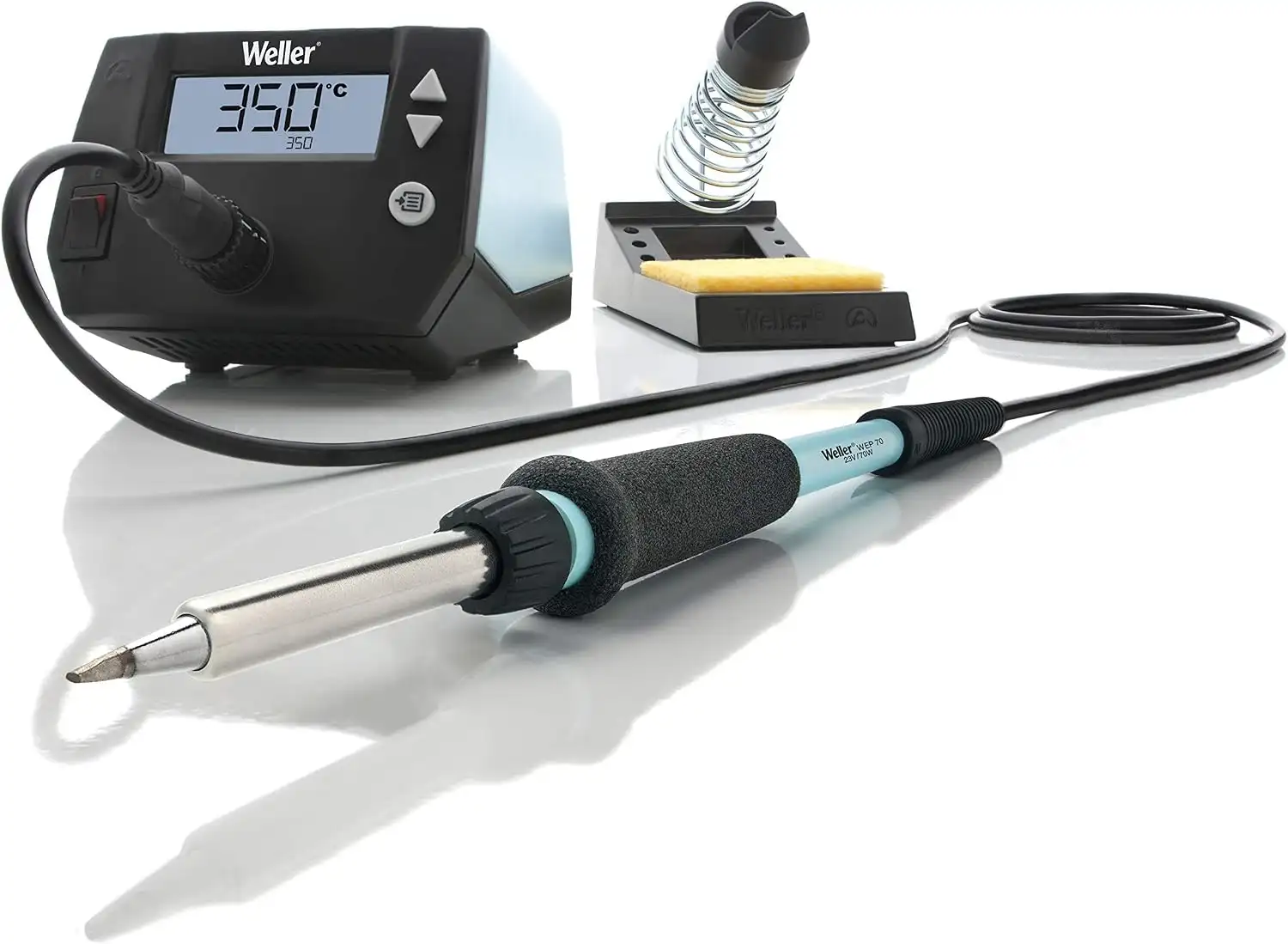
Weller WE1010NA Digital Soldering Station
A 70 W temperature-controlled soldering station with a digital readout for consistent joints.
- 70 W element — recovers heat quickly on larger joints instead of stalling mid-solder.
- Digital temperature setpoint — repeatable settings job to job, rather than a vague dial position.
- Adjustable temperature range — works for fine electronics and heavier control wiring with one station.
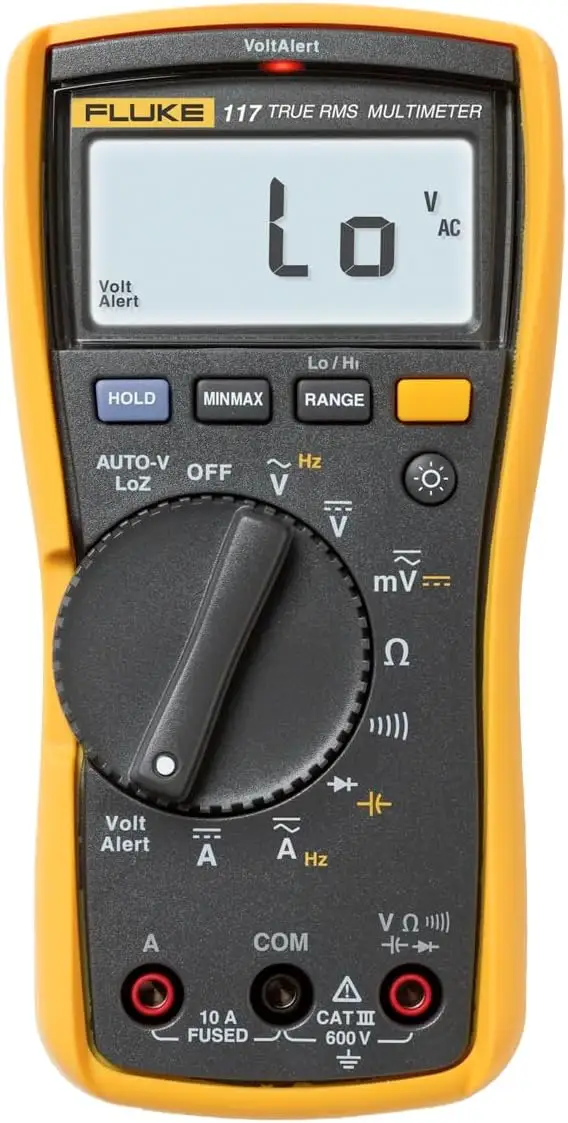
Fluke 117 True-RMS Multimeter
The everyday electrician's meter: true-RMS AC measurement, non-contact voltage detection and a CAT III 600 V rating in a compact body.
- True-RMS AC measurement — accurate readings on the electronic loads that fool cheaper average-sensing meters.
- Built-in non-contact voltage detection — confirm a circuit is live before you put a probe anywhere near it.
- CAT III 600 V safety rating — rated for the transient energy you meet in distribution panels and fixed wiring.
Related Engineering Guides
How to Choose Tool Bags & Storage
Compare open tool totes, rugged IP-rated meter cases, and modular storage systems.
How to Choose Wire Strippers & Crimpers
Match precision wire strippers and ratcheting crimpers to solid and stranded wire.
How to Choose Power Tools for Electrical Work
Compare cordless platforms, SDS rotary hammers, knockout punches, and cable cutters.