How to Choose Wire Strippers & Crimpers
Most of a job is preparation
Cutting, stripping and terminating takes longer than the fixing and the testing combined. Good hand tools make that time shorter and, more importantly, make the result repeatable — a termination that is right every time rather than usually.
Two tools carry most of that work: a stripper that removes insulation without touching the conductor, and a crimper that forms a connector properly. Both are cheap relative to the cost of a failed joint.
Strippers: self-adjusting or fixed-gauge
Self-adjusting strippers grip the cable, close to the conductor and pull the insulation off in one motion. They are fast, they do not need setting, and they work across a range of sizes — which suits anyone moving between cable types all day. Their limits are very fine stranded wire and unusual insulation materials.
Fixed-gauge strippers have a set of labelled notches. They are simple, precise on their intended sizes and easy to use on fine wire, but you must pick the right notch every time — and the wrong notch is exactly how conductors get nicked.
Either way, look for comfortable handles, a clean cutting edge that reaches the sizes you use, and a spring that returns reliably. A stripper that leaves the conductor bright and unscored is doing its job. Compare results with the AWG chart if you need to confirm a size.
Crimpers: the ratchet is the feature
A crimp works by cold-welding the connector to the conductor under controlled pressure. The pressure has to be right: too little and the joint is loose and resistive, too much and the strands are damaged.
A ratcheting crimper will not open until the full crimp is formed, so every joint gets the same treatment no matter how strong your hands are. It also makes long runs of terminations far less tiring. A plain hand crimper depends entirely on your grip, which drifts over a day.
The die matters as much as the mechanism. Different terminals need different die profiles — insulated butt splices, uninsulated terminals, ferrules and coaxial connectors are all different shapes. Buy a tool whose dies match the connectors you actually use, and keep a spare die set. A ratcheting crimper with interchangeable dies covers most work.
The connector dictates the tool
This is the rule that prevents most bad terminations: choose the tool from the connector, not the other way round. The manufacturer specifies a crimp tool and die for each terminal family, and using a different one voids the joint's approval as well as its reliability.
- Insulated terminals need a die that crimps through the sleeve without cutting it.
- Uninsulated terminals need a bare-metal die matched to the barrel.
- Ferrules need a square or trapezoid profile matched to the ferrule size.
- Soldered joints are a different technique entirely and need clean surfaces, correct flux and enough heat — a soldering station rather than a hand iron for anything repetitive.
What to look for when buying
- Strippers that leave no nicks — check a stripped conductor before you trust the tool.
- A ratcheting crimper with a release lever for a partly formed crimp.
- Dies matched to the connector families you use, available as spares.
- Comfortable, non-slip handles; you will hold these all day.
- Insulated versions if you ever work near live parts.
- Replaceable blades or jaws, because both wear.
Our verdict
Buy a good self-adjusting stripper for day-to-day work and a simple fixed-gauge one for fine wire. Buy a ratcheting crimper with dies matched to your connectors, and treat the die set as part of the tool rather than an accessory. Then check the first few terminations of every batch — a bright conductor and a fully formed crimp are the whole job.
VoltCalc provides educational information only and does not publish invented ratings or reviews.
Side-by-Side Worked Examples: North America (NEC) vs. International (IEC 60364 / BS 7671)
North American (NEC 2023/2026) Worked Example
Terminating a 20 A, 120 V branch circuit (12 AWG solid Cu, 3.31 mm²) and a 6 AWG stranded Cu EVSE feeder to 75 °C rated lugs (NEC 110.14(C)).
- Strip 12 AWG with the exact 12 AWG solid notch to avoid scoring the copper (a nicked conductor reduces effective cross-section and elevates local I²R heat), verify torque per device label, and remember 14 AWG is strictly capped at 15 A (NFPA 70 Table 310.16 / 240.4(D); NEC 310.12 dwelling rules apply only to residential main services).
- For fine-stranded Class K/I control or solar conductors landing in screw-cage lugs, crimp a UL-listed ferrule matching the AWG size with a ratcheting die before torquing.
International (IEC 60364 / IEC 60228 / BS 7671) Worked Example
Terminating 2.5 mm² IEC 60228 Class 5 flexible tri-rated control conductors inside a 230 V 16 A DIN-rail RCBO panel (Method C + C_a/C_g verified so I_b ≤ I_n ≤ I_z, with adiabatic PE S = √(I²t)/k verified).
- Strip to the exact 8 mm barrel depth and crimp an IEC blue 2.5 mm² insulated bootlace ferrule using a square/trapezoid ratcheting ferrule die — never clamp bare Class 5 fine strands under a direct screw without a pressure plate or ferrule.
- Note the lug/ferrule non-interchangeability rule: do not force a 2.5 mm² conductor into a 12 AWG (3.31 mm²) barrel or vice-versa without manufacturer-certified compatibility.
Related Calculators
Related Unit Converters
Watts to Amps Converter
Convert active power in watts (W) to current in amps (A) for DC and AC circuits.
Amps to Watts Converter
Convert current in amps (A) to active power in watts (W) for DC and AC systems.
AWG to mm² Converter (American Wire Gauge to Metric)
Convert American Wire Gauge (AWG) to metric mm² area, diameter, and resistance.
Frequently Asked Questions
Recommended Tools & Equipment for This Guide
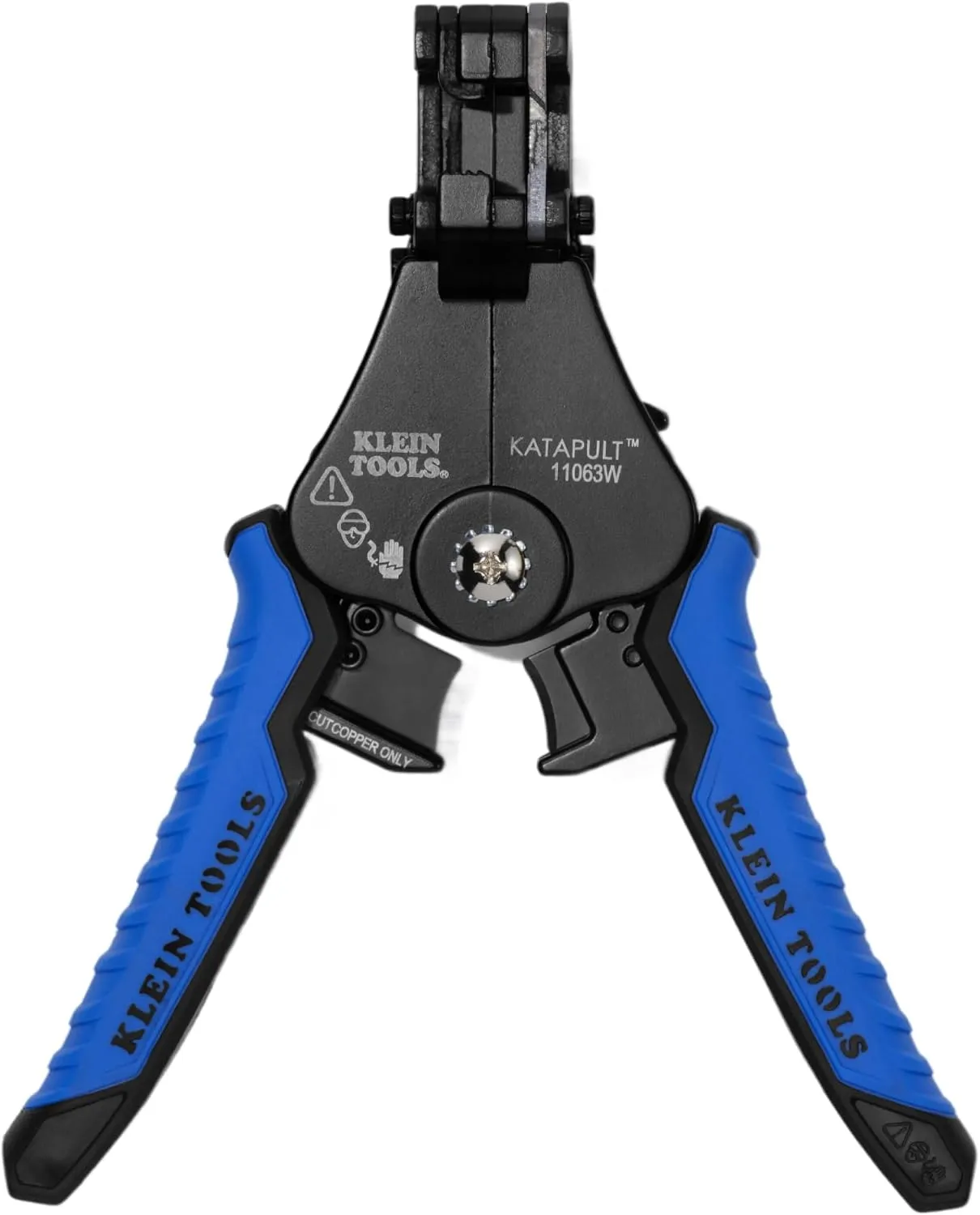
Klein Tools 11063W Wire Stripper and Cutter
Self-adjusting stripper that grips, strips and cuts common building wire in one motion.
- Self-adjusting action — squeeze once and the tool sets itself to the conductor size, so strips are repeatable.
- Clean strip without nicking — protects the copper, which is what keeps a termination reliable long term.
- Built-in cutter and plier nose — you can cut, strip and twist without swapping tools.
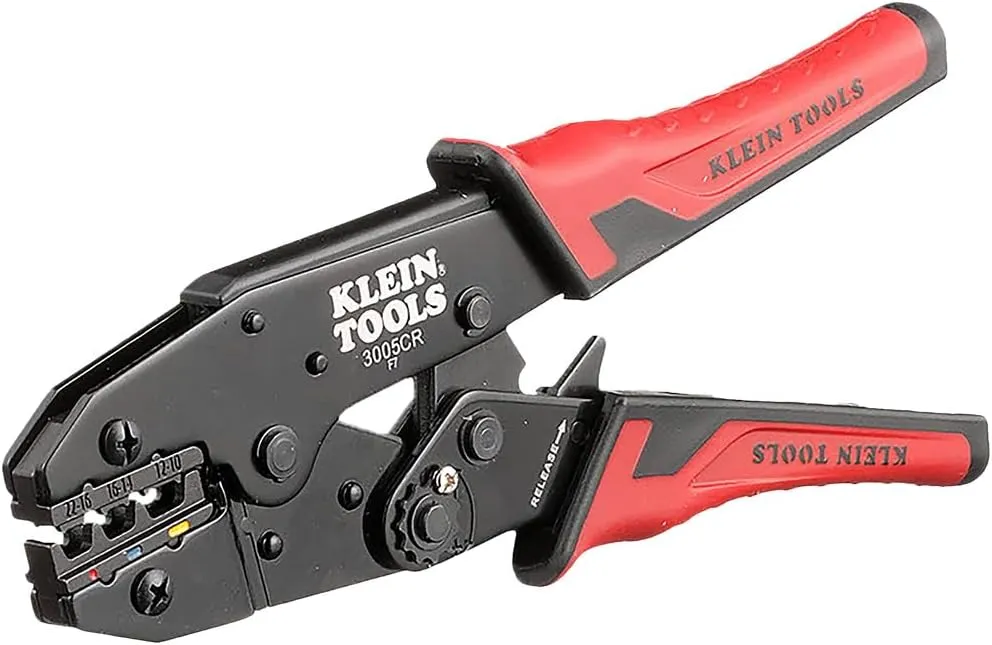
Klein Tools 3005CR Ratcheting Crimper
Ratcheting crimper that locks until the crimp is complete, so every termination is fully formed.
- Ratcheting mechanism — the tool stays locked until the crimp is fully formed, so a weak grip cannot produce a weak joint.
- 22–10 AWG range — covers the terminal sizes used in most panel and control wiring.
- Insulated and non-insulated terminals — one tool handles both, so you are not carrying two.
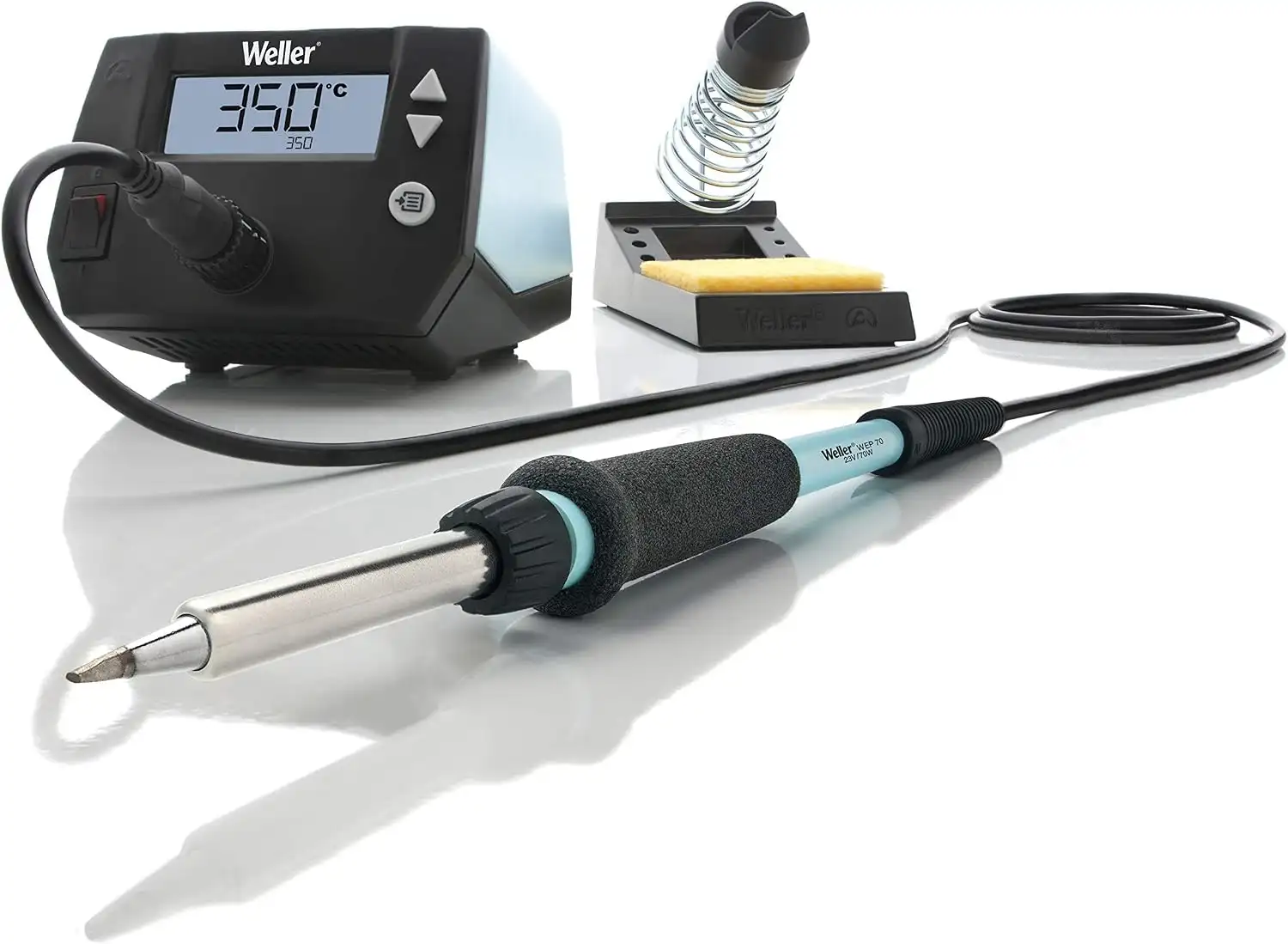
Weller WE1010NA Digital Soldering Station
A 70 W temperature-controlled soldering station with a digital readout for consistent joints.
- 70 W element — recovers heat quickly on larger joints instead of stalling mid-solder.
- Digital temperature setpoint — repeatable settings job to job, rather than a vague dial position.
- Adjustable temperature range — works for fine electronics and heavier control wiring with one station.
Related Engineering Guides
How to Choose Tool Bags & Storage
Compare open tool totes, rugged IP-rated meter cases, and modular storage systems.
How to Choose Power Tools for Electrical Work
Compare cordless platforms, SDS rotary hammers, knockout punches, and cable cutters.
How to Choose Electronic Components
Verify resistor power ratings, capacitor voltage derating, and thermal limits.