How to Choose Electronic Components
Resistors: value, tolerance, power
Three things to state for every resistor: the value, the tolerance and the power rating. Tolerance only matters where the part’s accuracy changes the result; power rating always matters. Calculate the dissipation (I²R or V²/R), then choose at least twice that figure so the part runs cool.
Prefer E12 or E24 values from a kit for prototyping, and the exact E96 value when a value is calculated. The Resistor Series & Parallel Calculator checks what a combination actually gives you, and the LED Resistor Calculator covers the common current-limiting case.
Capacitors: voltage, dielectric, temperature
The capacitance is the easy number. The voltage rating is the one that decides whether the part survives; derate it well below the rail it sits on, especially where a supply can spike. Electrolytics have a lifetime that shortens with temperature — every 10 °C hotter roughly halves it — so keep them away from hot parts.
Ceramic dielectrics are not all equal: some lose most of their capacitance under DC bias or shift with temperature. For filters and timing, check the dielectric code rather than assuming the printed value holds in circuit. The Capacitor Energy Calculator gives the stored energy, which is also a good reality check on what a part can dump into a fault.
Semiconductors: read the conditions, not the headline
A diode’s current rating, a transistor’s current rating and a MOSFET’s current rating all come with conditions attached — usually a case temperature you will never achieve.
For a MOSFET, start from on-resistance at your actual gate voltage, work out the dissipation, and compare it with the thermal resistance to ambient in your enclosure. A part chosen on current rating alone is the classic way to build something that works on the bench and fails in a box.
Boards, breadboards and logic levels
- Logic level decides compatibility: a 3.3 V board driving a 5 V module needs level shifting, and a 5 V sensor into a 3.3 V input can damage the pin.
- Breadboard contacts are rated for modest currents; anything drawing more than about an amp belongs on a soldered board with proper connectors.
- Development boards are chosen for the toolchain and the pin count as much as the chip. Buy the variant with the regulator and the headers you need.
Buy from a source with a data sheet
Unmarked parts from a marketplace can be a different value, a lower power rating or a counterfeit. For anything you will rely on, buy from a distributor with a part number and a data sheet you can open. For breadboarding, a labelled assortment is fine and much cheaper.
Verify what arrives: a multimeter will confirm resistor values and diode drops in seconds.
What to look for when buying
- Value, tolerance and power rating stated, not implied.
- Capacitor voltage rating and dielectric code on the data sheet.
- MOSFET on-resistance at the gate voltage you will use, plus thermal resistance.
- Logic level compatible with your board.
- A data sheet you can actually download, and a traceable part number.
- Kits that are labelled — unlabelled assortments cost you more in time than they save.
VoltCalc provides educational information only and does not publish invented ratings or reviews.
Side-by-Side Worked Examples: North America (UL / NEC Class 2) vs. International (IEC 61010 / EN)
North American (NEC Class 2 / UL 1310) Worked Example
Sizing a current-limiting resistor and status LED powered from a 24 V DC NEC Class 2 industrial control supply (V_f = 2.1 V, I_f = 15 mA).
- Series resistance: R = (24 − 2.1) ÷ 0.015 = 1,460 Ω -> pick standard E24 value 1.5 kΩ (actual I_f = 14.6 mA).
- Thermal derating: P_res = I² × R = (0.0146)² × 1,500 = 0.320 W -> apply ≥2× safety derating and specify a 1 W (or 0.6 W metal-film minimum) resistor so it stays cool inside a NEMA 12 control enclosure.
International (IEC / SELV Control Panel) Worked Example
Selecting a snubber/bleeder capacitor and discharge resistor on a 24 V DC SELV relay rail fed from a 230 V AC DIN PSU.
- Capacitor voltage derating: Apply a ≥2× rail margin on 24 V DC (which can peak at 28 V DC during charge/transients) by specifying a 50 V or 63 V 105 °C long-life electrolytic capacitor.
- Energy & discharge check (SELV < 60 V DC): Stored energy in a 2,200 µF rail capacitor at 24 V is E = 0.5 × 0.0022 × 24² = 0.634 J, bled safely across a 4.7 kΩ, 0.5 W discharge resistor (P = 24² ÷ 4,700 = 0.123 W, 4× thermal headroom).
Related Calculators
LED Resistor Calculator
Calculate the current-limiting resistor ohms and wattage for single or series LEDs.
Resistor Series & Parallel Calculator
Calculate total equivalent resistance and drops for series or parallel resistors.
Capacitor Energy Calculator
Calculate stored electrostatic energy in joules and charge from C and voltage.
Related Unit Converters
Watts to Amps Converter
Convert active power in watts (W) to current in amps (A) for DC and AC circuits.
Amps to Watts Converter
Convert current in amps (A) to active power in watts (W) for DC and AC systems.
AWG to mm² Converter (American Wire Gauge to Metric)
Convert American Wire Gauge (AWG) to metric mm² area, diameter, and resistance.
Frequently Asked Questions
Recommended Tools & Equipment for This Guide
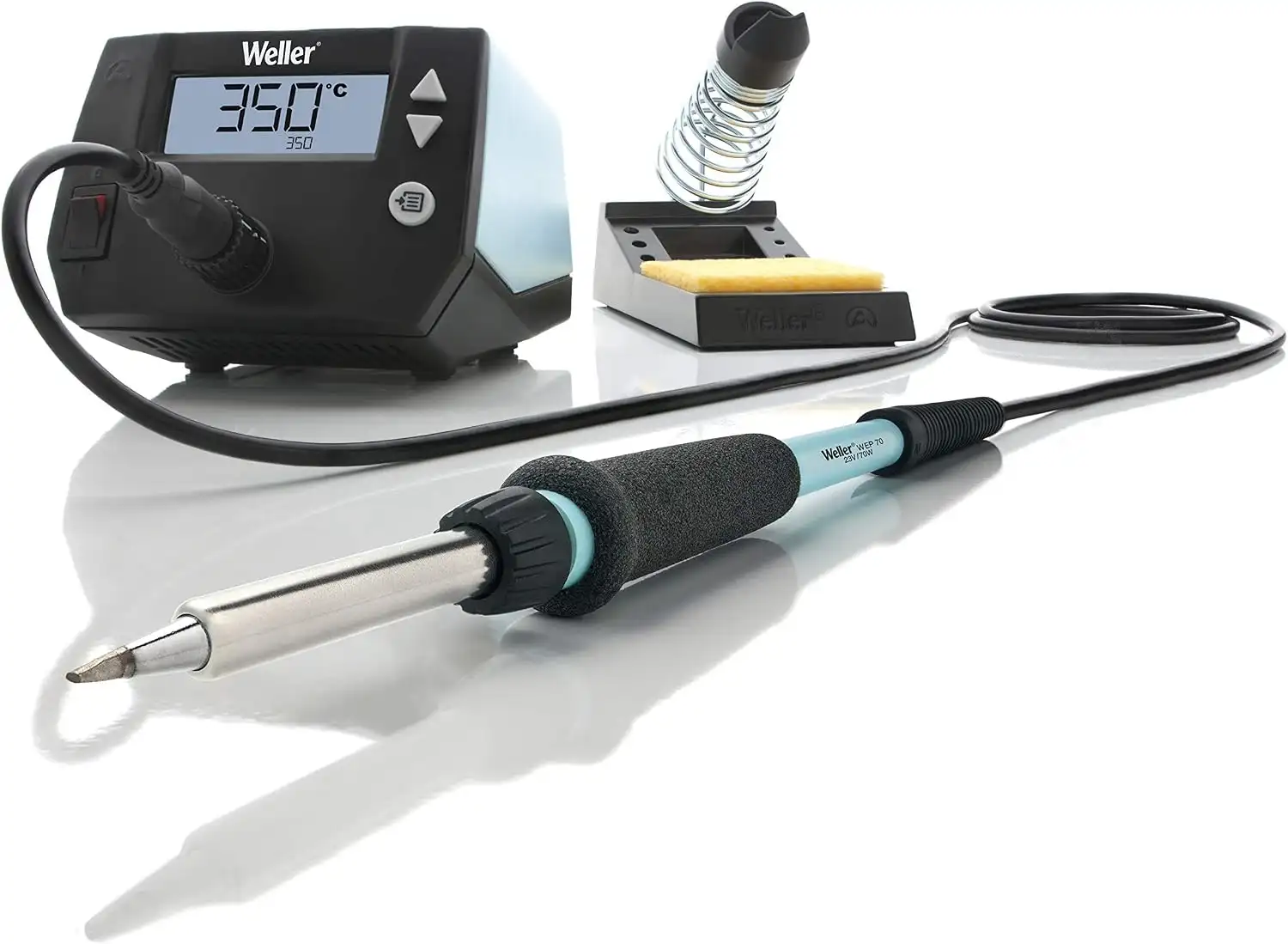
Weller WE1010NA Digital Soldering Station
A 70 W temperature-controlled soldering station with a digital readout for consistent joints.
- 70 W element — recovers heat quickly on larger joints instead of stalling mid-solder.
- Digital temperature setpoint — repeatable settings job to job, rather than a vague dial position.
- Adjustable temperature range — works for fine electronics and heavier control wiring with one station.
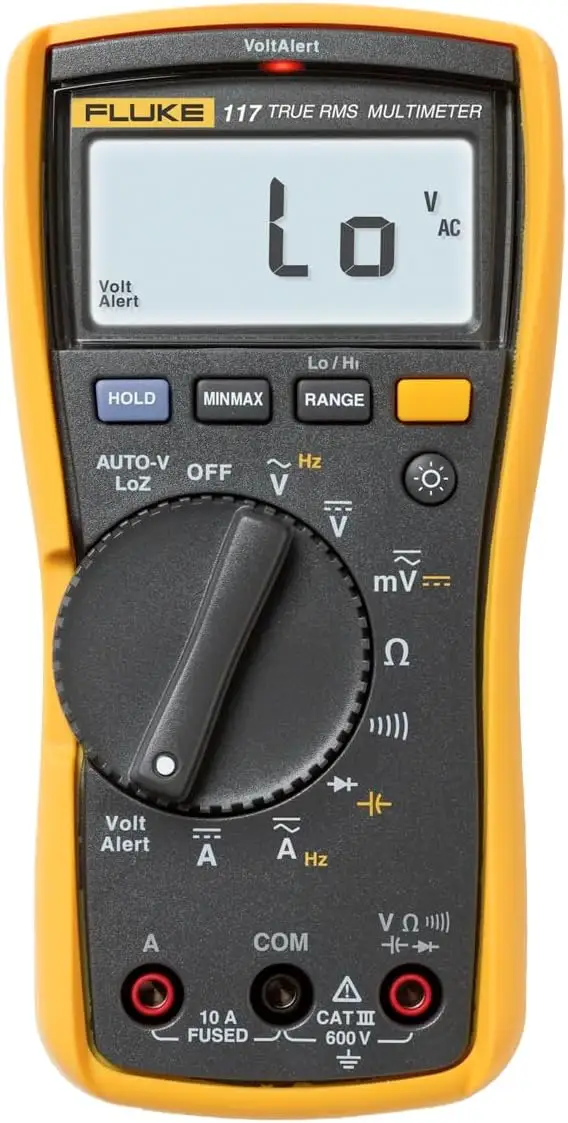
Fluke 117 True-RMS Multimeter
The everyday electrician's meter: true-RMS AC measurement, non-contact voltage detection and a CAT III 600 V rating in a compact body.
- True-RMS AC measurement — accurate readings on the electronic loads that fool cheaper average-sensing meters.
- Built-in non-contact voltage detection — confirm a circuit is live before you put a probe anywhere near it.
- CAT III 600 V safety rating — rated for the transient energy you meet in distribution panels and fixed wiring.
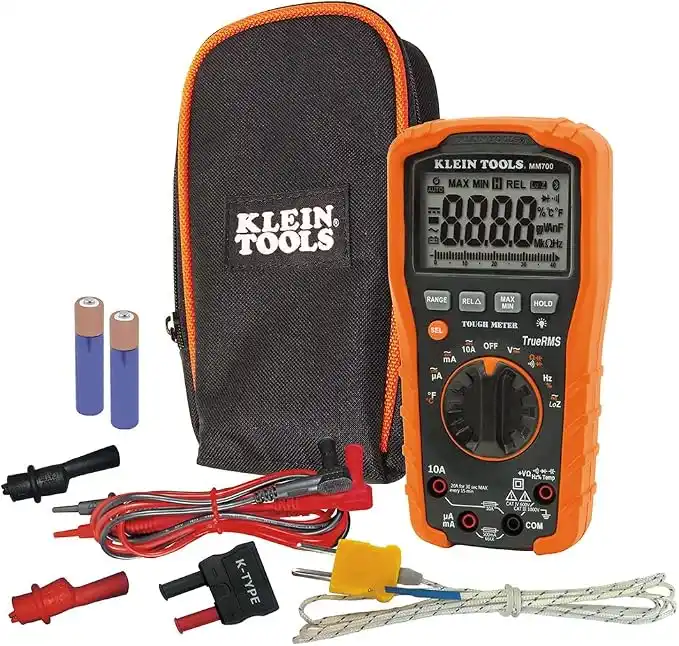
Klein Tools MM700 Auto-Ranging Multimeter
Auto-ranging true-RMS meter with a CAT IV 600 V rating and a tough, drop-tested housing.
- Auto-ranging — connect the probes and read the value, with no range dial to set first.
- True-RMS AC measurement — trustworthy numbers on drives, supplies and electronic lighting.
- CAT IV 600 V rating — the highest common safety category, covering outdoor and service-entrance work.
Related Engineering Guides
How to Choose Tool Bags & Storage
Compare open tool totes, rugged IP-rated meter cases, and modular storage systems.
How to Choose Wire Strippers & Crimpers
Match precision wire strippers and ratcheting crimpers to solid and stranded wire.
How to Choose Power Tools for Electrical Work
Compare cordless platforms, SDS rotary hammers, knockout punches, and cable cutters.