Resistor Series & Parallel Calculator
Calculate total resistance for resistors in series or parallel.
Step-by-step calculation
- R = 100 + 220 + 330 = 650 Ω
- Nearest Single Standard Value: E12 = 680 Ω | E24 = 620 Ω | E96 = 649 Ω
Formula
Input definitions
| Symbol | Input | Unit | Meaning & code relevance |
|---|---|---|---|
| Mode | Wiring Mode | — | Engineering input parameter for wiring mode, evaluated in real-time by the solver. |
| R₁ | Resistor 1 | Ω | Engineering input parameter for resistor 1 measured in Ω, evaluated in real-time by the solver. |
| R₂ | Resistor 2 | Ω | Engineering input parameter for resistor 2 measured in Ω, evaluated in real-time by the solver. |
| R₃ | Resistor 3 (optional) | Ω | Engineering input parameter for resistor 3 (optional) measured in Ω, evaluated in real-time by the solver. |
| R₄ | Resistor 4 (optional) | Ω | Engineering input parameter for resistor 4 (optional) measured in Ω, evaluated in real-time by the solver. |
Worked example
Series Combination of 100 Ω, 220 Ω, 330 Ω
Total resistance in series.
- R_total = 100 + 220 + 330 = 650 Ω
Assumptions
- All entered resistors are in the same unit (Ohms) and behave as linear, temperature-stable ohmic components.
- Series mode assumes all resistors share a single continuous current path with no branching nodes.
- Parallel mode assumes all resistors are connected across the exact same two electrical nodes.
Limitations
- Evaluates a pure series string or a pure parallel bank at a time; series-parallel ladder networks must be reduced group by group.
- In unequal resistor combinations, power dissipation is uneven (in series, largest R dissipates most power; in parallel, smallest R dissipates most power).
How it works
Sums resistances directly in series or computes the reciprocal sum in parallel configurations.
When to use it
- Calculating the total equivalent resistance (R_eq) of resistors connected in series (R_1 + R_2 + ...) or in parallel (1 ÷ Σ(1/R_i)).
- Synthesizing a non-standard target resistance value or higher wattage rating by combining standard E12/E24 stock resistors on a bench.
- Analyzing voltage divider drops in series chains and current splitting across parallel resistor branches.
Practical real-world applications
- Precision Calibration & Sensor Trimming: Combining two standard 1% resistors in series or parallel to hit an exact custom feedback or bridge resistance.
- Power Dissipation Sharing: Placing four 100 Ω 1 W resistors in parallel to create a 25 Ω dummy load capable of dissipating 4 W continuously.
- CAN Bus & RS-485 Termination Checks: Verifying that two 120 Ω termination resistors at opposite ends of a differential bus measure 60 Ω in parallel with a multimeter.
Original Editorial Review & Technical Evaluation
Computes total equivalent resistance (R_eq) and branch current/voltage division behavior for multi-resistor series chains and parallel banks.
PCB/analog circuit designers creating precision non-standard resistance values, engineering students, and test-bench technicians.
- Supports arbitrary comma-separated resistor lists up to high-count networks in either Series or Parallel mode
- Calculates total equivalent resistance, total supply current, and total network power when voltage is provided
- Automatically switches between series additive summation (ΣR) and reciprocal parallel conductance (1 / Σ(1/R))
Accuracy & methodology: Evaluates ideal lumped resistor networks ignoring PCB trace resistance, solder joint ohms, and individual resistor tolerance spread (±1% to ±5%). Total power dissipation divides unevenly across parallel branches in inverse proportion to each resistor’s ohmic value. Computational standards →
What to verify independently: Check power dissipation in the lowest-value parallel branch (P_i = V² / R_i) so no single resistor exceeds 50%–70% of its rated wattage.
Put the numbers to work with the Ohm's Law Calculator, Resistance Calculator and LED Resistor Calculator. For the background behind the numbers, read Ohm's Law Explained: Voltage, Current and Resistance and How to Choose Electronic Components.
Common mistakes
- Forgetting to take the final reciprocal (1 ÷ sum) when using the parallel conductance formula 1/R_eq = 1/R_1 + 1/R_2.
- Mixing ohms (Ω) and kilohms (kΩ) in the same series/parallel calculation (e.g., adding 470 Ω and 4.7 kΩ as 470 + 4.7 instead of 470 + 4,700 = 5,170 Ω).
- Assuming two unequal parallel resistors share power equally — the smaller resistor carries proportionally more current (I = V ÷ R) and dissipates far more heat (P = V² ÷ R).
Safety & code notice
Calculator results are planning estimates. Always verify electrical designs against applicable local codes, standards (NEC / IEC), and consult a qualified professional.
Frequently asked questions
Related Calculators
Ohm's Law Calculator
Calculate voltage, current, resistance, and power in DC or resistive AC circuits.
Resistance Calculator
Calculate electrical resistance in ohms from voltage, current, or power loss.
LED Resistor Calculator
Calculate the current-limiting resistor ohms and wattage for single or series LEDs.
Parallel Resistor Calculator
Calculate exact equivalent resistance and branch currents of parallel resistors.
Related Unit Converters
Electrical Resistance Converter (mΩ, Ω, kΩ, MΩ, GΩ)
Convert resistance between milliohms, ohms, kilohms, megohms, gigohms, and S.
Voltage Unit Converter (V, mV, µV, kV, MV)
Convert electrical potential across SI decades from microvolts to megavolts.
Electrical Current Converter (A, mA, µA, kA)
Convert electrical current across SI decades from microamperes to kiloamperes.
Electrical Frequency & Motor Speed Converter (Hz, kHz, MHz, GHz, rad/s, RPM)
Convert between Hz, kHz, MHz, GHz, angular velocity, period, and motor RPM.
Related Engineering Guides
Recommended Bench Multimeters & Soldering Equipment for Component Work
Verify component resistance and capacitance out-of-circuit with an auto-ranging True-RMS multimeter and use a temperature-controlled ESD-safe soldering station for clean joints.
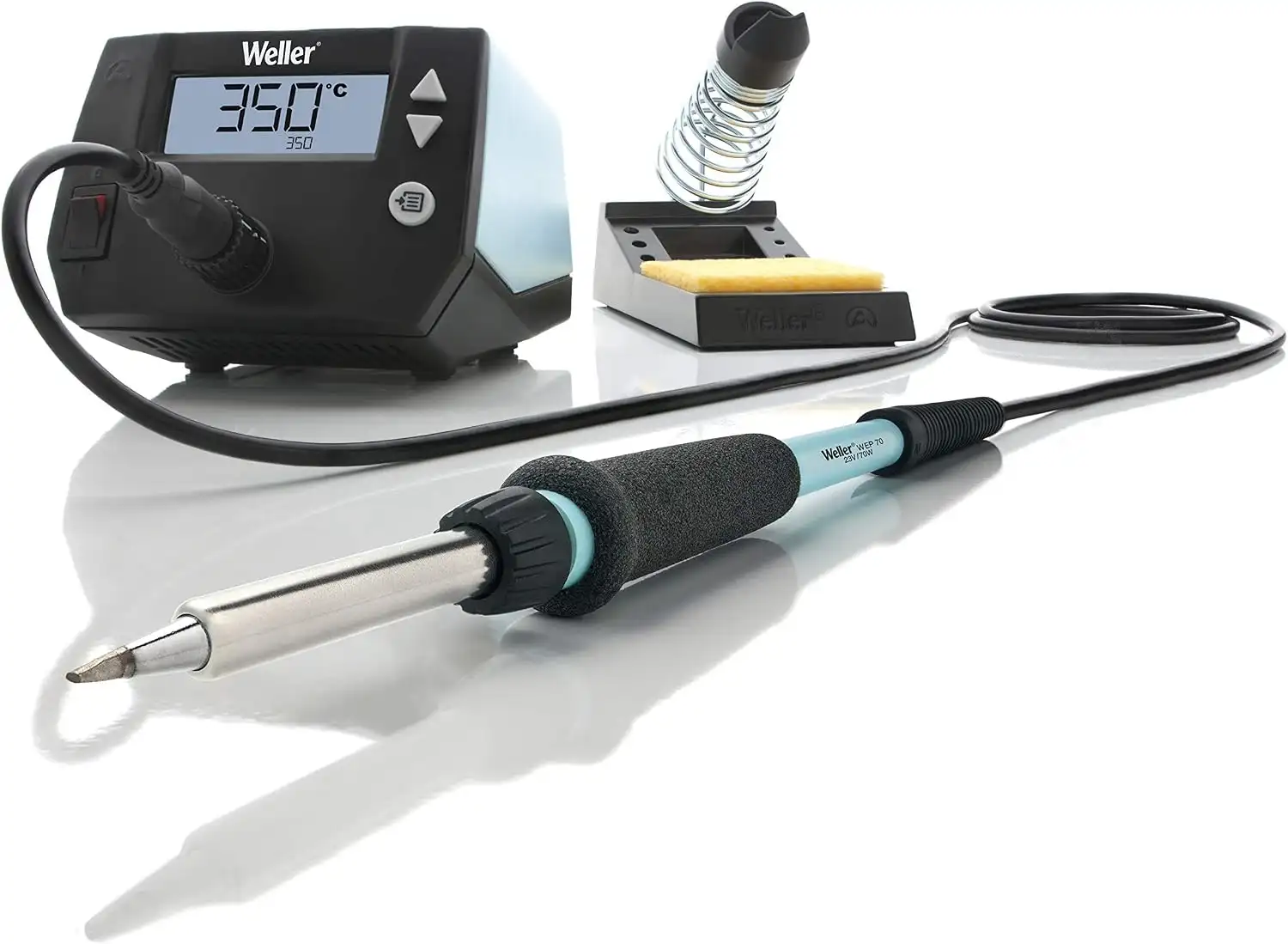
Weller WE1010NA Digital Soldering Station
A 70 W temperature-controlled soldering station with a digital readout for consistent joints.
- 70 W element — recovers heat quickly on larger joints instead of stalling mid-solder.
- Digital temperature setpoint — repeatable settings job to job, rather than a vague dial position.
- Adjustable temperature range — works for fine electronics and heavier control wiring with one station.
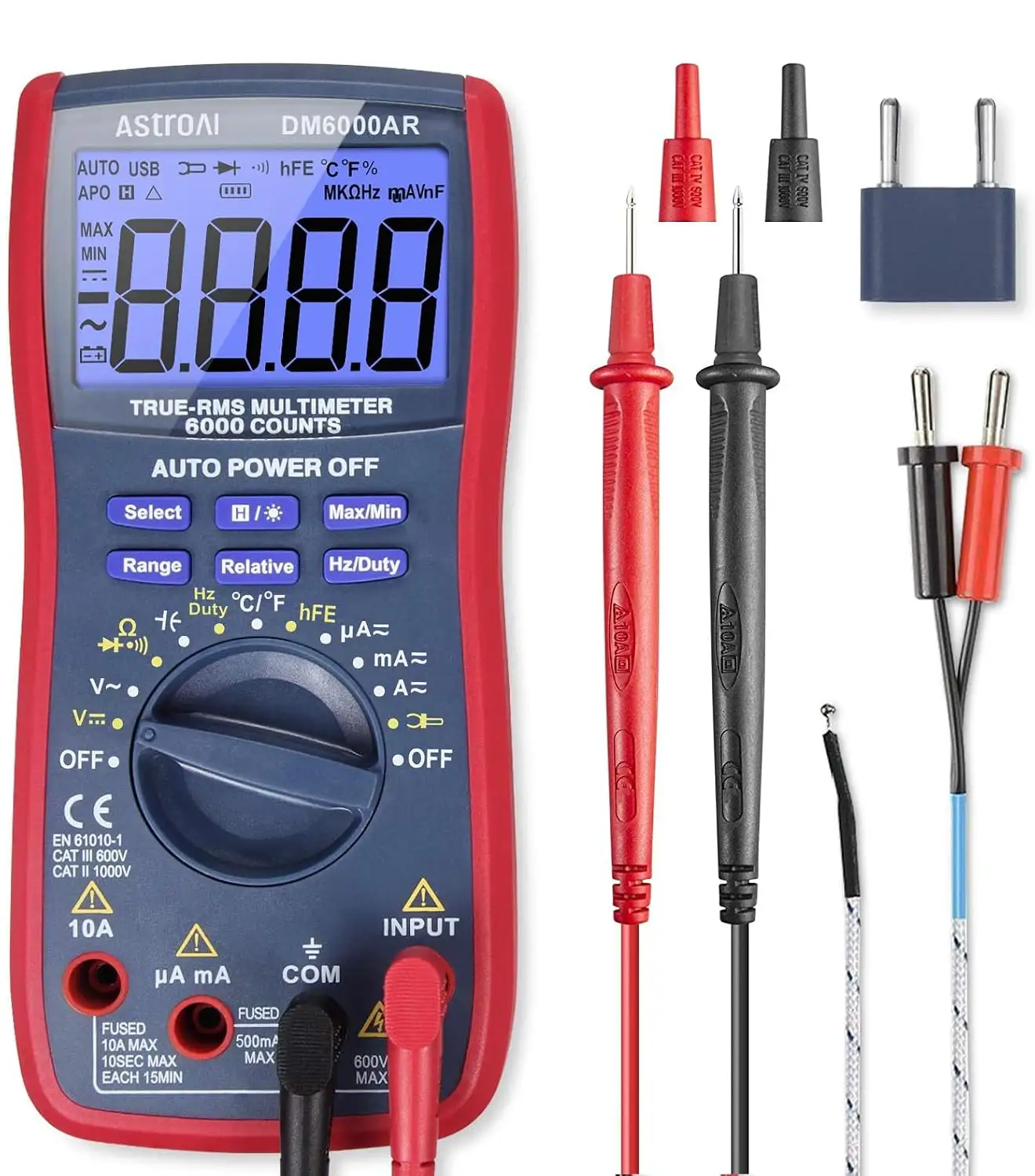
AstroAI DM6000AR True-RMS Digital Multimeter
A true-RMS 6000-count meter with temperature, capacitance and a CAT III 600 V rating — the budget option for DIY, hobby and student work.
- True-RMS AC measurement — accurate readings on the distorted, non-sinusoidal waveforms that switch-mode supplies, dimmers and inverters produce, which is where average-sensing meters quietly mislead.
- 6000-count display with 0.1 mV and 0.1 µA resolution — more resolution on low-voltage and low-current work than a typical 2000-count budget meter, so small changes are visible rather than rounded away.
- CAT III 600 V and CAT II 1000 V safety rating — rated for the transient energy of distribution panels and fixed wiring, not just bench work.
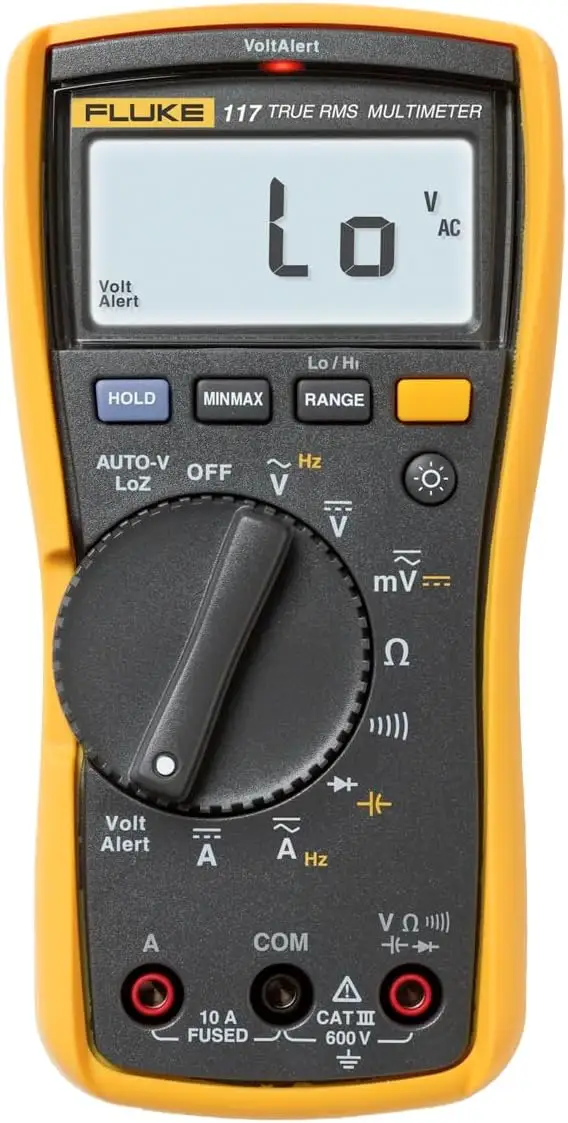
Fluke 117 True-RMS Multimeter
The everyday electrician's meter: true-RMS AC measurement, non-contact voltage detection and a CAT III 600 V rating in a compact body.
- True-RMS AC measurement — accurate readings on the electronic loads that fool cheaper average-sensing meters.
- Built-in non-contact voltage detection — confirm a circuit is live before you put a probe anywhere near it.
- CAT III 600 V safety rating — rated for the transient energy you meet in distribution panels and fixed wiring.

Klein Tools 11063W Wire Stripper and Cutter
Self-adjusting stripper that grips, strips and cuts common building wire in one motion.
- Self-adjusting action — squeeze once and the tool sets itself to the conductor size, so strips are repeatable.
- Clean strip without nicking — protects the copper, which is what keeps a termination reliable long term.
- Built-in cutter and plier nose — you can cut, strip and twist without swapping tools.