Electrical Current Converter (A, mA, µA, kA)
Convert electrical current between microamperes (µA), milliamperes (mA), amperes (A), and kiloamperes (kA) for electronics, RCD/GFCI trip thresholds, and fault-current studies.
Step-by-step calculation
- Base Current: 2.5 A
- Converted to mA: 2500 mA
Formula & mathematical explanation
Input definitions
| Symbol | Parameter | Unit | Engineering meaning & standards relevance |
|---|---|---|---|
| I | Current Value | Selection | Current magnitude to convert. |
| From | From Unit | Selection | Source current unit. |
| To | To Unit | Selection | Target current unit. |
Electrical Current Scale Reference (µA, mA, A, kA)
| Current Value | Amperes (A) | Milliamperes (mA) | Engineering Significance |
|---|---|---|---|
| 5 mA | 0.005 A | 5 mA | North American Class A GFCI trip threshold |
| 20 mA | 0.020 A | 20 mA | Standard LED forward current & 4–20 mA PLC loop full scale |
| 30 mA | 0.030 A | 30 mA | IEC / UK / EU RCD personal shock protection trip rating |
| 300 mA | 0.300 A | 300 mA | IEC fire-protection RCD trip threshold |
| 15 A / 20 A | 20 A | 20,000 mA | Residential branch circuit rating |
| 10 kA | 10,000 A | 10,000,000 mA | Residential breaker short-circuit interrupting rating (AIC / Icn) |
Worked example
Converting a 20 mA LED / 4–20 mA Sensor Loop and a 10 kA Breaker AIC Rating to Amps
Convert 20 mA and 10 kA into base amperes (A).
- 20 mA ÷ 1,000 = 0.020 A.
- 10 kA × 1,000 = 10,000 A short-circuit interrupting capacity.
Assumptions
- Exact SI factor of 1,000 between µA, mA, A, and kA.
Limitations
- Pure unit conversion; does not convert watts or volts to amps (use the Watts to Amps Converter for power-to-current).
How it works
Converts electrical current across SI prefixes from microamperes (10⁻⁶ A) and milliamperes (10⁻³ A) to base amperes (A) and kiloamperes (10³ A).
When to use it
- Converting LED or microcontroller currents in mA/µA into Amps (A) before using Ohm’s Law.
- Converting prospective short-circuit fault currents between Amps and Kiloamperes (kA).
Practical real-world applications
- LED Resistor Sizing: Converting 20 mA to 0.02 A so R = (V_supply − V_f) ÷ 0.02 A yields ohms directly.
- Industrial Instrumentation: Checking 4–20 mA analog transmitter current loops (0.004 A to 0.020 A across a 250 Ω sense resistor = 1 V to 5 V).
Original Editorial Review & Technical Evaluation
Converts across µA, mA, A, and kA with reference benchmarks for GFCI/RCD trip thresholds, 4–20 mA loops, and kA fault ratings.
Electronics engineers, PLC/instrumentation technicians, and electricians.
- 4-decade bidirectional current conversion (µA, mA, A, kA).
- Simultaneous readout across all four current scales.
Accuracy & methodology: Exact SI prefix definitions.
What to verify independently: Verify low-level mA signals using a multimeter’s fused mA/µA input jack.
Common mistakes
- Entering 20 mA as "20" instead of "0.02" in an Ohm’s Law or Power calculator expecting Amperes.
- Confusing breaker continuous current rating in Amps (e.g., 20 A) with short-circuit interrupting rating in kiloamps (e.g., 10 kA = 10,000 A).
Safety & code notice
Currents as low as 30 mA (0.03 A) AC across the chest can cause ventricular fibrillation; always test RCD/GFCI devices regularly.
Frequently asked questions
Related Unit Converters
Watts to Amps Converter
Convert active power in watts (W) to current in amps (A) for DC and AC circuits.
Amps to Watts Converter
Convert current in amps (A) to active power in watts (W) for DC and AC systems.
Electrical Resistance Converter (mΩ, Ω, kΩ, MΩ, GΩ)
Convert resistance between milliohms, ohms, kilohms, megohms, gigohms, and S.
Related Calculators
Current Calculator
Calculate circuit current in amps from voltage and resistance or load wattage.
Amperage Calculator
Calculate load amperage from wattage and voltage for DC, 1-phase, and 3-phase runs.
LED Resistor Calculator
Calculate the current-limiting resistor ohms and wattage for single or series LEDs.
Ohm's Law Calculator
Calculate voltage, current, resistance, and power in DC or resistive AC circuits.
Related Engineering Guides
Ohm's Law Explained: Voltage, Current and Resistance
Master the relationship between voltage, current, resistance, and power in circuits.
Electrical Safety Basics Everyone Should Know
Apply safe isolation, two-pole voltage proving, lockout/tagout, and arc-rated PPE.
How to Choose a Multimeter
Compare CAT III/IV safety ratings, True-RMS accuracy, and meter input protection.
Recommended Tools & Instruments
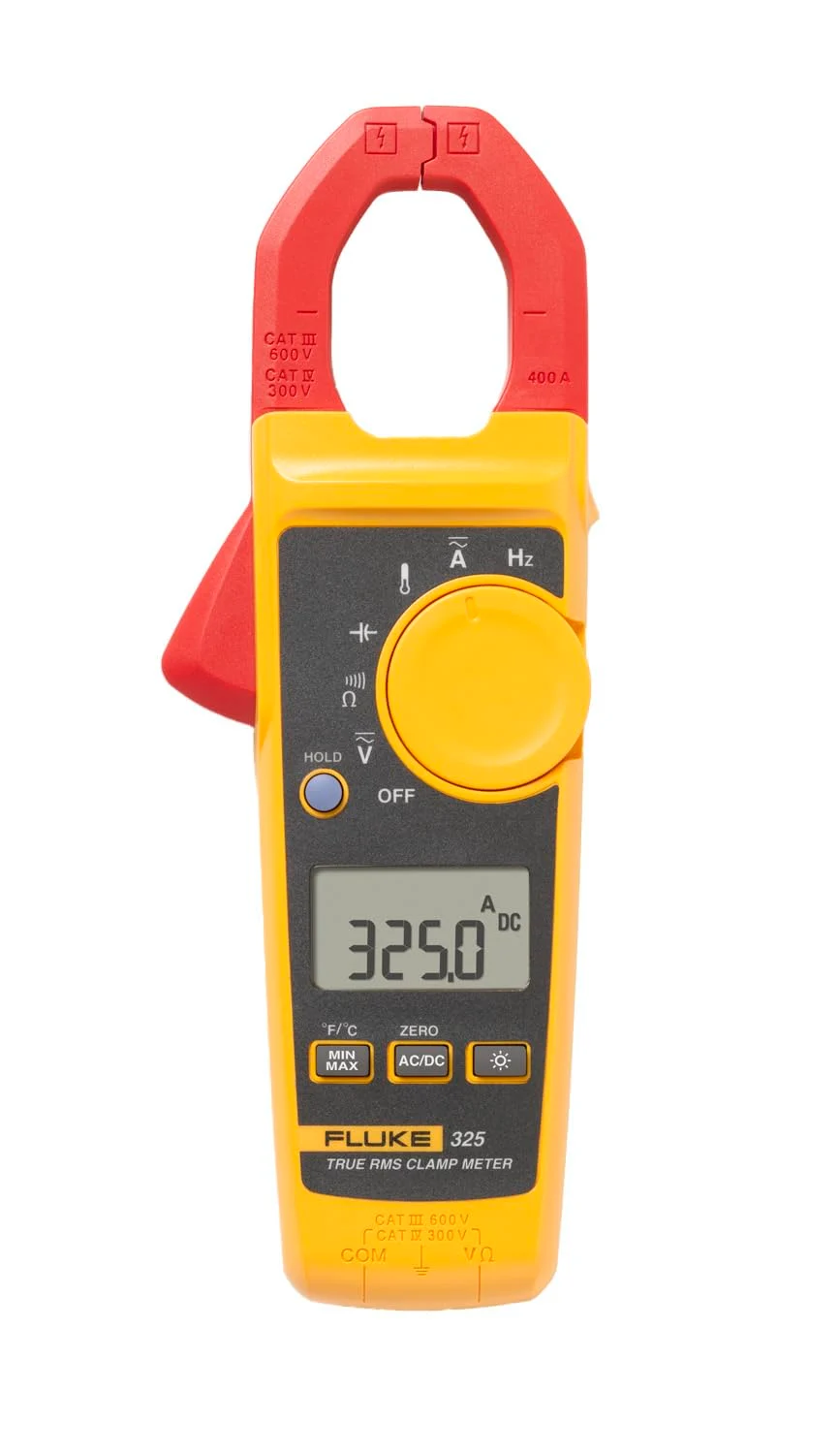
Fluke 325 True-RMS Clamp Meter
Clamp-on AC/DC current measurement in tight panels, with true-RMS accuracy and a CAT III 600 V rating.
- AC and DC current measurement — covers mains circuits, battery banks and solar strings with one tool.
- Clamp-on measurement — read current without disconnecting or disturbing the circuit.
- Slim jaw profile — slides into crowded panels where bulky clamps will not fit.

Klein Tools CL800 Digital Clamp Meter
Wide-jaw auto-ranging clamp meter with inrush capture for motor and compressor starting currents.
- Inrush current capture — see the starting surge that trips breakers, not just the running current.
- Wide jaw opening — accepts larger conductors and bundled cables that slim clamps cannot.
- Auto-ranging true-RMS measurement — fast readings you can trust on non-linear loads.
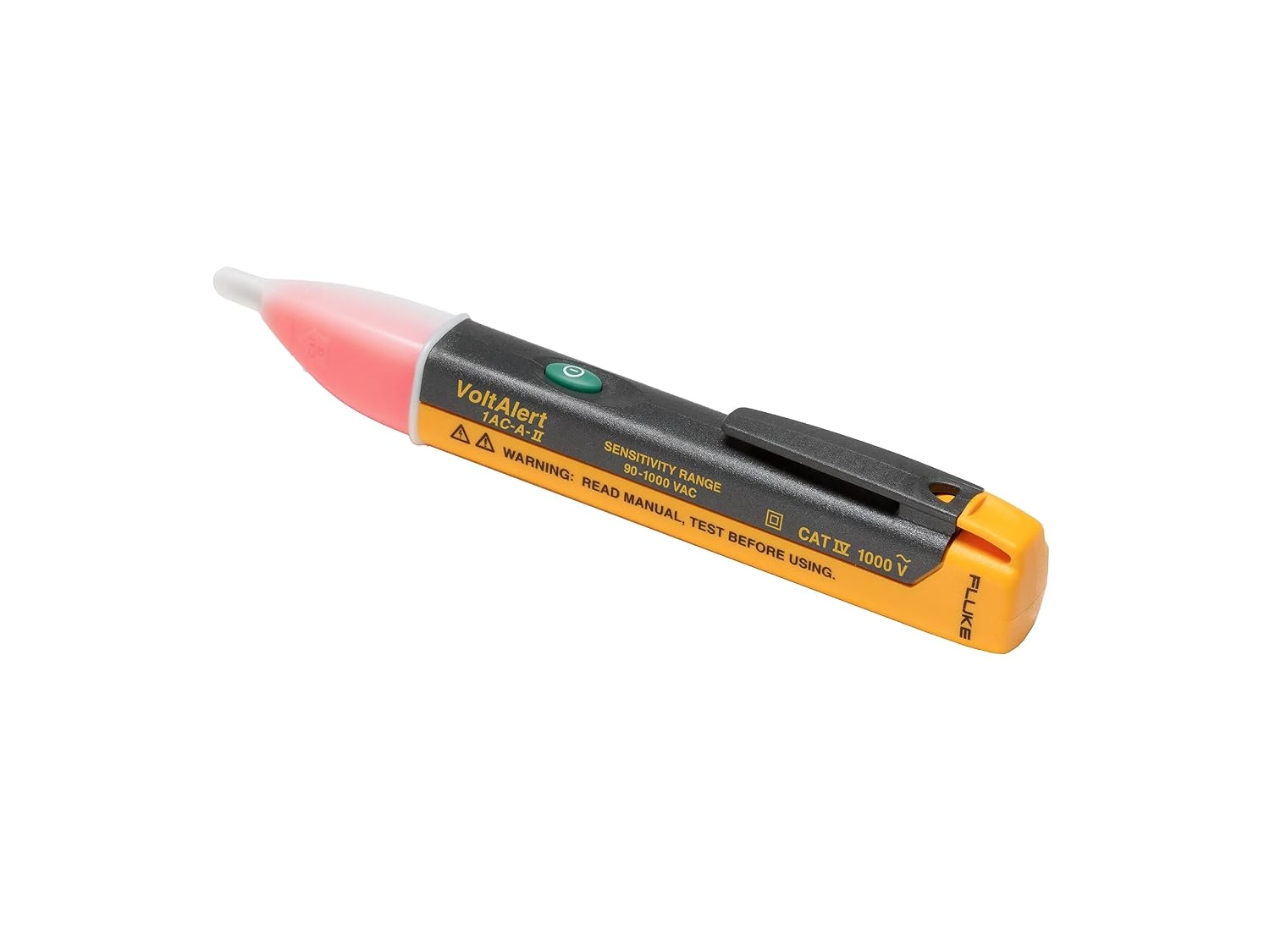
Fluke 1AC-II VoltAlert Non-Contact Voltage Tester
A quick live-wire check you can keep in a shirt pocket — CAT IV 1000 V rated.
- Non-contact detection — confirms voltage is present without any contact or exposed metal.
- Audible and visual indication — clear beep and bright glow, so you can confirm while looking elsewhere.
- CAT IV 1000 V rating — safety category suited to service entrances and outdoor conductors.
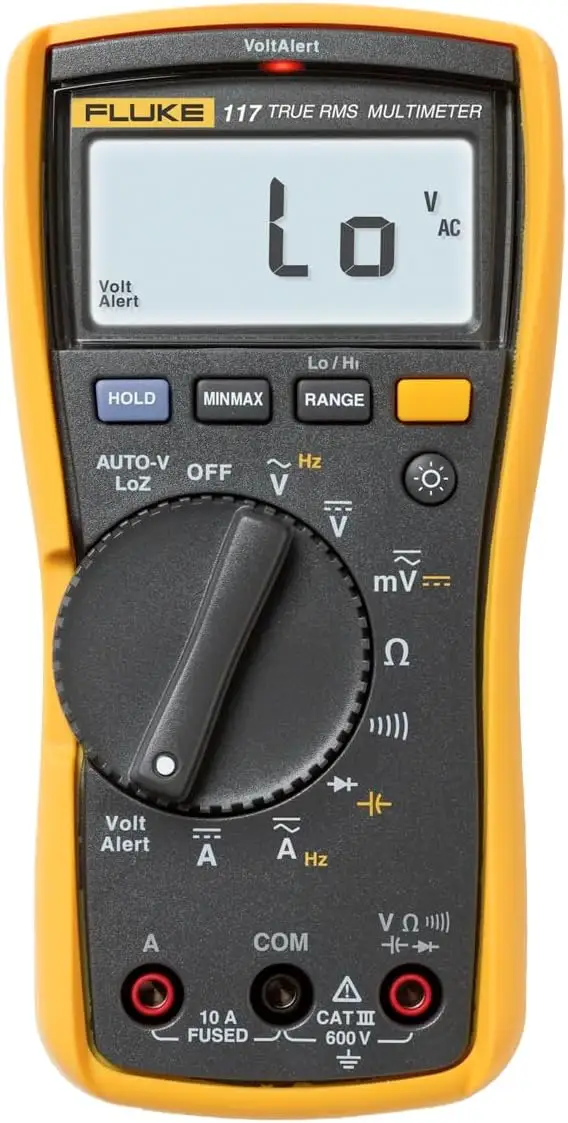
Fluke 117 True-RMS Multimeter
The everyday electrician's meter: true-RMS AC measurement, non-contact voltage detection and a CAT III 600 V rating in a compact body.
- True-RMS AC measurement — accurate readings on the electronic loads that fool cheaper average-sensing meters.
- Built-in non-contact voltage detection — confirm a circuit is live before you put a probe anywhere near it.
- CAT III 600 V safety rating — rated for the transient energy you meet in distribution panels and fixed wiring.