Watts to kW Converter (W to Kilowatts)
Convert watts (W) to kilowatts (kW) by dividing wattage by 1,000. Includes step-by-step math along with mechanical horsepower (745.7 W), metric PS (735.5 W), and BTU/hr equivalents.
Step-by-step calculation
- P = 3500 W ÷ 1,000 = 3.5 kW
- Mechanical Horsepower (1 hp = 745.7 W): 3500 ÷ 745.7 = 4.694 hp (Metric PS = 4.759 PS)
Formula & mathematical explanation
Input definitions
| Symbol | Parameter | Unit | Engineering meaning & standards relevance |
|---|---|---|---|
| P_W | Power in Watts | W | Power in watts (W). |
| cos φ | Power Factor (cos φ) | Selection | Optional AC power factor (cos φ) to also compute Apparent Power (VA / kVA). |
Watts (W) to Kilowatts (kW) Conversion Table
| Watts (W) | Kilowatts (kW) | Daily Energy (8 hrs) | Typical Load |
|---|---|---|---|
| 60 W | 0.06 kW | 0.48 kWh | Laptop charger / ceiling fan |
| 250 W | 0.25 kW | 2.00 kWh | Refrigerator / desktop PC & monitor |
| 745.7 W | 0.7457 kW | 5.97 kWh | 1 Mechanical HP motor equivalent |
| 1,500 W | 1.50 kW | 12.00 kWh | Portable space heater / hair dryer |
| 3,000 W | 3.00 kW | 24.00 kWh | Immersion water heater / kettle |
| 5,000 W | 5.00 kW | 40.00 kWh | Electric clothes dryer |
| 9,600 W | 9.60 kW | 76.80 kWh | 40A Level 2 EV charger |
Worked example
Converting 3,500 W of Appliance Load into Kilowatts
Express a 3,500 W combined kitchen appliance load in kilowatts for generator sizing.
- Divide 3,500 W ÷ 1,000 = 3.5 kW.
Assumptions
- Exact SI factor of 1,000 W = 1 kW.
- Power is continuous over the instant of measurement.
- Secondary conversions to HP (745.7 W), PS (735.5 W), and BTU/hr represent 100% theoretical energy equivalence.
Limitations
- Converting watts to kW does not account for inverter or motor efficiency losses.
- Utility bills charge for energy (kWh), which requires multiplying kW by operating hours.
How it works
Divides power in watts (W) by 1,000 to express the rating in kilowatts (kW), the standard unit used for utility billing, generator sizing, and solar/inverter specifications.
When to use it
- Preparing total connected load schedules in kW for utility service applications.
- Calculating electricity costs where utility tariffs are priced per kWh.
Practical real-world applications
- Energy Bill Estimation: Converting a 1,500 W heater to 1.5 kW so you can multiply by hours and tariff rate ($/kWh).
- Inverter & Generator Selection: Summing household wattages and converting to kW to pick a backup inverter.
Original Editorial Review & Technical Evaluation
Converts appliance and circuit wattages into kilowatts (kW), mechanical horsepower (745.7 W), metric PS (735.5 W), and BTU/hr.
Homeowners, electricians, solar designers, and energy auditors.
- 4-decimal precision for small electronic loads down to 0.1 W.
- Displays mechanical HP (745.7 W), metric PS (735.5 W), and thermal BTU/hr equivalents.
- Reference table includes 8-hour daily kWh consumption benchmarks.
Accuracy & methodology: Exact SI division by 1,000.
What to verify independently: Cross-check against our SI Prefixes Reference.
Common mistakes
- Multiplying by 1,000 instead of dividing when converting from W to kW.
- Treating VA (volt-amperes) on UPS nameplates as identical to W (typically W = 0.7 to 0.9 × VA).
Safety & code notice
When sizing backup inverters or generators from watt totals, include motor starting surge (2×–4× running watts).
Frequently asked questions
Related Unit Converters
kW to Watts Converter (Kilowatts to Watts)
Convert kilowatts (kW) to watts (W), megawatts, and mechanical horsepower (HP).
Electrical & Thermal Power Converter (W, kW, MW, HP, BTU/hr)
Convert between watts, kilowatts, megawatts, horsepower, metric PS, and BTU/hr.
Watts to Amps Converter
Convert active power in watts (W) to current in amps (A) for DC and AC circuits.
Electrical Energy Converter (kWh, Wh, Joules, kJ, MJ, BTU)
Convert electrical and thermal energy between kWh, Wh, joules, kJ, and BTU.
Related Calculators
kWh Calculator
Convert appliance wattage and daily hours into daily, monthly, and annual kWh.
Electricity Cost Calculator
Estimate daily, monthly, and annual electricity cost from wattage and utility rate.
Power Calculator
Calculate active, apparent, and reactive power from voltage, current, or PF.
Inverter Size Calculator
Determine continuous and surge watt ratings for an off-grid or backup inverter.
Related Engineering Guides
Recommended Tools & Instruments
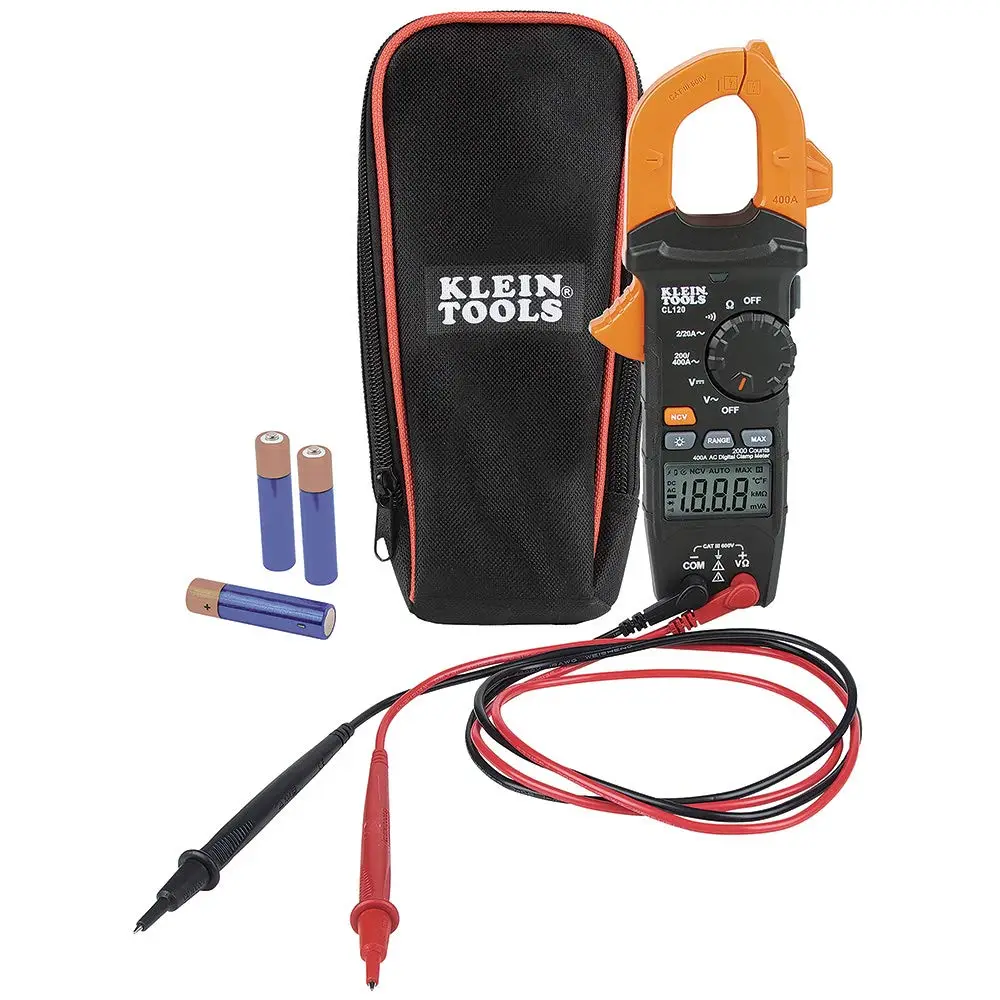
Klein Tools CL120 Auto-Ranging Clamp Meter
Auto-ranging 400 A AC clamp with NCV detection — choose the function and let the meter pick the range.
- Auto-ranging — select the measurement type and the meter picks the range, so no overload indications and no dial-fiddling at the top of a ladder.
- 400 A AC clamp — covers domestic and light commercial circuit current, measured without breaking the circuit.
- 2000-count display with backlight — resolution fine enough for small loads, and readable in a dark consumer unit.
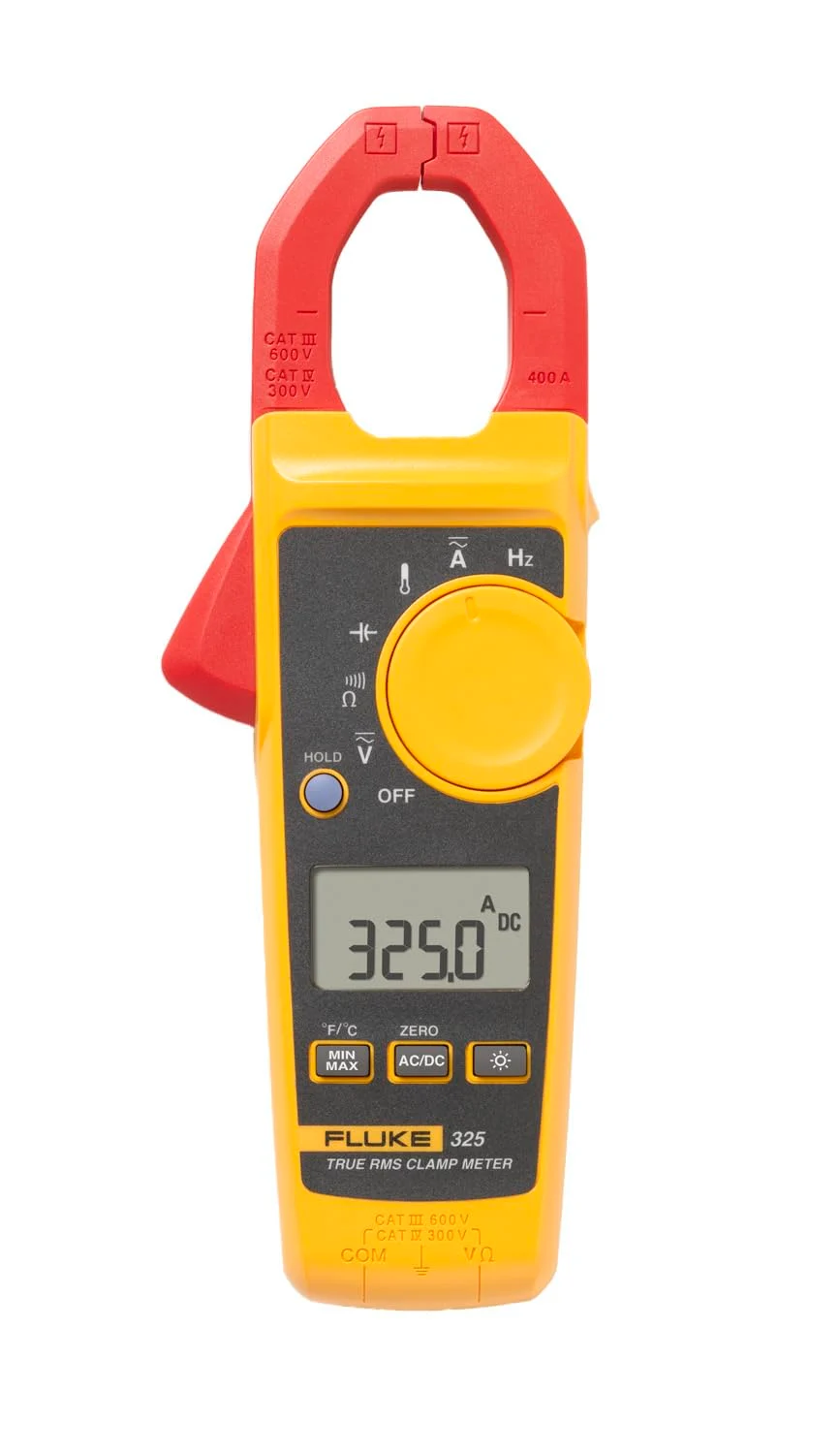
Fluke 325 True-RMS Clamp Meter
Clamp-on AC/DC current measurement in tight panels, with true-RMS accuracy and a CAT III 600 V rating.
- AC and DC current measurement — covers mains circuits, battery banks and solar strings with one tool.
- Clamp-on measurement — read current without disconnecting or disturbing the circuit.
- Slim jaw profile — slides into crowded panels where bulky clamps will not fit.

Klein Tools ET310 Circuit Breaker Finder Kit
Finds the breaker feeding a circuit without shutting the panel down — the transmitter plugs into the outlet, the receiver traces it back.
- Transmitter and receiver pair — plug the transmitter into the socket, then sweep the receiver across the panel to identify the matching breaker.
- Wiring status indicator on the transmitter — the same open ground, open neutral, open hot, reversed hot/neutral and reversed hot/ground checks as a standard outlet tester.
- GFCI test button — trips a GFCI device to confirm it is actually protecting the circuit, not just installed.
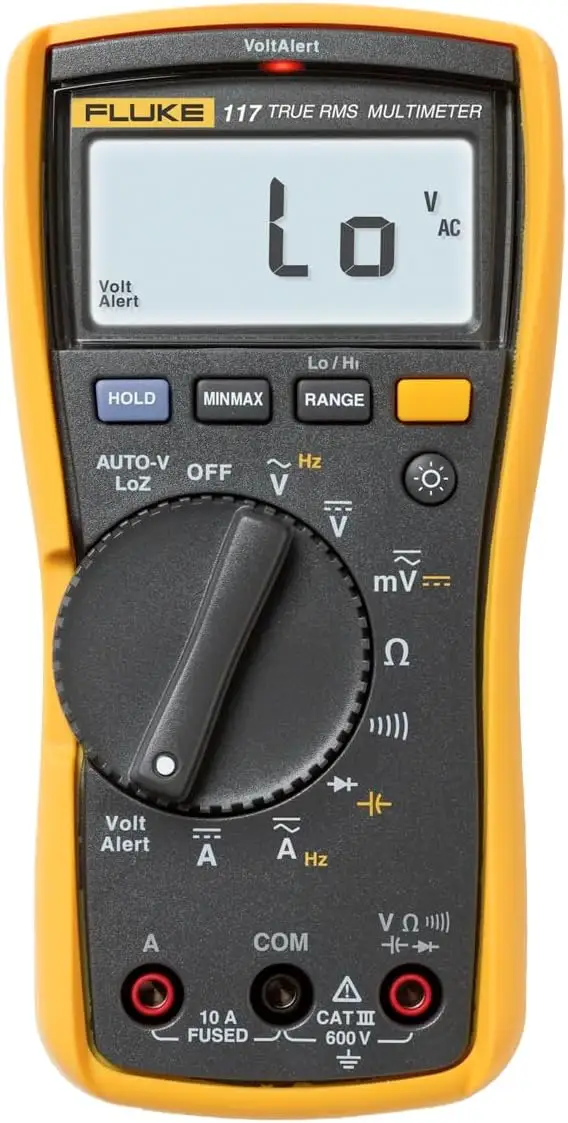
Fluke 117 True-RMS Multimeter
The everyday electrician's meter: true-RMS AC measurement, non-contact voltage detection and a CAT III 600 V rating in a compact body.
- True-RMS AC measurement — accurate readings on the electronic loads that fool cheaper average-sensing meters.
- Built-in non-contact voltage detection — confirm a circuit is live before you put a probe anywhere near it.
- CAT III 600 V safety rating — rated for the transient energy you meet in distribution panels and fixed wiring.