Klein Tools ET310 Circuit Breaker Finder Kit
Finds the breaker feeding a circuit without shutting the panel down — the transmitter plugs into the outlet, the receiver traces it back.
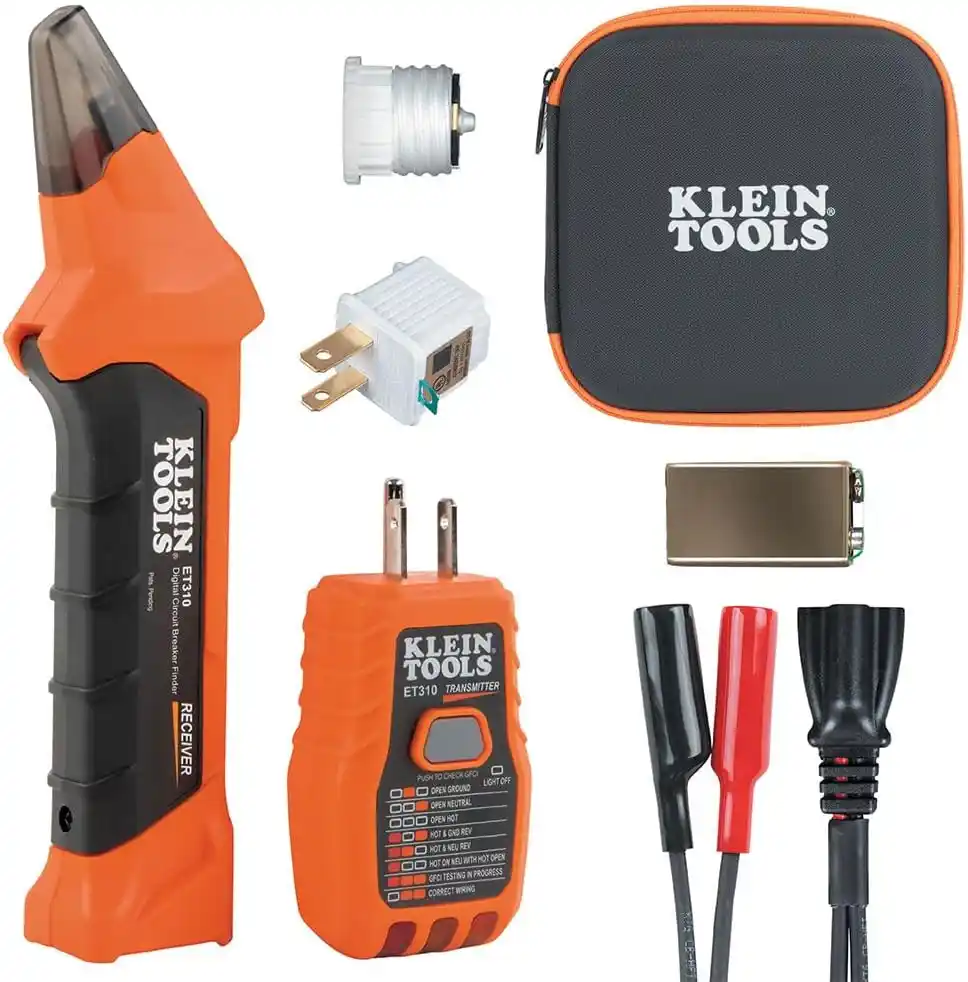
A circuit breaker finder kit with a plug-in transmitter and a receiver that identifies which breaker feeds a socket, supplied with a light socket adapter, ground adapter and carry case.
- Pinpoints the exact breaker without tripping
- Transmitter tests outlet wiring & GFCI
- Sender docks inside receiver for storage
Affiliate Disclosure: VoltCalc may earn a commission from qualifying purchases made through product links at no extra cost to you. Product specs and availability are for reference and may change.
Field Overview
Every electrician has done it the slow way: plug a lamp into the socket, walk to the panel, flip breakers one at a time and wait to see if the light goes out. It works, but it means killing power to circuits you did not need to disturb, and on a busy site that is not always acceptable. The Klein ET310 takes the guesswork out of it. The transmitter plugs into the outlet and puts a signal on the wiring; the receiver is swept across the breakers in the panel and tells you which one is carrying that signal. You identify the circuit first, then isolate only the breaker you actually need.
Detailed Feature Breakdown
- Transmitter and receiver pair — plug the transmitter into the socket, then sweep the receiver across the panel to identify the matching breaker.
- Wiring status indicator on the transmitter — the same open ground, open neutral, open hot, reversed hot/neutral and reversed hot/ground checks as a standard outlet tester.
- GFCI test button — trips a GFCI device to confirm it is actually protecting the circuit, not just installed.
- Light socket and ground adapters included — reach circuits wired to a lamp holder or an ungrounded two-prong outlet.
- Zippered carry case — keeps the transmitter, receiver and adapters together so nothing goes missing in the van.
Performance & Practical Use
On a clearly labelled panel with breakers fed from separate cables, the ET310 identifies the right breaker quickly and saves a walk back and forth to the load. It is genuinely useful on new-build and renovation work where panel schedules are wrong or nonexistent. Be realistic about the limits, though: the signal can couple onto adjacent conductors, so on a tightly packed panel or a shared neutral circuit you may pick up a strong reading on a neighbouring breaker. When that happens, reduce the receiver sensitivity or sweep more slowly and confirm the result by isolating the breaker. The light socket and ground adapters are the details that make it usable on older wiring rather than just modern installations.
How It Compares
The ET310 pairs naturally with the RT210 outlet tester — use the ET310 to identify the circuit and the RT210 for a quick wiring check at the outlet itself.
Pros
- Identifies the correct breaker without switching circuits off
- Includes light socket and ground adapters for older wiring
- Transmitter also checks for common wiring faults and tests GFCIs
- Carry case keeps the kit together
Cons
- Signal can couple to adjacent breakers in crowded panels
- Not a substitute for proving a circuit dead before working on it
VoltCalc Verdict
If you label panels, trace circuits or work in older buildings with unreliable panel schedules, this kit saves real time on almost every job and removes the need to shut down circuits unnecessarily. It is a convenience tool rather than a safety device — always confirm the isolated circuit is dead before touching it. Buy it if you trace circuits regularly; skip it if your panels are already well labelled and you rarely need to identify a mystery circuit.