Start with the energy you need
Everything begins with a daily energy figure in watt-hours. List each appliance, multiply its power by the hours it runs, and add the results. A 60 W fan running 8 hours uses 480 Wh; a 5 W router running continuously uses 120 Wh.
Size the array
A panel's daily output is roughly:
Daily Wh per panel = Panel W × Peak Sun Hours × Derate factor
So a 400 W panel in a location with 4.5 peak sun hours and an 80% derate yields about 1440 Wh per day. Divide your daily energy need by this figure and round up to get the number of panels.
Size the battery bank
The battery must cover your overnight load and, if you are off-grid, several cloudy days:
Ah = (Daily Wh × Days of autonomy) ÷ (System V × DoD × Efficiency)
Depth of discharge (DoD) is how far you allow the battery to discharge. Lithium typically allows 80–90%; lead-acid is often limited to 50% for acceptable life. Ignoring DoD is the most common sizing error.
Choose a charge controller
The controller current is the array power divided by the system voltage, plus a safety margin. MPPT controllers are more efficient and accept higher array voltages; PWM controllers are simpler but only work well when array and battery voltages are close.
Don't forget the inverter
The inverter must handle the continuous load plus losses, and its surge rating must cover motor starting. See the Inverter Size Calculator.
A note on safety
Battery banks store a great deal of energy and can deliver enormous fault currents. All DC work should be fused at the battery, and installation should follow the relevant code and be checked by a qualified person.
Start with the Solar Panel Calculator and the Solar Battery Calculator.
Put the numbers to work with the Solar Panel Calculator and Solar Battery Calculator. For the background behind the numbers, read Integrating Renewable Energy: Grid-Tied, Hybrid and Off-Grid Systems.
Frequently asked questions
What are peak sun hours?
Why add a derate factor?
Related calculators
Solar Panel Calculator
Calculate how many solar panels are needed for a daily energy target.
Solar Battery Calculator
Calculate the battery bank capacity for a solar system with autonomy days.
Solar Charge Controller Calculator
Calculate the minimum charge controller current rating.
Battery Runtime Calculator
Estimate how long a battery will run a given load.
Products mentioned in this guide
All products →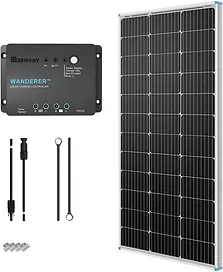
Renogy 100 W Solar Panel Starter Kit
A 100 W monocrystalline solar panel starter kit with a charge controller and mounting hardware for off-grid and RV systems.
- Everything matched in one box — panel, charge controller, mounts and cabling, so nothing is missing on install day.
- Monocrystalline panel — performs better than polycrystalline in low light and overcast conditions.
- Scales by adding identical panels — you can grow the array later without replacing the controller if it has headroom.
- Everything needed to start in one box
- Monocrystalline panel performs well in low light
- Scales by adding identical panels
- Kits are usually cheaper per watt when bought piece by piece at larger sizes
VoltCalc may earn a commission when you buy through links on this page, at no extra cost to you. Prices and availability are shown as a guide only and may change.
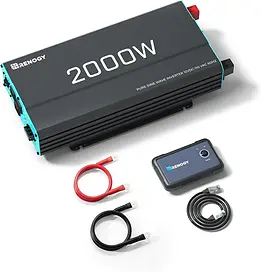
Renogy 2000 W Pure Sine Wave Inverter
A 2000 W pure sine wave inverter that converts battery DC into clean mains AC for appliances, tools and electronics.
- Pure sine wave output — equipment runs as it would on mains, with no buzzing motors or misbehaving supplies.
- 2000 W continuous output — enough for fridges, power tools and a run of household electronics.
- Surge headroom for motor starting — covers the brief inrush a fridge compressor or pump draws on start-up.
- Pure sine wave is safe for motors and sensitive electronics
- Surge headroom covers fridge and pump starting
- Protections shut down cleanly instead of failing
- Needs a substantial battery bank to deliver full output
VoltCalc may earn a commission when you buy through links on this page, at no extra cost to you. Prices and availability are shown as a guide only and may change.
VoltCalc may earn a commission when you buy through links on this page, at no extra cost to you. Prices and availability are shown as a guide only and may change.
Related articles
- Integrating Renewable Energy: Grid-Tied, Hybrid and Off-Grid Systems
How a solar array, battery and inverter actually connect to a building and to the grid — architectures, protection and the sizing sequence.
- How to Choose Solar & Portable Power
Panels, batteries, controllers and inverters — how to size a small solar or portable power system before you buy any of the parts.
- How to Choose an Inverter or UPS
Continuous versus surge rating, sine wave quality, idle draw and transfer time — picking an inverter or UPS that will not trip out on the load you already own.