How to Choose Solar & Portable Power
Size the system before you shop
Solar purchases go wrong in one direction: someone buys panels, then a battery, then an inverter, and discovers the parts do not suit the load. Do the arithmetic first and the shopping list writes itself.
Work through four questions in order:
- How much energy per day? Add up the watt-hours of everything you will run, multiplied by hours of use. That is your daily energy requirement.
- How much sun do you really get? Use the worst month you expect to use the system, not the best. Panel output falls steeply with cloud, low sun angle and heat.
- How much storage? Size the battery for the energy you need to carry through the dark hours plus a margin for depth of discharge.
- What peak power? The largest simultaneous load sets the inverter, with the surge from motors and pumps checked separately.
The Solar Panel Calculator, the Solar Battery Calculator, the Solar Charge Controller Calculator and the Inverter Size Calculator walk through each step.
Panels: rigid, flexible or folded
- Rigid framed panels are the most efficient and cheapest per watt, and last decades when mounted with airflow behind them. They are heavy and need a structure.
- Flexible panels are light and can follow a curved surface, but they run hotter and typically produce less per rated watt, with a shorter life.
- Folding portable panels suit camping and temporary use — light, packable, and usually paired with a power station.
Whatever you buy, match panel voltage to the controller's input range. Two panels in series add voltage; in parallel they add current. Check the controller can accept the array's open-circuit voltage with cold-weather margin, because panel voltage rises as temperature falls.
Batteries and what the rating really means
The amp-hour figure on the label is not the energy you can use. Lead-acid types should not be discharged below about half their capacity if you want them to last; LiFePO4 typically allows far deeper discharge with a much longer cycle life and weighs a fraction as much.
So compare systems on usable kilowatt-hours over their cycle life, not on headline capacity. Add up:
- Usable capacity per cycle × expected cycles = lifetime energy delivered.
- Then add the cost of replacing the battery sooner if you discharge it deeply.
A small, correctly sized lithium battery will usually beat a large lead-acid one over five years. For a starter setup, a solar starter kit shows the typical combination of panel, controller and mounting hardware.
Inverters, controllers and power stations
Inverters convert battery DC to mains AC. Buy a pure sine wave unit for anything with a motor, electronics or a charger in it — modified sine wave output upsets them. Check the continuous rating against your steady load and the surge rating against motor starting currents. Standby consumption matters too: an inverter left on drains the battery even with nothing plugged in.
Charge controllers sit between panels and battery. MPPT controllers harvest noticeably more than PWM types, particularly in poor light and cold weather, and are the sensible choice for any system worth building.
Portable power stations bundle battery, inverter, charger and often a solar input into one unit. They are ideal for occasional and mobile use, and their solar input limits are stated clearly. Their trade-offs are capacity ceilings and the fact that nothing is individually replaceable. A pure sine wave inverter illustrates the component route when you want to scale beyond one box.
What to look for when buying
- Panels with a stated temperature coefficient and a real warranty, not just a peak wattage.
- A controller whose voltage range comfortably covers your array, including cold mornings.
- A battery rated in usable capacity and cycle life, with a stated chemistry.
- A pure sine wave inverter with surge rating stated separately.
- Fusing and isolation on the battery, panel and inverter circuits.
- Cable sized for the current and the run — DC losses are larger than people expect.
Our verdict
Size the system from your daily energy and your worst-case sun, then choose chemistry by cost per usable kilowatt-hour rather than by headline amp-hours. Prefer MPPT control, pure sine wave inversion and correct cable sizing. A well-sized small system will always outperform an oversized array with an undersized battery and a cheap controller.
VoltCalc provides calculations and educational information only. Installation must follow the rules that apply where you are and be carried out or verified by a competent person.
Side-by-Side Worked Examples: North America (NEC) vs. International (IEC 60364 / BS 7671)
North American (NEC 2023/2026) Worked Example
Sizing a 24 V DC workshop solar setup needing 2,400 Wh/day (AC loads via a 120 V 60 Hz pure sine inverter, 90% efficiency) in an area with 4.0 worst-month sun hours and −15 °C winter mornings.
- PV array & MPPT cold-Voc (NEC 690.7): 2,400 ÷ (4.0 × 0.80) = 750 W -> 2 × 400 W panels (800 W) in 2S. With Voc_STC = 49.0 V and β_Voc = −0.28%/°C at −15 °C (ΔT = −40 °C), Voc_max = 2 × 49.0 × [1 + (−0.0028 × −40)] = 109.0 V DC — safely inside a 150 V MPPT controller. Charge current = 800 ÷ 24 = 33.3 A -> 40 A MPPT (apply NEC 1.56× Isc factor to PV string wire).
- Storage bank: 2 days autonomy on 24 V LiFePO₄ (80% DoD): (2,400 × 2) ÷ (24 × 0.80 × 0.90) = 278 Ah -> 300 Ah at 24 V.
International (IEC 62548 / IEC 60364-7-712) Worked Example
Sizing a 230 V 50 Hz portable/cabin backup array for 3,600 Wh/day on a 48 V LiFePO₄ rack battery (85% DoD, 92% inverter efficiency, 1 day autonomy).
- Battery sizing: 3,600 ÷ (48 × 0.85 × 0.92) = 95.9 Ah -> 100 Ah (5.12 kWh) 48 V module.
- IEC string & OCPD check: For a 1,600 W (4S × 400 W) array, size DC PV cable at 1.25 × Isc_STC per IEC 62548, install a lockable DC isolator rated above cold Voc_max, and protect the 230 V AC inverter output with a 30 mA Type A RCD wired to a verified TN/TT earthing reference.
Related Calculators
Solar Panel Calculator
Calculate solar PV array wattage and panel count from daily kWh and sun hours.
Solar Battery Calculator
Calculate solar battery capacity in Ah and kWh from daily load and autonomy.
Solar Charge Controller Calculator
Calculate minimum MPPT or PWM charge controller amps from PV watts and voltage.
Inverter Size Calculator
Determine continuous and surge watt ratings for an off-grid or backup inverter.
Related Unit Converters
Watts to Amps Converter
Convert active power in watts (W) to current in amps (A) for DC and AC circuits.
Amps to Watts Converter
Convert current in amps (A) to active power in watts (W) for DC and AC systems.
AWG to mm² Converter (American Wire Gauge to Metric)
Convert American Wire Gauge (AWG) to metric mm² area, diameter, and resistance.
Frequently Asked Questions
Recommended Tools & Equipment for This Guide
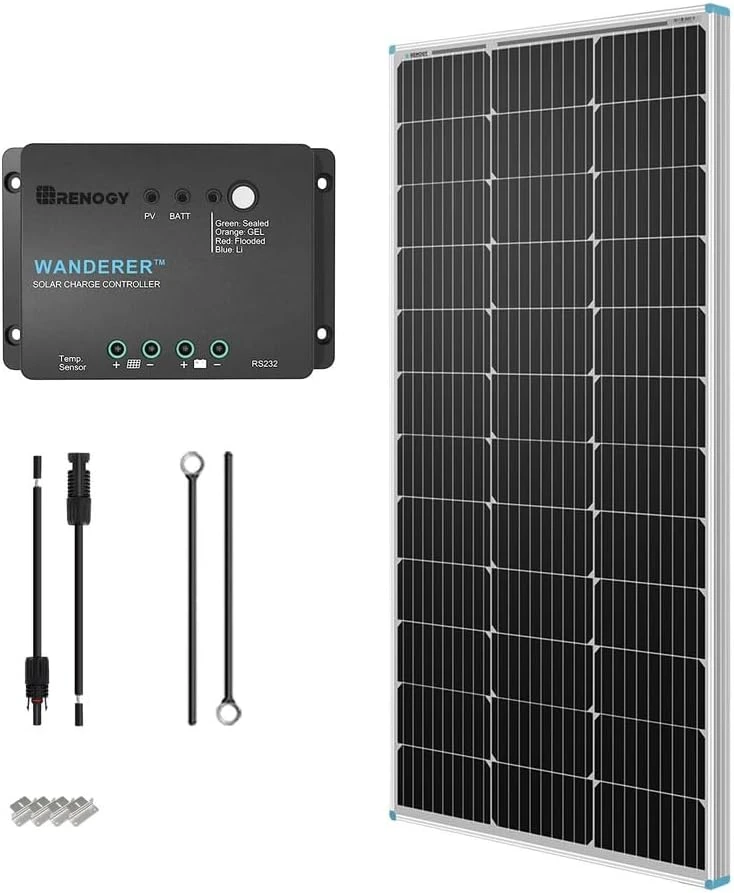
Renogy 100 W Solar Panel Starter Kit
A complete first solar kit — panel, charge controller and mounts — for off-grid and RV use.
- Everything matched in one box — panel, charge controller, mounts and cabling, so nothing is missing on install day.
- Monocrystalline panel — performs better than polycrystalline in low light and overcast conditions.
- Scales by adding identical panels — you can grow the array later without replacing the controller if it has headroom.
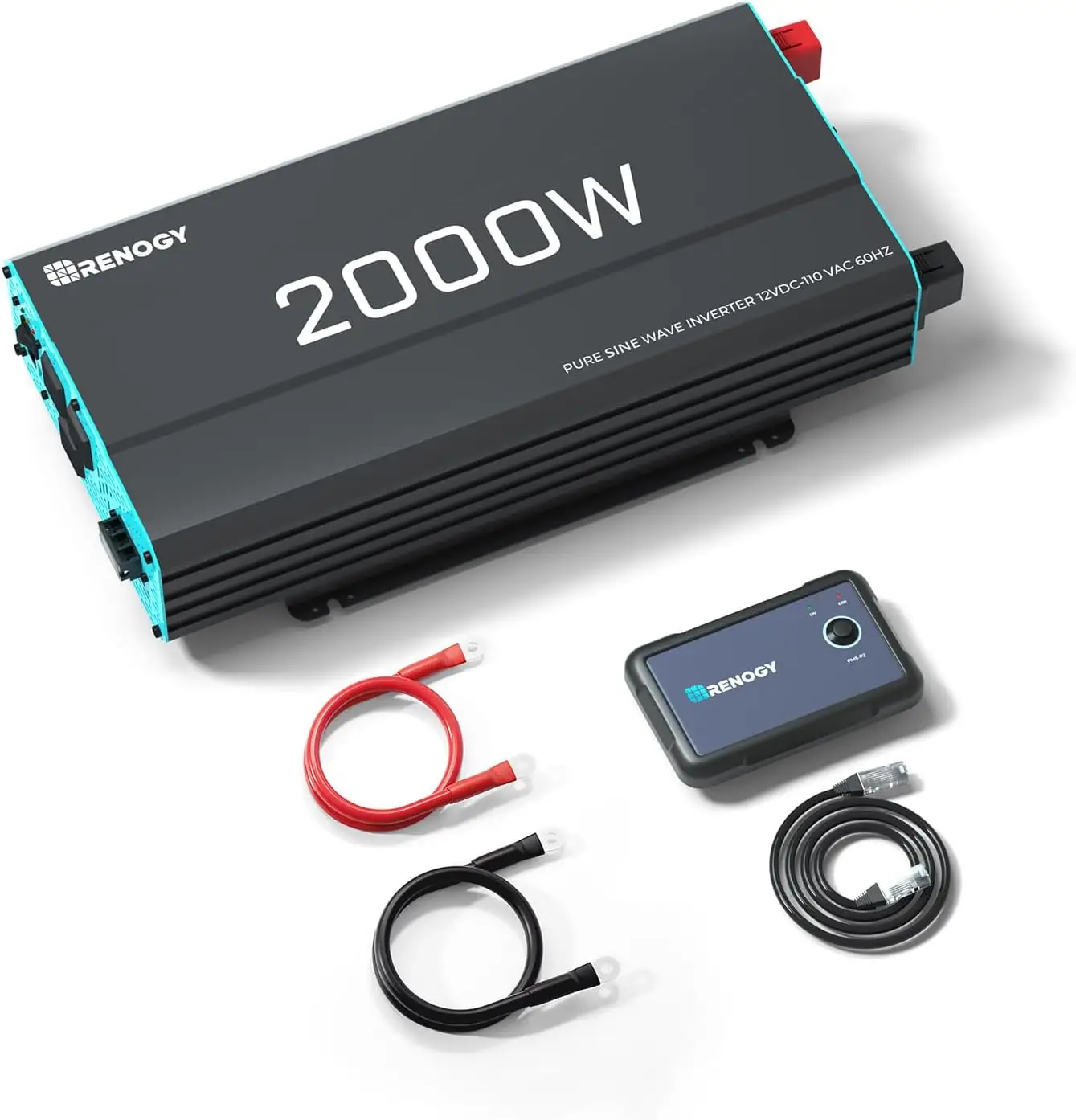
Renogy 2000 W Pure Sine Wave Inverter
Pure sine wave output at 2000 W continuous, with a higher surge rating for motor starting.
- Pure sine wave output — equipment runs as it would on mains, with no buzzing motors or misbehaving supplies.
- 2000 W continuous output — enough for fridges, power tools and a run of household electronics.
- Surge headroom for motor starting — covers the brief inrush a fridge compressor or pump draws on start-up.
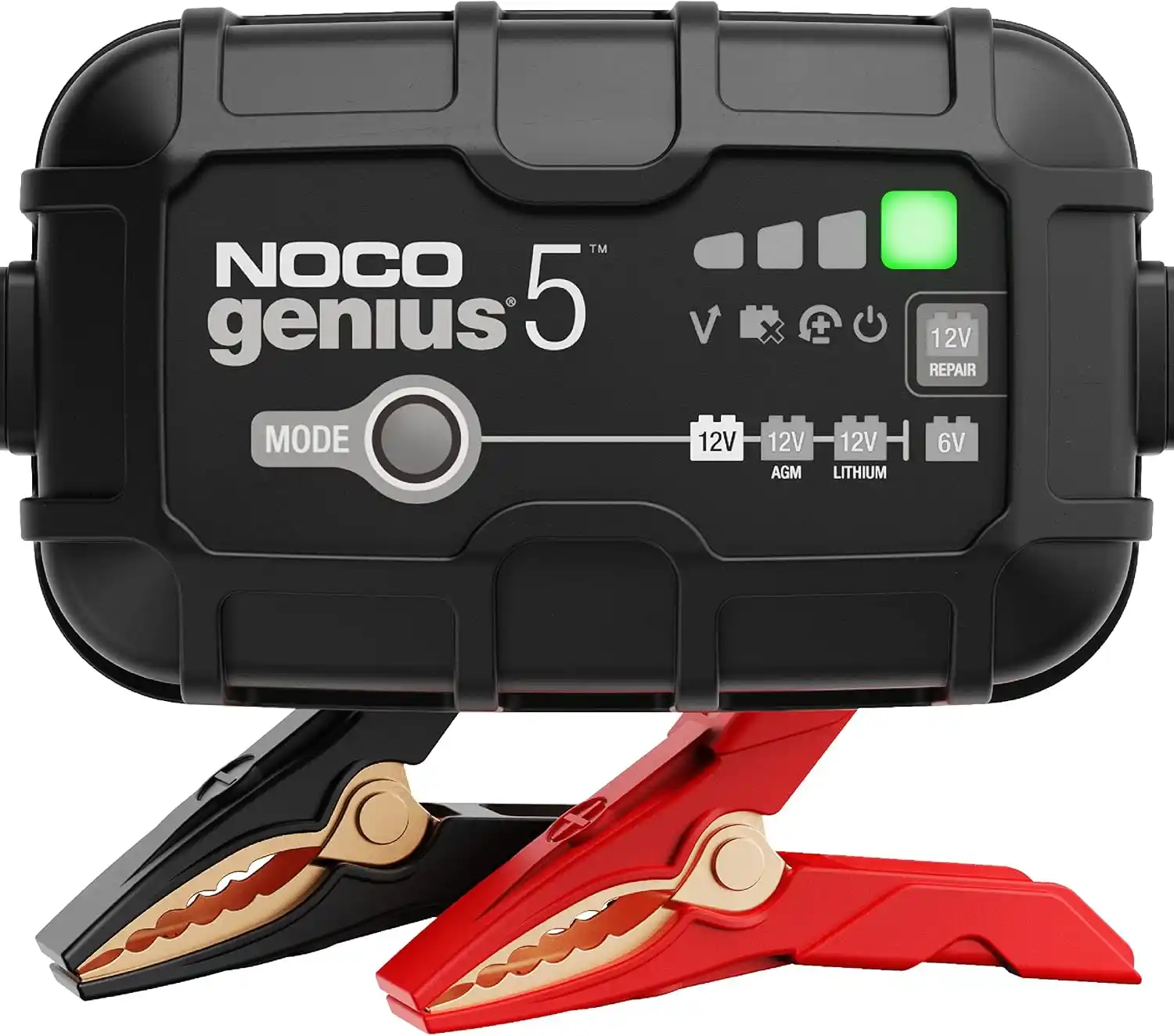
NOCO GENIUS5 Battery Charger
A 5 A automatic charger and maintainer that can stay connected long-term without overcharging.
- Safe long-term maintenance — leave it connected through winter without overcharging the battery.
- 6 V and 12 V support — covers cars, motorcycles, ride-on mowers and most small batteries.
- Multiple chemistry profiles — charges lead-acid and lithium correctly, with the right profile for each.
Related Engineering Guides
Solar System Sizing: Panels, Batteries and Controllers
Follow the four-step workflow to size solar PV arrays, batteries, and inverters.
Integrating Renewable Energy: Grid-Tied, Hybrid and Off-Grid Systems
Connect solar PV arrays, battery banks, and hybrid inverters to building panels.
How to Choose an Inverter or UPS
Evaluate continuous vs. surge watts, pure sine output, DC cables, and transfer time.