Skip to content

Solar Panel Calculator

Calculate how many solar panels are needed for a daily energy target.

Solar Panel Calculator

Enter Daily Energy Need to see the result.

Formula

Panels = Daily Energy ÷ (Panel W × Peak Sun Hours × Derate)

Input definitions

InputSymbolUnitWhat it means
Daily Energy NeedEWhTotal electrical energy needed per day, in watt-hours.
Panel RatingP_panelWNameplate output of one solar panel at standard test conditions, in watts.
Peak Sun HoursPSHhDaily equivalent hours of full solar irradiance, not total daylight hours.
System Deratek%The percentage adjustment described by the label: delivered solar output, range conditions, or continuous-load sizing, depending on the calculator.

Assumptions

  • The displayed formula and selected mode define the simplified model. Only the inputs shown are included; unstated installation conditions are not inferred.
  • Enter each value in the unit printed beside its input. Any conversion needed by the formula is handled as shown in the calculation steps.
  • Entered ratings, efficiencies, loads and component values are treated as constant for the operating point or time period being estimated.

Limitations

  • No code tables are applied: ampacity, derating for grouping, ambient temperature and installation method must be checked separately.
  • Harmonics, non-linear loads, motor starting current and protective-device trip characteristics are not modelled.
  • The result is a planning estimate for a single operating point, not a load study or a design verification.

Safety and code notice

Use this tool for learning and preliminary calculations. Always verify electrical designs against applicable local codes and a qualified professional. VoltCalc provides planning estimates, not code compliance — see the methodology and safety disclaimer.

How it works

Each panel produces its rated power times the peak sun hours, reduced by system losses (derate factor). Dividing the daily energy need by this per-panel yield gives the number of panels.

When to use it

Use it when sizing an off-grid or grid-tied solar array.

Put the numbers to work with the Solar Battery Calculator, Solar Charge Controller Calculator and Battery Capacity Calculator.

Common mistakes

Using rated panel power as actual output, and ignoring the derate factor for wiring, inverter, and temperature losses.

Frequently asked questions

What are peak sun hours?
The equivalent number of hours per day at 1000 W/m² irradiance — typically 3–6 depending on location.
Why a derate factor?
Real systems lose 15–25% to temperature, wiring, dust, and inverter losses.

Related guides

All products →
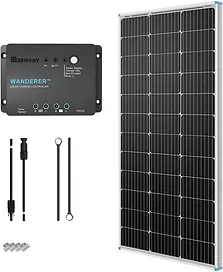
Renogy solar kit with a Wanderer charge controller, framed solar panel, cables and brackets
Renogy

Renogy 100 W Solar Panel Starter Kit

A 100 W monocrystalline solar panel starter kit with a charge controller and mounting hardware for off-grid and RV systems.

  • Everything matched in one box — panel, charge controller, mounts and cabling, so nothing is missing on install day.
  • Monocrystalline panel — performs better than polycrystalline in low light and overcast conditions.
  • Scales by adding identical panels — you can grow the array later without replacing the controller if it has headroom.
Pros
  • Everything needed to start in one box
  • Monocrystalline panel performs well in low light
  • Scales by adding identical panels
Cons
  • Kits are usually cheaper per watt when bought piece by piece at larger sizes
Check PriceView details

VoltCalc may earn a commission when you buy through links on this page, at no extra cost to you. Prices and availability are shown as a guide only and may change.
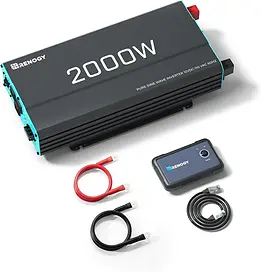
Black Renogy 2000 W pure sine wave inverter with cyan vents, remote control and battery cables
Renogy

Renogy 2000 W Pure Sine Wave Inverter

A 2000 W pure sine wave inverter that converts battery DC into clean mains AC for appliances, tools and electronics.

  • Pure sine wave output — equipment runs as it would on mains, with no buzzing motors or misbehaving supplies.
  • 2000 W continuous output — enough for fridges, power tools and a run of household electronics.
  • Surge headroom for motor starting — covers the brief inrush a fridge compressor or pump draws on start-up.
Pros
  • Pure sine wave is safe for motors and sensitive electronics
  • Surge headroom covers fridge and pump starting
  • Protections shut down cleanly instead of failing
Cons
  • Needs a substantial battery bank to deliver full output
Check PriceView details

VoltCalc may earn a commission when you buy through links on this page, at no extra cost to you. Prices and availability are shown as a guide only and may change.

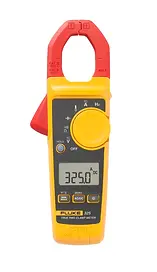
Yellow Fluke 325 clamp meter with red jaws open and a screen reading 325.0 A DC
Fluke

Fluke 325 True-RMS Clamp Meter

A true-RMS clamp meter that measures AC and DC current without breaking the circuit, with a slim jaw for tight panels.

  • AC and DC current measurement — covers mains circuits, battery banks and solar strings with one tool.
  • Clamp-on measurement — read current without disconnecting or disturbing the circuit.
  • Slim jaw profile — slides into crowded panels where bulky clamps will not fit.
Pros
  • Measures current without disconnecting the circuit
  • DC current support covers batteries and solar strings
  • Slim jaw fits awkward panel layouts
Cons
  • Jaw opening limits the largest conductor it can accept
  • No inrush capture for motor starting current
Check PriceView details

VoltCalc may earn a commission when you buy through links on this page, at no extra cost to you. Prices and availability are shown as a guide only and may change.

VoltCalc may earn a commission when you buy through links on this page, at no extra cost to you. Prices and availability are shown as a guide only and may change.