Battery Capacity Calculator
Calculate the battery capacity needed to run a load for a target time.
Step-by-step calculation
- Energy required = 300 W × 8 h = 2400 Wh
- Capacity = 2400 Wh ÷ (24 V × 0.8 × 0.9) = 138.889 Ah
Formula
Input definitions
| Symbol | Input | Unit | Meaning & code relevance |
|---|---|---|---|
| P | Load Power | W | Active electrical or mechanical power transfer (W) dissipated or delivered to the load. |
| t | Desired Runtime | hrs | Continuous or daily operating duration over which power consumption or battery discharge is integrated. |
| V | System Voltage | V | Nominal RMS AC or steady-state DC system potential (e.g., 120V/240V/480V NEC or 230V/400V IEC 60038). |
| DoD | Usable DoD | % | Engineering input parameter for usable dod measured in %, evaluated in real-time by the solver. |
Worked example
300 W Load for 8 Hours at 24 V
Find minimum battery Amp-hours needed.
- Usable Wh = 300 × 8 = 2400 Wh
- Total Wh at 80% DoD = 3000 Wh
- Ah = 3000 ÷ 24 = 125 Ah
Assumptions
- Total required energy (Wh) is divided by the allowable Depth of Discharge (DoD) to protect battery cycle life.
- Amp-hour rating is referenced to the selected nominal system voltage (12 V, 24 V, or 48 V).
- Load wattage represents the average continuous draw over the desired runtime.
Limitations
- Does not automatically add inverter conversion loss (divide AC load watts by ~0.88 if running through an inverter).
- Cold ambient operation (<10°C / 50°F) requires 15–25% additional Ah capacity.
How it works
Multiplies load watts by required runtime hours, divides by safe Depth of Discharge, and converts energy to Amp-Hours at your bank voltage.
When to use it
- Calculating the minimum battery bank Amp-hour (Ah) and Watt-hour (Wh) rating required to support a given load (Watts or Amps) for a target backup duration.
- Applying Depth of Discharge (DoD), inverter efficiency, and temperature/aging derating margins before purchasing battery modules.
- Comparing required total bank Ah across 12 V, 24 V, and 48 V DC system architectures.
Practical real-world applications
- Server Room & Network Rack UPS Sizing: Determining the 48 V battery Ah capacity required to keep a 1,500 W IT rack online for 4 hours during a utility outage.
- Off-Grid DC Refrigeration & Lighting: Sizing a 12 V or 24 V lithium battery bank for a medical clinic or remote telemetry station.
- Industrial DC Control Bus Backup: Specifying station battery capacity per IEEE 485 / 1188 with a 1.25 aging factor for substation switchgear tripping.
Original Editorial Review & Technical Evaluation
Determines required battery storage capacity in amp-hours (Ah) and kilowatt-hours (kWh) needed to power a target wattage load for a specified backup runtime.
Backup UPS specifiers, off-grid DC system designers, and portable power station shoppers.
- Solves minimum Ah = (Load Watts × Hours) ÷ (Battery Voltage × DoD × Inverter Efficiency)
- Automatically accounts for DC-to-AC inverter conversion losses and safe chemistry Depth of Discharge
- Computes resulting continuous DC bus amperage to guide main battery cable and ANL/Class-T fuse sizing
Accuracy & methodology: Calculates required nominal capacity at 25 °C ambient conditions using fixed DoD and inverter efficiency multipliers. Sub-zero operating temperatures, inverter standby tare losses, and 20-hour C/20 rating derating require larger physical battery banks. Computational standards →
What to verify independently: Confirm C-rate discharge limits, BMS continuous current capability, and Class-T/HRC DC fuse interrupting ratings per ABYC E-11 or NEC Article 706.
Put the numbers to work with the Solar Battery Calculator, Solar Charge Controller Calculator and Battery Runtime Calculator. For the background behind the numbers, read How to Choose Batteries & Power Storage and How to Choose an Inverter or UPS.
Common mistakes
- Buying a battery whose raw nameplate Ah equals the net load Ah without dividing by safe Depth of Discharge (0.50 for lead-acid, 0.80 for LiFePO4).
- Wiring old and new batteries—or different capacities and chemistries—together in the same series/parallel string, causing severe cell imbalance and premature failure.
- Forgetting cold-temperature capacity derating when batteries are installed in unheated garages or outdoor enclosures (capacity drops 20%–40% at 0 °C / 32 °F).
Safety & code notice
Calculator results are planning estimates. Always verify electrical designs against applicable local codes, standards (NEC / IEC), and consult a qualified professional.
Frequently asked questions
Related Calculators
Solar Battery Calculator
Calculate solar battery capacity in Ah and kWh from daily load and autonomy.
Solar Charge Controller Calculator
Calculate minimum MPPT or PWM charge controller amps from PV watts and voltage.
Battery Runtime Calculator
Estimate how long a lead-acid or LiFePO4 battery bank will run a DC or AC load.
Inverter Size Calculator
Determine continuous and surge watt ratings for an off-grid or backup inverter.
Related Unit Converters
Watts to Amps Converter
Convert active power in watts (W) to current in amps (A) for DC and AC circuits.
kW to Watts Converter (Kilowatts to Watts)
Convert kilowatts (kW) to watts (W), megawatts, and mechanical horsepower (HP).
Electrical Energy Converter (kWh, Wh, Joules, kJ, MJ, BTU)
Convert electrical and thermal energy between kWh, Wh, joules, kJ, and BTU.
Electrical & Thermal Power Converter (W, kW, MW, HP, BTU/hr)
Convert between watts, kilowatts, megawatts, horsepower, metric PS, and BTU/hr.
Related Engineering Guides
Recommended Solar PV, Inverter & Battery Commissioning Gear
Verify open-circuit PV string voltage and DC bus current with an AC/DC clamp meter, crimp low-resistance battery lugs, and match pure sine wave inverter surge ratings to your battery bank.

NOCO GENIUS5 Battery Charger
A 5 A automatic charger and maintainer that can stay connected long-term without overcharging.
- Safe long-term maintenance — leave it connected through winter without overcharging the battery.
- 6 V and 12 V support — covers cars, motorcycles, ride-on mowers and most small batteries.
- Multiple chemistry profiles — charges lead-acid and lithium correctly, with the right profile for each.
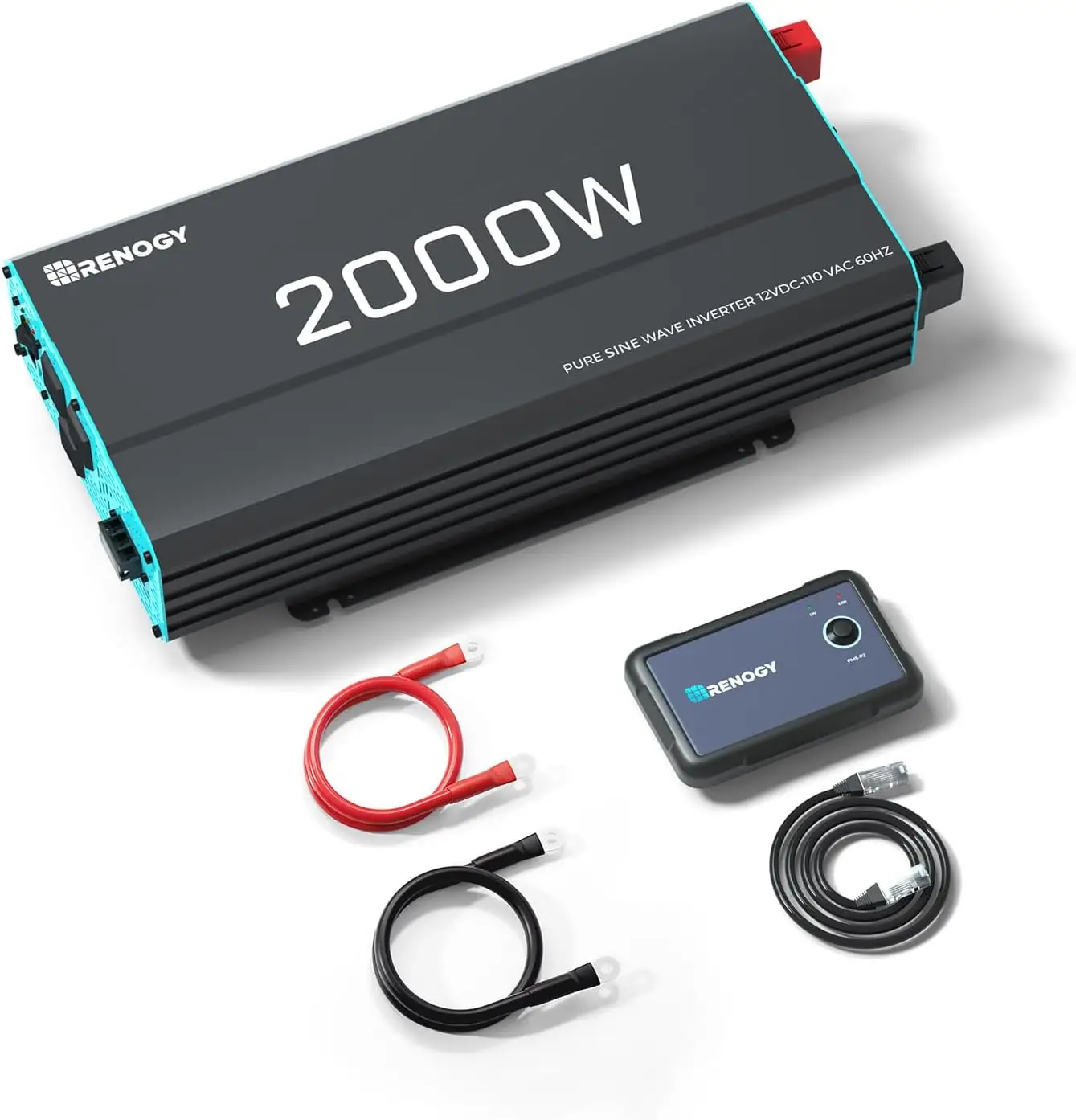
Renogy 2000 W Pure Sine Wave Inverter
Pure sine wave output at 2000 W continuous, with a higher surge rating for motor starting.
- Pure sine wave output — equipment runs as it would on mains, with no buzzing motors or misbehaving supplies.
- 2000 W continuous output — enough for fridges, power tools and a run of household electronics.
- Surge headroom for motor starting — covers the brief inrush a fridge compressor or pump draws on start-up.
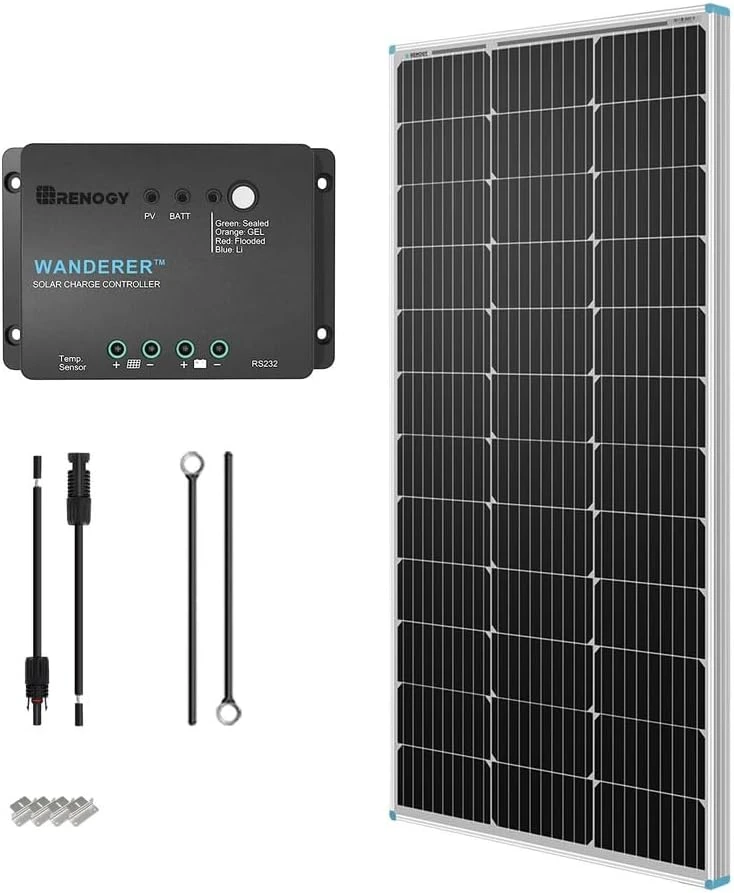
Renogy 100 W Solar Panel Starter Kit
A complete first solar kit — panel, charge controller and mounts — for off-grid and RV use.
- Everything matched in one box — panel, charge controller, mounts and cabling, so nothing is missing on install day.
- Monocrystalline panel — performs better than polycrystalline in low light and overcast conditions.
- Scales by adding identical panels — you can grow the array later without replacing the controller if it has headroom.
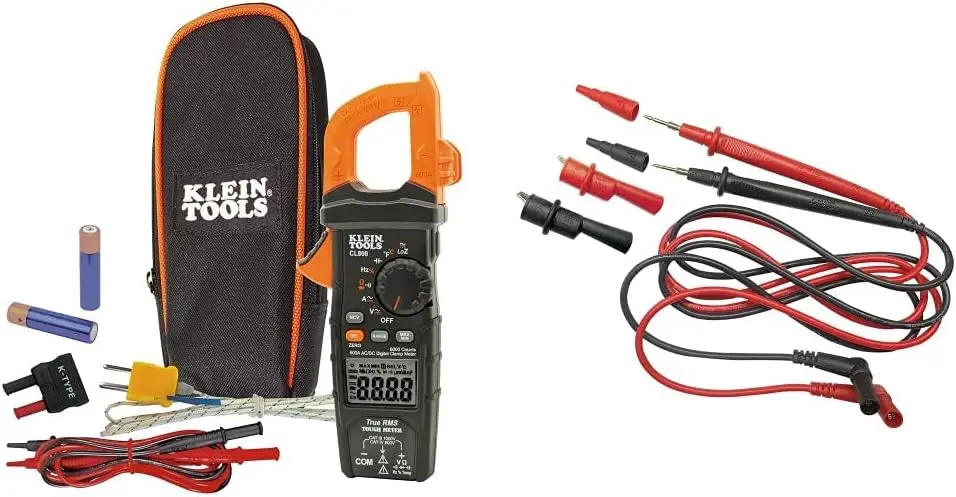
Klein Tools CL800 Digital Clamp Meter
Wide-jaw auto-ranging clamp meter with inrush capture for motor and compressor starting currents.
- Inrush current capture — see the starting surge that trips breakers, not just the running current.
- Wide jaw opening — accepts larger conductors and bundled cables that slim clamps cannot.
- Auto-ranging true-RMS measurement — fast readings you can trust on non-linear loads.