How to Choose Batteries & Power Storage
Chemistry decides everything else
Three chemistries cover almost every purchase:
- LiFePO4 — high usable capacity, long cycle life, light for its energy, and a flat discharge curve. The BMS is mandatory and the price is higher up front.
- AGM / sealed lead-acid — cheap, tolerant of abuse, heavy, and best kept above 50% depth of discharge for a decent life.
- Flooded lead-acid — cheapest per Ah, needs ventilation, watering and maintenance, and does not belong indoors without care.
Match the chemistry to the duty cycle. A battery cycled daily wants LiFePO4; one that only takes over during outages can be lead-acid and still last years.
Compare in watt-hours, then apply usable capacity
Amp-hours are only half a figure. Convert first: Wh = Ah × nominal voltage. Then multiply by the depth of discharge you are willing to use — around 50% for lead-acid, 80–90% for lithium. That second number is what you actually own.
Work the arithmetic before comparing products. The Battery Capacity Calculator converts a load profile into Ah at your system voltage, and the Battery Runtime Calculator tells you how long a given bank will carry a given load — including inverter losses.
Charge rate, cycle life and temperature
- Maximum charge current is stated on the data sheet. Lead-acid typically accepts 10–20% of its Ah rating; LiFePO4 often 0.5C. Stay below the limit and the battery runs cool.
- Cycle life is quoted at a stated depth of discharge and temperature. A figure given at 100% DoD and 25 °C will not be what you get at 40% DoD in a hot cupboard.
- Temperature is the quiet killer. Charging lead-acid below freezing damages it; lithium should not be charged below 0 °C at all. Keep banks ventilated and out of direct sun.
Series and parallel strings work, but keep cables equal in length and cells matched. A 12 V pair in series is a 24 V bank; two strings in parallel double the Ah. Neither doubles the charge current you may apply — check the pack limit.
Monitoring and charging
A shunt-based battery monitor counts what goes in and out, which is the only honest state-of-charge reading on a lithium bank — voltage alone is nearly flat across most of the curve. A smart charger or solar controller should have a proper absorption and float stage for your chemistry, and a temperature sensor where the manufacturer asks for one.
Size the charger to the bank, not to the mains circuit.
What to look for when buying
- Capacity quoted in Wh as well as Ah, with the nominal voltage stated.
- A stated maximum charge current and continuous discharge current.
- Cycle life with its depth of discharge and temperature conditions.
- A BMS with a current rating above your largest load, on lithium packs.
- Terminals and cable lugs sized for the current you will actually draw.
- A charger or controller with a profile for your exact chemistry.
VoltCalc provides educational information only and does not publish invented ratings or reviews.
Side-by-Side Worked Examples: North America (NEC) vs. International (IEC 60364 / BS 7671)
North American (NEC Article 480 / 706) Worked Example
Sizing a 48 V LiFePO₄ stationary backup bank for a 120/240 V critical-loads subpanel consuming 4.8 kWh over 12 hours (90% inverter efficiency, 80% DoD).
- Required usable & total capacity: Total DC Wh = (4,800 ÷ 0.90) ÷ 0.80 = 6,667 Wh -> 6,667 ÷ 48 = 138.9 Ah (use a 150 Ah 48 V / 7.68 kWh ESS rack).
- DC overcurrent & UL 9540 check: At peak 4,000 W draw (4,000 ÷ [48 × 0.90] = 92.6 A DC), apply NEC 125% continuous sizing (92.6 × 1.25 = 115.7 A -> 125 A DC Class T fuse / MCCB) and 2 AWG Cu battery leads.
International (IEC 62619 / BS 7671) Worked Example
Comparing 24 V Lead-Acid (AGM, 50% DoD) vs. 24 V LiFePO₄ (85% DoD) for a 230 V 50 Hz telecom backup requiring 1.5 kWh usable energy (92% inverter efficiency).
- AGM bank: (1,500 ÷ 0.92) ÷ (24 × 0.50) = 135.9 Ah -> 150 Ah AGM (~95 kg, ~400–600 cycles).
- LiFePO₄ bank: (1,500 ÷ 0.92) ÷ (24 × 0.85) = 79.9 Ah -> 100 Ah LiFePO₄ (~24 kg, >3,000 cycles) — half the weight and footprint with lower I²R losses when protected by a DC-rated 100 A isolator close to the positive terminal.
Related Calculators
Battery Capacity Calculator
Calculate required battery bank capacity in Ah and Wh for a target backup time.
Battery Runtime Calculator
Estimate how long a lead-acid or LiFePO4 battery bank will run a DC or AC load.
Solar Battery Calculator
Calculate solar battery capacity in Ah and kWh from daily load and autonomy.
Related Unit Converters
Watts to Amps Converter
Convert active power in watts (W) to current in amps (A) for DC and AC circuits.
Amps to Watts Converter
Convert current in amps (A) to active power in watts (W) for DC and AC systems.
AWG to mm² Converter (American Wire Gauge to Metric)
Convert American Wire Gauge (AWG) to metric mm² area, diameter, and resistance.
Frequently Asked Questions
Recommended Tools & Equipment for This Guide

NOCO GENIUS5 Battery Charger
A 5 A automatic charger and maintainer that can stay connected long-term without overcharging.
- Safe long-term maintenance — leave it connected through winter without overcharging the battery.
- 6 V and 12 V support — covers cars, motorcycles, ride-on mowers and most small batteries.
- Multiple chemistry profiles — charges lead-acid and lithium correctly, with the right profile for each.
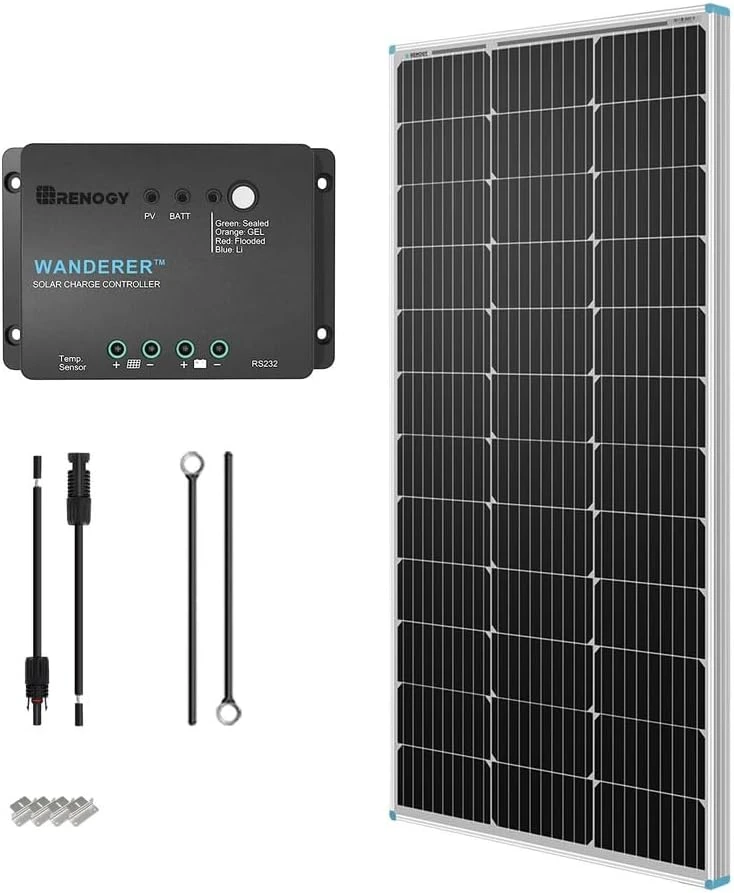
Renogy 100 W Solar Panel Starter Kit
A complete first solar kit — panel, charge controller and mounts — for off-grid and RV use.
- Everything matched in one box — panel, charge controller, mounts and cabling, so nothing is missing on install day.
- Monocrystalline panel — performs better than polycrystalline in low light and overcast conditions.
- Scales by adding identical panels — you can grow the array later without replacing the controller if it has headroom.