
Skip to content

Battery Runtime Calculator

Estimate how long a battery will run a given load.

Battery Runtime Calculator

Enter Battery Capacity, Battery Voltage, Load to see the result.

Formula

t = (Ah × V × DoD × η) ÷ Load(W)

Input definitions

InputSymbolUnitWhat it means
Battery CapacityAhAhBattery capacity in amp-hours at its rated voltage.
Battery VoltageVVThe potential difference across the circuit or component, in volts.
LoadP_loadWContinuous power drawn by the connected equipment, in watts.
Depth of DischargeDoD%Depth of discharge — the fraction of capacity you allow the battery to use.
Inverter Efficiencyη%Useful output divided by input, entered as a percentage; applies to the conversion or equipment named in the label.

Assumptions

  • The displayed formula and selected mode define the simplified model. Only the inputs shown are included; unstated installation conditions are not inferred.
  • Enter each value in the unit printed beside its input. Any conversion needed by the formula is handled as shown in the calculation steps.
  • Entered ratings, efficiencies, loads and component values are treated as constant for the operating point or time period being estimated.

Limitations

  • No code tables are applied: ampacity, derating for grouping, ambient temperature and installation method must be checked separately.
  • Harmonics, non-linear loads, motor starting current and protective-device trip characteristics are not modelled.
  • The result is a planning estimate for a single operating point, not a load study or a design verification.

Safety and code notice

Use this tool for learning and preliminary calculations. Always verify electrical designs against applicable local codes and a qualified professional. VoltCalc provides planning estimates, not code compliance — see the methodology and safety disclaimer.

How it works

Battery capacity in amp-hours multiplied by voltage gives watt-hours of stored energy. Depth of discharge limits how much of that is usable, and inverter losses reduce it further.

When to use it

Use it to size a battery bank for backup or off-grid use.

Put the numbers to work with the Battery Capacity Calculator, Inverter Size Calculator and Solar Battery Calculator.

Common mistakes

Assuming 100% of the rated capacity is usable — it is not, especially for lead-acid.

Frequently asked questions

Why limit depth of discharge?
Deep discharges shorten battery life significantly, particularly for lead-acid types.
Does temperature matter?
Yes — capacity drops in cold weather and battery life shortens in heat.

Related guides

All products →
Black NOCO Genius 5 battery charger with a mode button, charging LEDs and red and black clamps
NOCO

NOCO GENIUS5 Battery Charger

A 5 A smart battery charger and maintainer for 6 V and 12 V lead-acid and lithium batteries, with automatic charging profiles.

  • Safe long-term maintenance — leave it connected through winter without overcharging the battery.
  • 6 V and 12 V support — covers cars, motorcycles, ride-on mowers and most small batteries.
  • Multiple chemistry profiles — charges lead-acid and lithium correctly, with the right profile for each.
Pros
  • Safe to leave connected as a maintainer
  • Handles multiple battery chemistries
  • Reconditions sulphated lead-acid batteries
Cons
  • 5 A is slow to charge a deeply discharged large battery
Check PriceView details

VoltCalc may earn a commission when you buy through links on this page, at no extra cost to you. Prices and availability are shown as a guide only and may change.
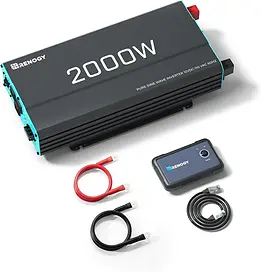
Black Renogy 2000 W pure sine wave inverter with cyan vents, remote control and battery cables
Renogy

Renogy 2000 W Pure Sine Wave Inverter

A 2000 W pure sine wave inverter that converts battery DC into clean mains AC for appliances, tools and electronics.

  • Pure sine wave output — equipment runs as it would on mains, with no buzzing motors or misbehaving supplies.
  • 2000 W continuous output — enough for fridges, power tools and a run of household electronics.
  • Surge headroom for motor starting — covers the brief inrush a fridge compressor or pump draws on start-up.
Pros
  • Pure sine wave is safe for motors and sensitive electronics
  • Surge headroom covers fridge and pump starting
  • Protections shut down cleanly instead of failing
Cons
  • Needs a substantial battery bank to deliver full output
Check PriceView details

VoltCalc may earn a commission when you buy through links on this page, at no extra cost to you. Prices and availability are shown as a guide only and may change.

VoltCalc may earn a commission when you buy through links on this page, at no extra cost to you. Prices and availability are shown as a guide only and may change.