HP to kW Converter (Horsepower to Kilowatts)
Convert mechanical horsepower (1 hp = 745.7 W), metric PS (1 PS = 735.5 W), or electrical horsepower into kilowatts (kW) and watts (W) for motors, drives, and generators.
Step-by-step calculation
- Input = 10 HP (mechanical, 1 hp = 745.7 W)
- Mechanical Shaft Power = 10 × 0.7457 = 7.457 kW (7457 W)
- Metric Horsepower Equivalent (1 PS = 735.5 W): 10.139 PS
Formula & mathematical explanation
Input definitions
| Symbol | Parameter | Unit | Engineering meaning & standards relevance |
|---|---|---|---|
| HP | Horsepower | HP | Motor or engine power rating in horsepower. |
| Type | Horsepower Standard | Selection | Select the horsepower standard printed on the equipment nameplate. |
| η | Motor Efficiency (η) | % | Keep at 100% for direct shaft power conversion, or enter motor efficiency (e.g., 90%) to compute electrical input kW. |
Horsepower (HP) to Kilowatts (kW) Conversion Table
| NEMA Horsepower (HP) | Exact Mechanical kW | Exact Watts (W) | Standard IEC Motor (kW) |
|---|---|---|---|
| 0.5 HP (1/2 HP) | 0.373 kW | 373 W | 0.37 kW |
| 0.75 HP (3/4 HP) | 0.559 kW | 559 W | 0.55 kW |
| 1 HP | 0.746 kW | 746 W | 0.75 kW |
| 1.5 HP | 1.119 kW | 1,119 W | 1.1 kW |
| 2 HP | 1.491 kW | 1,491 W | 1.5 kW |
| 3 HP | 2.237 kW | 2,237 W | 2.2 kW |
| 5 HP | 3.728 kW | 3,728 W | 3.7 / 4.0 kW |
| 7.5 HP | 5.593 kW | 5,593 W | 5.5 kW |
| 10 HP | 7.457 kW | 7,457 W | 7.5 kW |
| 15 HP | 11.185 kW | 11,185 W | 11 kW |
| 20 HP | 14.914 kW | 14,914 W | 15 kW |
| 25 HP | 18.642 kW | 18,642 W | 18.5 kW |
| 50 HP | 37.285 kW | 37,285 W | 37 kW |
Worked example
Converting a 15 HP NEMA Motor to Kilowatts
Find the shaft kW rating and estimated electrical input kW for a 15 HP three-phase motor at 91% efficiency.
- Shaft Output Power: 15 HP × 0.7457 kW/HP = 11.186 kW (nearest standard IEC frame is 11 kW).
- Electrical Input Power at 91% efficiency: 11.186 kW ÷ 0.91 = 12.29 kW.
Assumptions
- Horsepower rating represents mechanical output power at the motor or engine shaft.
- Estimated electrical input kW secondary metric assumes a typical 90% motor efficiency.
- Standard NIST / IEC conversion constants are used.
Limitations
- Across-the-line motor starting requires 3× to 6× the running kVA during acceleration unless a VFD or soft starter is used.
- Does not account for altitude or ambient temperature derating of the motor.
How it works
Multiplies horsepower by 0.745699872 kW/HP (mechanical), 0.746 kW/HP (electrical), or 0.73549875 kW/PS (metric) to give shaft output power in kilowatts, plus estimated electrical input kW at 90% motor efficiency.
When to use it
- Sizing Variable Frequency Drives (VFDs), contactors, and generators for HP-rated motors.
- Converting North American pump, fan, and compressor HP specs into SI kilowatts.
Practical real-world applications
- VFD Selection: Matching a 20 HP pump motor (14.91 kW) to a 15 kW / 18.5 kW rated variable frequency drive.
- Standby Generator Sizing: Calculating running kW and starting kVA required to start a 5 HP well pump or air compressor.
Original Editorial Review & Technical Evaluation
Translates Imperial, Electrical, and Metric horsepower ratings into kilowatts and watts, including estimated electrical input power.
Electrical engineers, HVAC/pump installers, industrial electricians, and generator specifiers.
- Supports Mechanical, Electrical, and Metric horsepower standards.
- Shows both shaft output kW and estimated electrical input kW (at 90% efficiency).
- Complete NEMA HP to IEC kW standard motor lookup table.
Accuracy & methodology: Exact NIST conversion factors.
What to verify independently: Verify motor nameplate FLA, efficiency (IE3/IE4 or NEMA Premium), and service factor.
Common mistakes
- Sizing a standby generator equal to the exact shaft kW of a motor without allowing for motor efficiency and starting inrush kVA.
- Multiplying by 1.341 instead of 0.7457 (which converts in the reverse direction).
Safety & code notice
Always verify motor locked-rotor code letters and NEC Article 430 / IEC 60947-4-1 coordination tables before sizing motor starters and short-circuit protection.
Frequently asked questions
Related Unit Converters
kW to HP Converter (Kilowatts to Horsepower)
Convert kilowatts (kW) to mechanical (HP) and metric horsepower for motor sizing.
Electrical & Thermal Power Converter (W, kW, MW, HP, BTU/hr)
Convert between watts, kilowatts, megawatts, horsepower, metric PS, and BTU/hr.
kW to Watts Converter (Kilowatts to Watts)
Convert kilowatts (kW) to watts (W), megawatts, and mechanical horsepower (HP).
Watts to Amps Converter
Convert active power in watts (W) to current in amps (A) for DC and AC circuits.
Related Calculators
Motor Power Calculator
Calculate motor shaft output power in kW and HP, speed, and full-load torque.
Motor Current Calculator
Calculate full-load motor current, speed, starting inrush, and overload trip.
Motor Sizing Calculator
Size an electric motor from load power or shaft torque with standard ratings.
Power Calculator
Calculate active, apparent, and reactive power from voltage, current, or PF.
Related Engineering Guides
Recommended Tools & Instruments
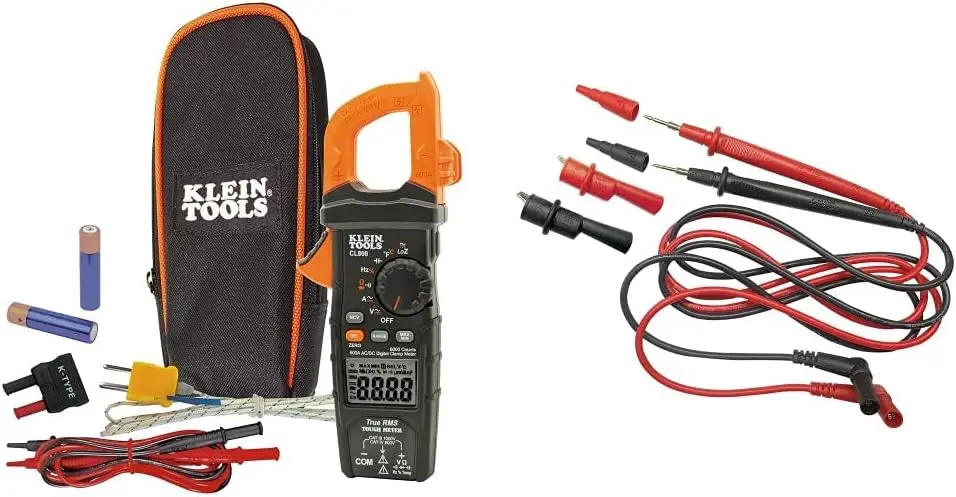
Klein Tools CL800 Digital Clamp Meter
Wide-jaw auto-ranging clamp meter with inrush capture for motor and compressor starting currents.
- Inrush current capture — see the starting surge that trips breakers, not just the running current.
- Wide jaw opening — accepts larger conductors and bundled cables that slim clamps cannot.
- Auto-ranging true-RMS measurement — fast readings you can trust on non-linear loads.
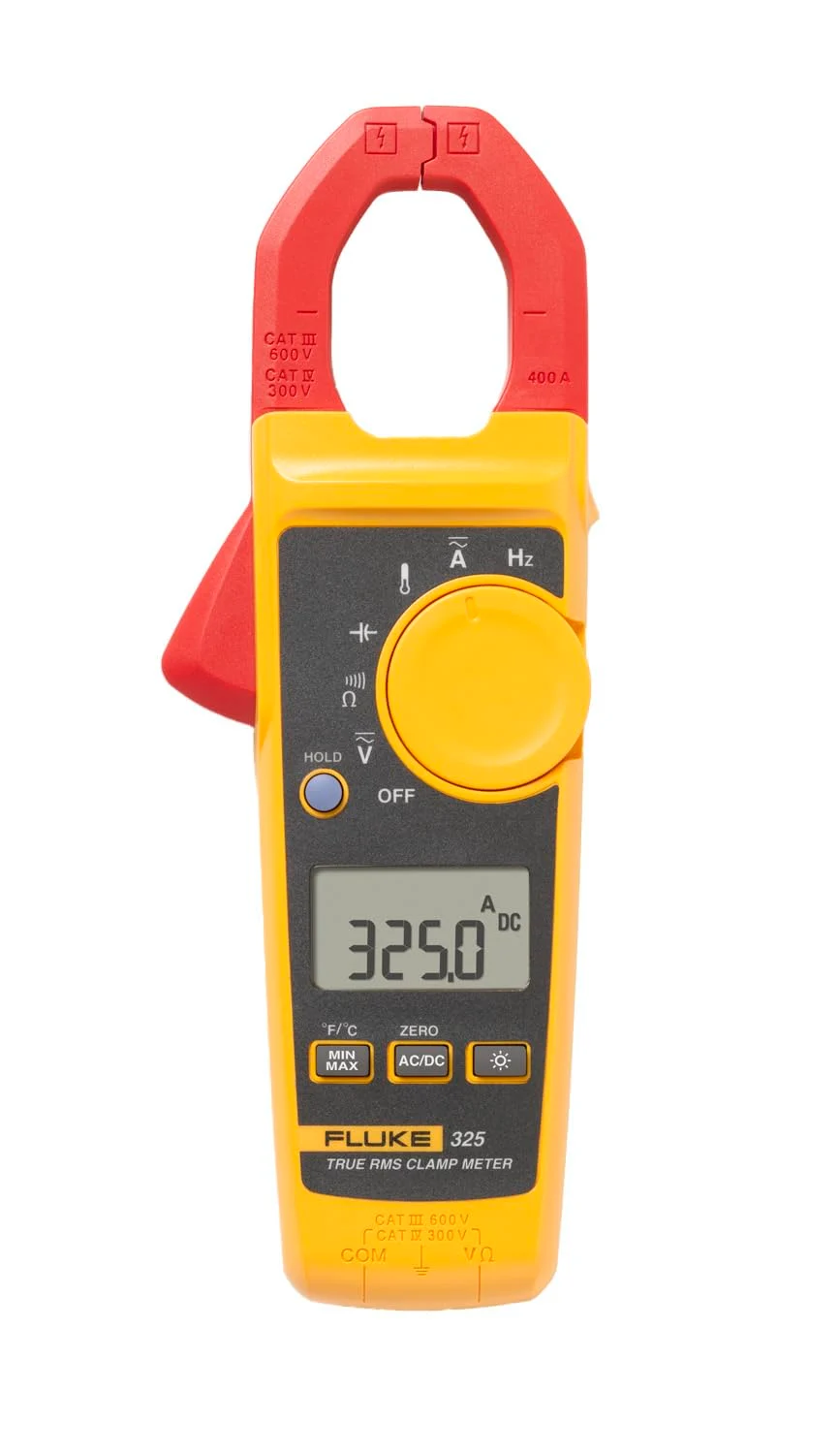
Fluke 325 True-RMS Clamp Meter
Clamp-on AC/DC current measurement in tight panels, with true-RMS accuracy and a CAT III 600 V rating.
- AC and DC current measurement — covers mains circuits, battery banks and solar strings with one tool.
- Clamp-on measurement — read current without disconnecting or disturbing the circuit.
- Slim jaw profile — slides into crowded panels where bulky clamps will not fit.
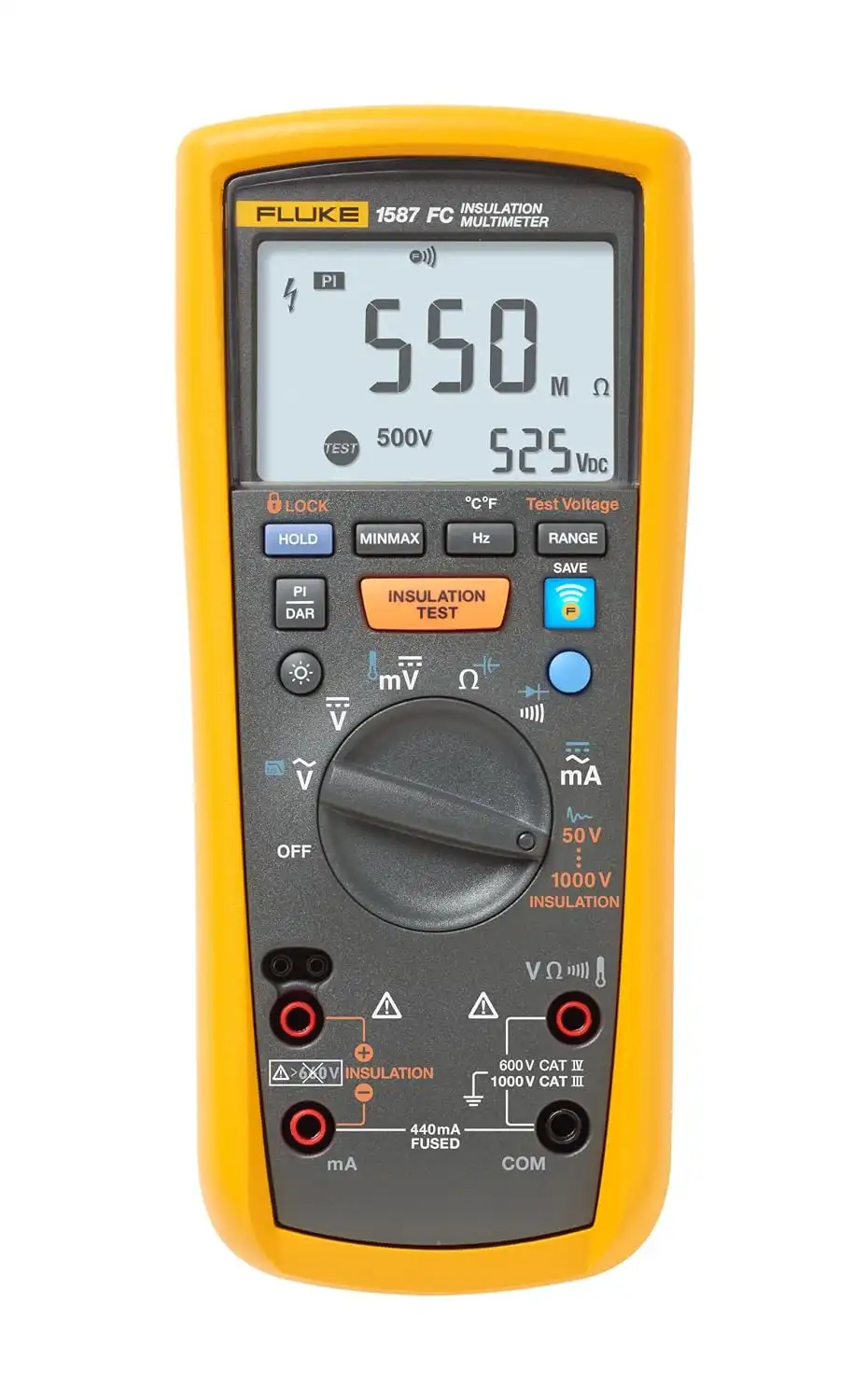
Fluke 1587 FC Insulation Multimeter
Insulation testing and full multimeter functions in one instrument, with selectable test voltages up to 1000 V.
- Insulation test voltages from 50 V to 1000 V — matches the test voltage to the equipment instead of using one fixed setting.
- Full true-RMS multimeter functions — voltage, current, resistance and continuity without a second instrument.
- Wireless result logging — builds a trend over time so you can see insulation degrading before it fails.
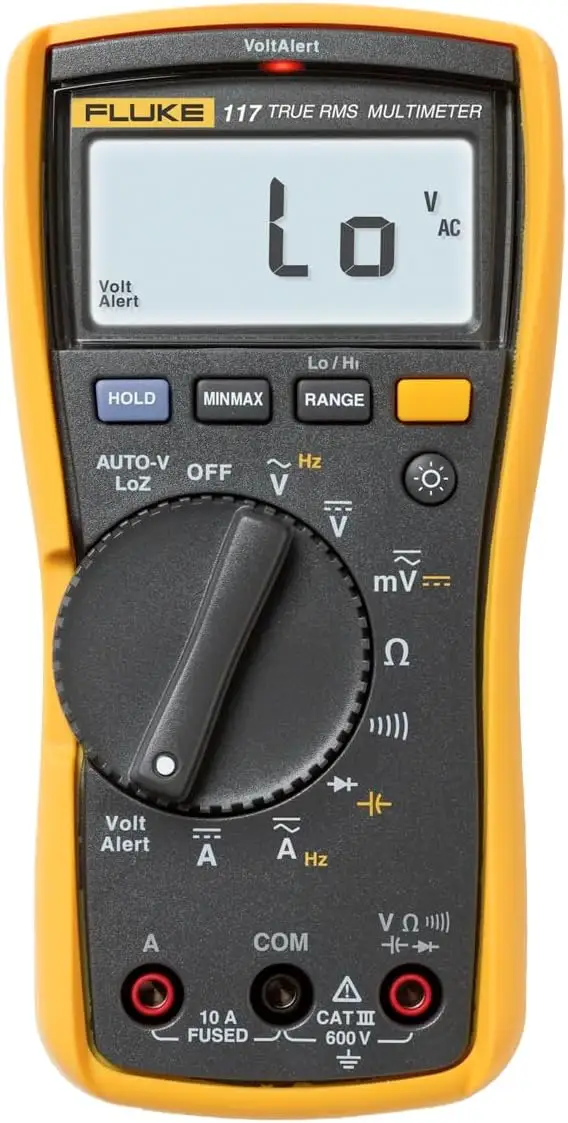
Fluke 117 True-RMS Multimeter
The everyday electrician's meter: true-RMS AC measurement, non-contact voltage detection and a CAT III 600 V rating in a compact body.
- True-RMS AC measurement — accurate readings on the electronic loads that fool cheaper average-sensing meters.
- Built-in non-contact voltage detection — confirm a circuit is live before you put a probe anywhere near it.
- CAT III 600 V safety rating — rated for the transient energy you meet in distribution panels and fixed wiring.