Three kinds of power
In AC circuits, not all the supplied power does useful work:
- Real power (W) actually performs work — turning a motor, heating an element.
- Reactive power (VAR) shuttles back and forth to build magnetic fields in motors and transformers. It does no useful work but must still be supplied.
- Apparent power (VA) is the combination of the two, and is what the cables and supply must actually carry.
Power factor defined
Power factor is the ratio of real power to apparent power:
PF = P ÷ S = cos φ
A power factor of 1 means everything supplied does useful work. A value of 0.8 means only 80% is useful, and the remaining 20% is reactive.
Why a low power factor costs money
Because apparent power determines current, a low power factor means more current for the same useful output. More current means:
- Larger cables and switchgear
- Higher I²R losses and more heat
- Reduced capacity available from transformers and generators
Utilities often charge a penalty when power factor drops below a threshold, because they must supply the extra current.
Correcting power factor
The standard remedy is to add power factor correction capacitors, which supply reactive power locally so it does not have to travel from the supply. This reduces the current drawn, freeing capacity and cutting losses.
Measuring it
Power factor is calculated from real and apparent power. In practice, a power quality analyser measures it directly, but you can compute it from a wattmeter reading and a voltage × current measurement.
Try the Power Factor Calculator to see how real and apparent power relate, and the Three Phase Power Calculator for balanced three-phase systems.
Put the numbers to work with the Power Factor Calculator and Three Phase Power Calculator. For the background behind the numbers, read Ohm's Law Explained: Voltage, Current and Resistance.
Frequently asked questions
What is a good power factor?
Can power factor exceed 1?
Related calculators
Products mentioned in this guide
All products →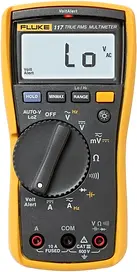
Fluke 117 True-RMS Multimeter
A true-RMS digital multimeter built for electrical work in commercial and residential settings, with non-contact voltage detection and a CAT III 600 V safety rating.
- True-RMS AC measurement — accurate readings on the electronic loads that fool cheaper average-sensing meters.
- Built-in non-contact voltage detection — confirm a circuit is live before you put a probe anywhere near it.
- CAT III 600 V safety rating — rated for the transient energy you meet in distribution panels and fixed wiring.
- True-RMS readings stay accurate on non-sinusoidal loads
- Non-contact voltage detection saves time on live circuits
- Well documented and widely supported, with parts that stay available
- No current clamp — a separate accessory is needed for high current
- Costs noticeably more than entry-level meters
- No data logging, memory or Bluetooth
VoltCalc may earn a commission when you buy through links on this page, at no extra cost to you. Prices and availability are shown as a guide only and may change.
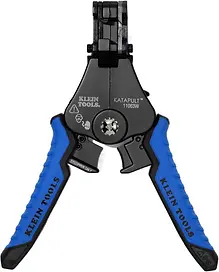
Klein Tools 11063W Wire Stripper and Cutter
A self-adjusting wire stripper and cutter that handles solid and stranded conductors from 8–18 AWG without nicking the copper.
- Self-adjusting action — squeeze once and the tool sets itself to the conductor size, so strips are repeatable.
- Clean strip without nicking — protects the copper, which is what keeps a termination reliable long term.
- Built-in cutter and plier nose — you can cut, strip and twist without swapping tools.
- Self-adjusting action is fast on repetitive work
- Clean strips without nicking conductors
- Doubles as a cutter and plier
- Bulkier than a simple stripping tool in tight boxes
VoltCalc may earn a commission when you buy through links on this page, at no extra cost to you. Prices and availability are shown as a guide only and may change.
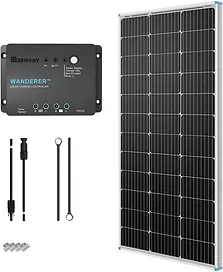
Renogy 100 W Solar Panel Starter Kit
A 100 W monocrystalline solar panel starter kit with a charge controller and mounting hardware for off-grid and RV systems.
- Everything matched in one box — panel, charge controller, mounts and cabling, so nothing is missing on install day.
- Monocrystalline panel — performs better than polycrystalline in low light and overcast conditions.
- Scales by adding identical panels — you can grow the array later without replacing the controller if it has headroom.
- Everything needed to start in one box
- Monocrystalline panel performs well in low light
- Scales by adding identical panels
- Kits are usually cheaper per watt when bought piece by piece at larger sizes
VoltCalc may earn a commission when you buy through links on this page, at no extra cost to you. Prices and availability are shown as a guide only and may change.
VoltCalc may earn a commission when you buy through links on this page, at no extra cost to you. Prices and availability are shown as a guide only and may change.
Related articles
- Ohm's Law Explained: Voltage, Current and Resistance
A plain-language introduction to the relationship that underpins almost every electrical calculation.