Electrical Frequency & Motor Speed Converter (Hz, kHz, MHz, GHz, rad/s, RPM)
Convert between Hertz (Hz), kilohertz (kHz), megahertz (MHz), gigahertz (GHz), angular frequency (rad/s), wave period (ms), and synchronous AC motor RPM.
Step-by-step calculation
- Frequency f = 60 Hz (0.06 kHz)
- Angular Frequency ω = 2 × π × 60 = 376.99 rad/s
- Cycle Period T = 1,000 ÷ 60 = 16.667 ms
- 4-Pole Synchronous Motor Speed = (120 × 60) ÷ 4 = 1800 RPM
Formula & mathematical explanation
Input definitions
| Symbol | Parameter | Unit | Engineering meaning & standards relevance |
|---|---|---|---|
| f | Frequency Value | Selection | Frequency value to convert (e.g., 50 Hz or 60 Hz mains frequency). |
| From | From Unit | Selection | Source frequency unit. |
| P | AC Motor Poles (for Synchronous RPM) | poles | Number of stator magnetic poles for synchronous AC motor speed calculation. |
50 Hz vs. 60 Hz & VFD Frequency Reference Table
| Frequency (Hz) | Angular ω (rad/s) | Period T (ms) | 2-Pole Sync RPM | 4-Pole Sync RPM | 6-Pole Sync RPM |
|---|---|---|---|---|---|
| 25 Hz (VFD 50%) | 157.08 rad/s | 40.00 ms | 1,500 RPM | 750 RPM | 500 RPM |
| 50 Hz (IEC Grid) | 314.16 rad/s | 20.00 ms | 3,000 RPM | 1,500 RPM | 1,000 RPM |
| 60 Hz (NEC Grid) | 376.99 rad/s | 16.67 ms | 3,600 RPM | 1,800 RPM | 1,200 RPM |
| 400 Hz (Avionics) | 2,513.27 rad/s | 2.50 ms | 24,000 RPM | 12,000 RPM | 8,000 RPM |
Worked example
Comparing 50 Hz (IEC) and 60 Hz (NEC) Mains Supplies
Find the angular frequency, cycle period, and 4-pole synchronous motor speed for 50 Hz and 60 Hz power grids.
- At 50 Hz: ω = 314.16 rad/s, Period T = 20.0 ms, 4-pole Sync Speed = (120 × 50) ÷ 4 = 1,500 RPM.
- At 60 Hz: ω = 376.99 rad/s, Period T = 16.67 ms, 4-pole Sync Speed = (120 × 60) ÷ 4 = 1,800 RPM.
Assumptions
- Synchronous speed Ns = 120 × f ÷ P assumes zero rotor slip (induction motors run 1%–3% slower under full load).
- ω = 2πf assumes a continuous sinusoidal waveform.
Limitations
- Operating a 60 Hz transformer on 50 Hz at the same voltage increases core flux density by 20% and can cause core saturation and overheating.
How it works
Converts between SI frequency decades (Hz, kHz, MHz, GHz), angular frequency ω = 2πf (used in inductive reactance XL = ωL and capacitive reactance XC = 1/ωC), cycle time period T = 1/f, and AC motor synchronous speed Ns = 120f/P.
When to use it
- Calculating angular frequency ω for AC reactance and impedance equations.
- Determining VFD output frequency (Hz) needed to achieve a target motor RPM.
Practical real-world applications
- VFD Pump Speed Control: Finding that a 4-pole motor runs at 1,350 synchronous RPM when driven at 45 Hz.
- Oscilloscope Timebase Verification: Converting a 16.67 ms sine-wave period into 60 Hz.
Original Editorial Review & Technical Evaluation
Converts electrical frequency across Hz, kHz, MHz, GHz, rad/s, cycle period (ms), and synchronous AC motor RPM.
Motor/VFD technicians, power engineers, and electronics students.
- Simultaneously calculates ω (rad/s), cycle period T (ms), and selectable 2/4/6/8-pole synchronous motor RPM.
- Side-by-side 50 Hz, 60 Hz, and 400 Hz reference chart.
Accuracy & methodology: Exact SI and electromechanical relationships.
What to verify independently: Measure motor shaft RPM with an optical tachometer and frequency with a True-RMS multimeter.
Common mistakes
- Forgetting the factor of 2π when plugging Hz into ω = 2πf reactance formulas.
- Using number of pole pairs instead of total poles in N = 120f ÷ P.
Safety & code notice
Never connect 60 Hz-only magnetic transformers or contactors to a 50 Hz supply without derating voltage or verifying dual 50/60 Hz nameplate listing.
Frequently asked questions
Related Unit Converters
Related Calculators
Reactance Calculator
Calculate inductive (XL) and capacitive (XC) reactance from frequency, L, or C.
Impedance Calculator
Calculate total AC impedance (Z) and phase angle from resistance and reactance.
Motor Power Calculator
Calculate motor shaft output power in kW and HP, speed, and full-load torque.
Transformer Calculator
Calculate 1-phase and 3-phase transformer kVA, full-load amps, and fault current.
Related Engineering Guides
Recommended Tools & Instruments
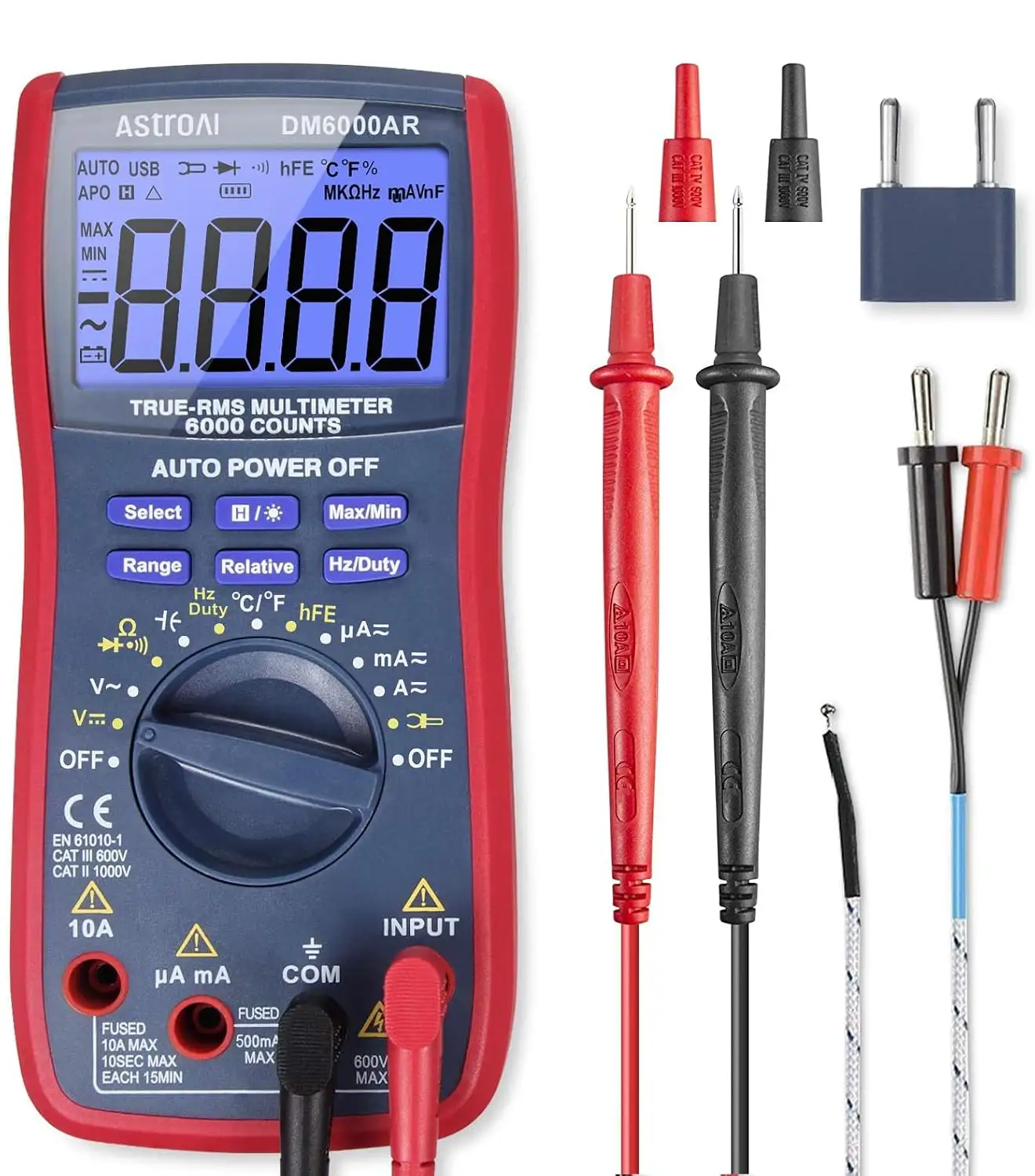
AstroAI DM6000AR True-RMS Digital Multimeter
A true-RMS 6000-count meter with temperature, capacitance and a CAT III 600 V rating — the budget option for DIY, hobby and student work.
- True-RMS AC measurement — accurate readings on the distorted, non-sinusoidal waveforms that switch-mode supplies, dimmers and inverters produce, which is where average-sensing meters quietly mislead.
- 6000-count display with 0.1 mV and 0.1 µA resolution — more resolution on low-voltage and low-current work than a typical 2000-count budget meter, so small changes are visible rather than rounded away.
- CAT III 600 V and CAT II 1000 V safety rating — rated for the transient energy of distribution panels and fixed wiring, not just bench work.
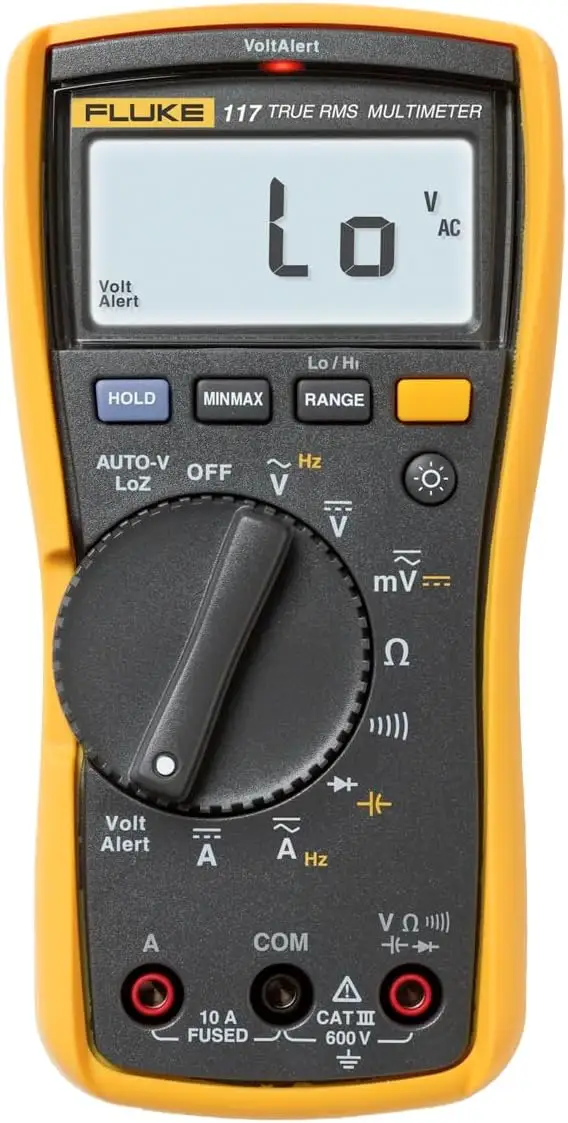
Fluke 117 True-RMS Multimeter
The everyday electrician's meter: true-RMS AC measurement, non-contact voltage detection and a CAT III 600 V rating in a compact body.
- True-RMS AC measurement — accurate readings on the electronic loads that fool cheaper average-sensing meters.
- Built-in non-contact voltage detection — confirm a circuit is live before you put a probe anywhere near it.
- CAT III 600 V safety rating — rated for the transient energy you meet in distribution panels and fixed wiring.
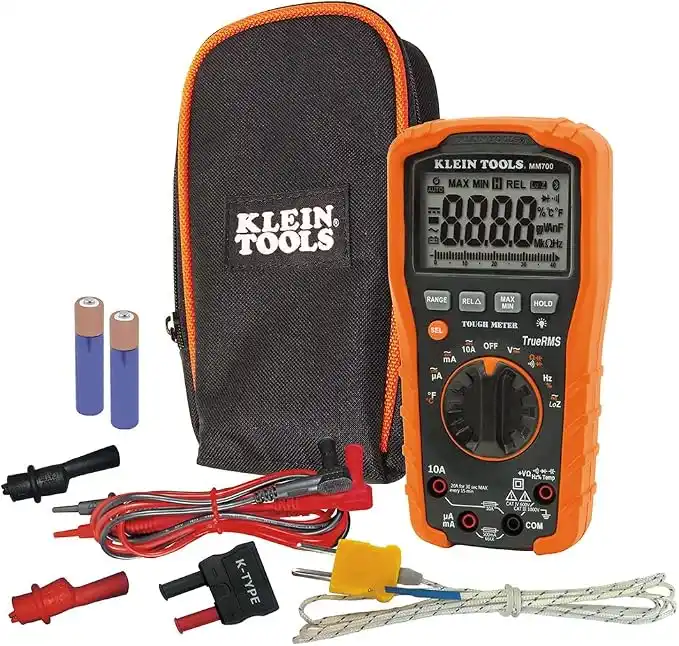
Klein Tools MM700 Auto-Ranging Multimeter
Auto-ranging true-RMS meter with a CAT IV 600 V rating and a tough, drop-tested housing.
- Auto-ranging — connect the probes and read the value, with no range dial to set first.
- True-RMS AC measurement — trustworthy numbers on drives, supplies and electronic lighting.
- CAT IV 600 V rating — the highest common safety category, covering outdoor and service-entrance work.
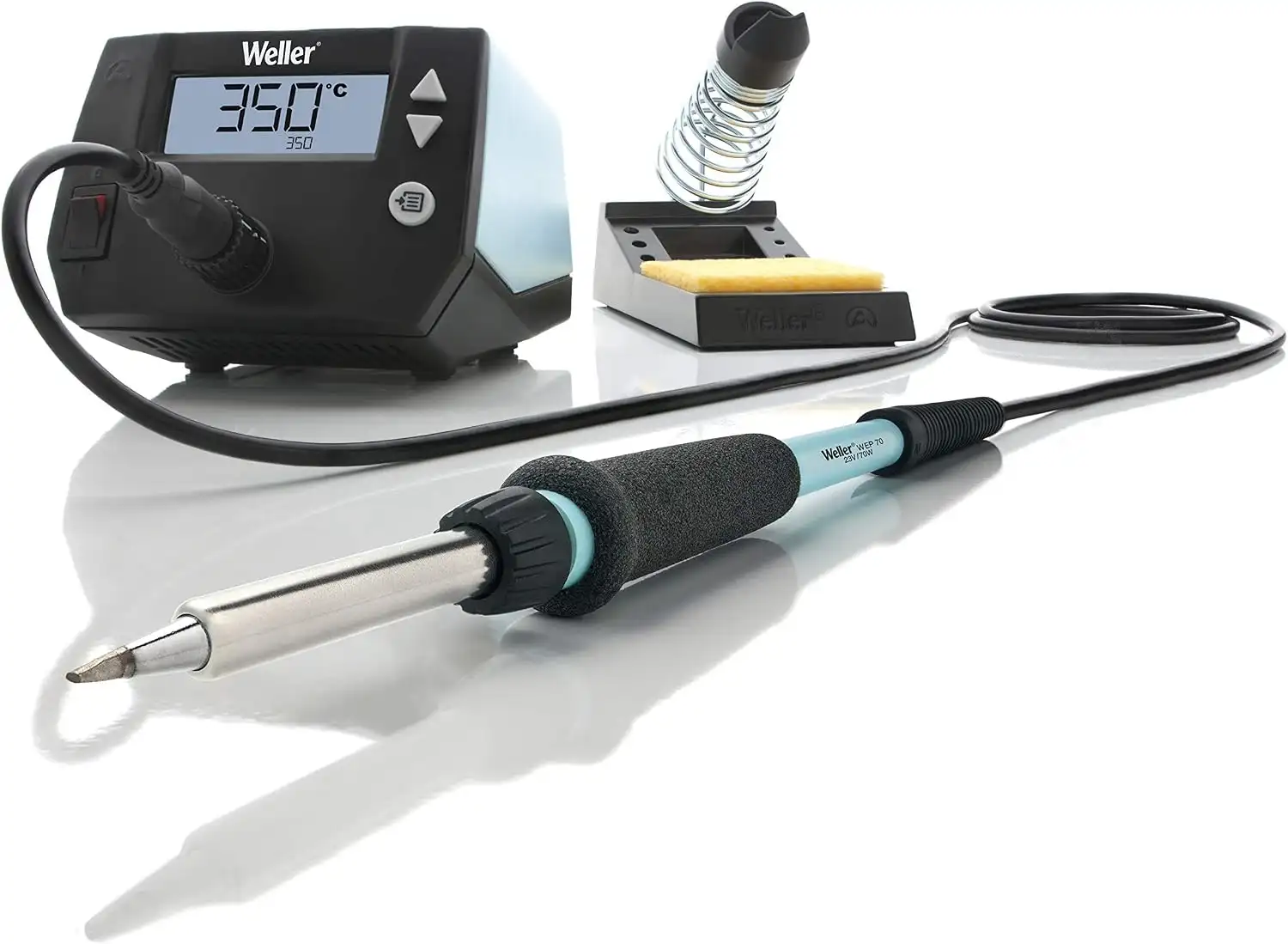
Weller WE1010NA Digital Soldering Station
A 70 W temperature-controlled soldering station with a digital readout for consistent joints.
- 70 W element — recovers heat quickly on larger joints instead of stalling mid-solder.
- Digital temperature setpoint — repeatable settings job to job, rather than a vague dial position.
- Adjustable temperature range — works for fine electronics and heavier control wiring with one station.