Work backwards from the circuit
Cable is not chosen by what looks about right on the shelf. It is chosen by working backwards from the circuit: what current will flow, how long the run is, where the cable runs, and what the wiring rules where you are require. Answer those four questions first and the cable almost picks itself.
Buying cable is one of the few places in electrical work where the cheaper option is genuinely the right one — as long as it is correctly sized. Oversizing "to be safe" wastes money and makes terminations harder; undersizing is a fire risk.
Conductor size is the number that matters
The cross-sectional area of the conductor — its gauge or millimetre-squared size — sets how much current it can carry without overheating. Two constraints apply at once, and both must pass:
- Ampacity. The continuous current the conductor can carry in its actual installation conditions.
- Voltage drop. The loss along the run, which grows with both length and current.
A cable can pass the ampacity check and still fail on voltage drop over a long run, which is why both are checked every time. The Wire Size Calculator covers the ampacity side and the Voltage Drop Calculator the other. Compare the two results and use the larger conductor.
Derating: the reason table figures mislead
The figure in a cable table assumes a set of conditions — a certain ambient temperature, a certain number of circuits, free air or a defined installation method. Change those conditions and the real capacity changes with them:
- Bundling. Several current-carrying cables grouped together cannot shed heat as easily, so each carries less.
- Thermal insulation. Cable buried in loft insulation is effectively wrapped in a blanket.
- Ambient temperature. A cable in a hot plant room or roof space starts from a higher temperature and has less headroom.
- Installation method. Clipped to a surface, in conduit, or in a wall all behave differently.
The published figure is a starting point. Applying the derating factors is what turns it into a safe number.
Voltage rating and insulation
The jacket and insulation are not cosmetic. They determine where the cable may legally be used:
- Voltage rating. Must be at least the system voltage, with margin for transients. This is printed on the cable.
- Temperature rating. Thermoplastic (PVC-type) and thermosetting (XLPE-type) insulations have different maximum conductor temperatures, which changes both ampacity and where the cable can be used.
- Mechanical protection. Armoured or steel-wire types resist damage where a cable is exposed, buried, or at risk from rodents.
- Environment. UV resistance outdoors, oil resistance in a workshop, low-smoke zero-halogen in occupied buildings and escape routes.
Solid or stranded?
Both are correct — for different jobs. Solid core is stiffer, slightly cheaper for a given size, and ideal for fixed wiring that will never move. Stranded conductors flex without cracking, and are the only sensible choice for anything pulled through conduit, connected to a machine, or repeatedly handled.
Flexible multi-strand cable is also easier to terminate neatly in a crowded panel. If you are choosing cable for a portable tool or a connection that sees vibration, stranded is not a preference — it is the requirement.
What to look for when buying
- The printed rating. Voltage and temperature rating, conductor size and standards compliance should all be legible on the jacket. Illegible or absent markings are a reason to walk away.
- Copper, not copper-coated. Aluminium conductors have their place in large service cables, but for general wiring check that the conductor is what the listing says.
- Consistent diameter. A cable that is noticeably thinner than the same nominal size from a reputable brand is worth measuring before you trust it.
- Approvals for your region. A cable listed for one market's rules may not be accepted under another's.
- Full-length reels. Reel length is worth checking; short measure is common in cheap stock.
Tools that make cable work easier
Cable work is mostly preparation, and the right hand tools turn a fiddly job into a quick one. A good wire stripper cuts insulation to depth without nicking the conductor — a nicked conductor is a weak point that fails later. For terminations, a ratcheting crimper gives a repeatable, gas-tight joint that a hand-squeezed tool cannot match.
For quick reference away from a calculator, the AWG chart converts between gauge and cross-sectional area, and the wire resistance tool shows what a given length of conductor will actually cost you in volts.
Our verdict
Choose cable in this order: current, then length, then environment, then code. Size it with the calculators, apply the derating factors honestly, and buy from a supplier whose markings you can read. Spend the extra on the tools that prepare it properly — a well-made crimp on a correctly sized cable is worth more than an oversized cable joined badly.
VoltCalc provides calculations and educational information only. Cable selection and installation must follow the wiring rules that apply where you are and be carried out or verified by a competent person.
Put the numbers to work with the Wire Size Calculator and Voltage Drop Calculator. For the background behind the numbers, read How to Size a Circuit Breaker Correctly.
Frequently asked questions
What size cable do I need for a circuit?
Is a thicker cable always better?
Can I use solid core instead of stranded?
Why does the same cable size carry less current in some installations?
Does the colour of the insulation tell me the voltage rating?
Related calculators
Wire Size Calculator
Find the minimum conductor cross-section for a given current, length, and allowable drop.
Voltage Drop Calculator
Calculate voltage drop along a conductor run for single or three-phase circuits.
Circuit Breaker Size Calculator
Calculate the recommended circuit breaker rating for a load.
Electrical Load Calculator
Calculate demand load, load current, and recommended supply size from connected load.
Products mentioned in this guide
All products →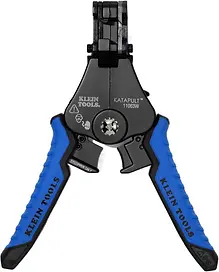
Klein Tools 11063W Wire Stripper and Cutter
A self-adjusting wire stripper and cutter that handles solid and stranded conductors from 8–18 AWG without nicking the copper.
- Self-adjusting action — squeeze once and the tool sets itself to the conductor size, so strips are repeatable.
- Clean strip without nicking — protects the copper, which is what keeps a termination reliable long term.
- Built-in cutter and plier nose — you can cut, strip and twist without swapping tools.
- Self-adjusting action is fast on repetitive work
- Clean strips without nicking conductors
- Doubles as a cutter and plier
- Bulkier than a simple stripping tool in tight boxes
VoltCalc may earn a commission when you buy through links on this page, at no extra cost to you. Prices and availability are shown as a guide only and may change.
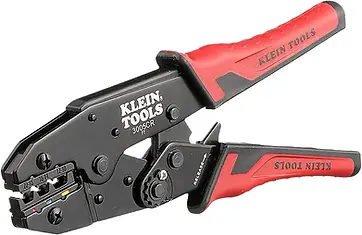
Klein Tools 3005CR Ratcheting Crimper
A ratcheting crimping tool for insulated and non-insulated terminals from 22–10 AWG, with a full-cycle release.
- Ratcheting mechanism — the tool stays locked until the crimp is fully formed, so a weak grip cannot produce a weak joint.
- 22–10 AWG range — covers the terminal sizes used in most panel and control wiring.
- Insulated and non-insulated terminals — one tool handles both, so you are not carrying two.
- The ratchet prevents half-formed crimps
- Handles both insulated and bare terminals
- Comfortable over long runs
- A single tool cannot cover every terminal type — some connectors need dedicated dies
VoltCalc may earn a commission when you buy through links on this page, at no extra cost to you. Prices and availability are shown as a guide only and may change.
VoltCalc may earn a commission when you buy through links on this page, at no extra cost to you. Prices and availability are shown as a guide only and may change.
Related articles
- How to Size a Circuit Breaker Correctly
Breaker sizing depends on the load, the cable, and the type of protection — here is how to get it right.
- Circuit Protection Basics: Breakers, Fuses, RCDs and Coordination
Overload, short circuit and earth fault are three different problems needing three different responses — here is how the devices work together.
- 100 Amp Wire Size: What Gauge You Actually Need
The conductor size for a 100 A circuit, feeder or subpanel — in AWG and mm², with the temperature, drop and derating checks that change the answer.