EV Charging Time Calculator
Work out how long an electric car takes to charge from direct kW or 1-phase/3-phase AC supply, with charger efficiency η and driving range added per hour.
Step-by-step calculation
- Net battery energy needed = 75 kWh × (80% − 20%) = 45.00 kWh
- Metered wall energy drawn (at η = 90%) = 45.00 kWh ÷ 0.9 = 50.00 kWh
- Time = 45.00 kWh ÷ (9.60 kW × 0.9) = 5.21 h (5h 12m)
Formula
Input definitions
| Symbol | Input | Unit | Meaning & code relevance |
|---|---|---|---|
| kWh | EV Usable Battery Size | kWh | Nominal energy storage rating in amp-hours (Ah) or kilowatt-hours (kWh) before applying Depth of Discharge (DoD). |
| Mode | Charger Power Input Mode | — | Active electrical or mechanical power transfer (W/kW) dissipated or delivered to the load. |
| kW | Charger Power | kW | Active electrical or mechanical power transfer (kW) dissipated or delivered to the load. |
| SoC₀ | Start State of Charge | % | Engineering input parameter for start state of charge measured in %, evaluated in real-time by the solver. |
| SoC₁ | Target State of Charge | % | Engineering input parameter for target state of charge measured in %, evaluated in real-time by the solver. |
| η | Wall-to-Battery Efficiency | % | Ratio of useful output power to total input power expressed as a percentage (η = P_out / P_in × 100). |
| Unit | Vehicle Consumption Unit (Optional Range/hr) | — | Engineering input parameter for vehicle consumption unit (optional range/hr), evaluated in real-time by the solver. |
| Eff | Vehicle Efficiency (for Range/hr) | — | Ratio of useful output power to total input power expressed as a percentage (η = P_out / P_in × 100). |
Worked example
20% to 80% Charge on 75 kWh Pack at 9.6 kW (40 A @ 240 V 1φ)
Calculate session duration and gross wall energy drawn at 90% charging efficiency.
- Net pack energy added = 75 kWh × (80% − 20%) = 45.0 kWh.
- Gross wall energy drawn = 45.0 kWh ÷ 0.90 = 50.0 kWh.
- Effective charging rate = 9.6 kW × 0.90 = 8.64 kW → Time = 45.0 ÷ 8.64 = 5.21 hrs (5h 13m).
Assumptions
- Battery capacity (kWh) represents usable net pack capacity.
- Charger power remains constant across the selected State of Charge window (typically true for AC Level 1/2 charging up to ~90% SoC).
- Charging efficiency (default 90%) accounts for onboard charger AC-to-DC conversion and thermal management.
Limitations
- DC fast charging (Level 3) follows a non-linear charging curve that tapers sharply above 80% SoC; add 20–30 minutes if DC fast charging to 100%.
- Actual AC charging speed is capped by whichever is lower: the wallbox kW rating or the vehicle’s onboard AC charger rating.
How it works
Calculates net kWh battery replenishment needed, derives AC charger kW from either direct kW, 1-phase (V × I), or 3-phase (√3 × V × I), and divides by effective charger kW accounting for onboard AC-to-DC conversion losses.
When to use it
- Estimating EV charging duration (hours and minutes) from usable battery capacity (kWh), starting/target State of Charge (SoC %), and charger power (kW).
- Comparing overnight home charging times across Level 1 (1.4 kW / 120V), Level 2 (7.4 kW 230V / 9.6 kW 240V / 11 kW 3-phase), and DC Fast Charging.
- Calculating miles or kilometers of driving range added per hour of charging.
Practical real-world applications
- Overnight Home Level 2 Planning: Verifying that a 20% to 80% daily top-up on a 75 kWh EV battery (45 kWh net) finishes within a 6-hour off-peak utility window on a 40 A (9.6 kW) charger.
- Commercial 208V vs. Residential 240V Comparison: Evaluating how a 32 A EVSE delivers 7.68 kW at 240 V vs. 6.66 kW on a 208 V commercial apartment garage feeder.
- Road-Trip DC Fast Charge Stop Estimation: Calculating 10% to 80% charge time while accounting for battery management system (BMS) thermal taper above 80% SoC.
Original Editorial Review & Technical Evaluation
Estimates Level 1, Level 2 AC, and DC Fast Charging session duration (hours & minutes) from battery pack kWh, Start-to-Target State of Charge (SoC %), charger power, and charging efficiency.
EV drivers planning overnight home vs. trip charging, fleet dispatchers scheduling depot turnarounds, and EVSE installers comparing 7.2 kW vs. 11.5 kW vs. 22 kW chargers.
- Calculates exact net energy required (Battery kWh × ΔSoC%) divided by effective wall-to-battery power
- Accounts for onboard AC rectifier efficiency (~88%–92%) and vehicle onboard-charger AC kW ceiling
- Highlights the constant-voltage (CV) taper slowdown typically occurring above 80% SoC
Accuracy & methodology: Uses an average constant-rate charging power model over the selected SoC window weighted by charger efficiency. Above ~80% SoC (and in sub-freezing battery temperatures), the vehicle BMS sharply tapers charge current, lengthening real 80%→100% completion times. Computational standards →
What to verify independently: Verify your vehicle’s onboard AC charger kW limit (e.g., 7.4 kW, 11 kW, or 19.2 kW) and DC fast-charge curve before sizing EVSE hardware.
Put the numbers to work with the kWh Calculator, EV Charging Cost Calculator and EV Range Calculator. For the background behind the numbers, read Best EV Chargers of 2026: Home & Field Guide and How to Size a Circuit Breaker Correctly.
Common mistakes
- Forgetting that 208 V commercial 3-phase wye derives 208 V line-to-line (so a 40 A Level 2 charger delivers 8.32 kW instead of 9.60 kW at 240 V).
- Ignoring the 8%–12% onboard AC-to-DC rectifier conversion loss when estimating charging duration.
- Assuming DC fast chargers maintain peak kW from 0% to 100% SoC (charging speed tapers sharply above 80% SoC to protect lithium-ion cells).
Safety & code notice
Calculator results are planning estimates. Always verify electrical designs against applicable local codes, standards (NEC / IEC), and consult a qualified professional.
Frequently asked questions
Related Calculators
kWh Calculator
Convert appliance wattage and daily hours into daily, monthly, and annual kWh.
EV Charging Cost Calculator
Calculate home and public EV charging session cost, wall kWh, and cost per mile.
EV Range Calculator
Estimate electric vehicle driving range in miles and km from usable battery kWh.
EV Charger Circuit Calculator
Size EV charger branch-circuit breakers, phase wires, and protective earthing.
Related Unit Converters
kW to Watts Converter (Kilowatts to Watts)
Convert kilowatts (kW) to watts (W), megawatts, and mechanical horsepower (HP).
Watts to Amps Converter
Convert active power in watts (W) to current in amps (A) for DC and AC circuits.
Electrical Energy Converter (kWh, Wh, Joules, kJ, MJ, BTU)
Convert electrical and thermal energy between kWh, Wh, joules, kJ, and BTU.
Electrical Length Converter (Meters, Feet, Inches, Yards, km, Miles)
Convert cable lengths between meters, feet, inches, millimeters, yards, and miles.
Related Engineering Guides
Recommended Level 2 EV Chargers, Adapters & Feeder Protection
Size continuous EVSE branch circuits at 125% of charger output, protect receptacle circuits with Class A GFCI breakers where required, and torque terminal lugs to nameplate specifications.
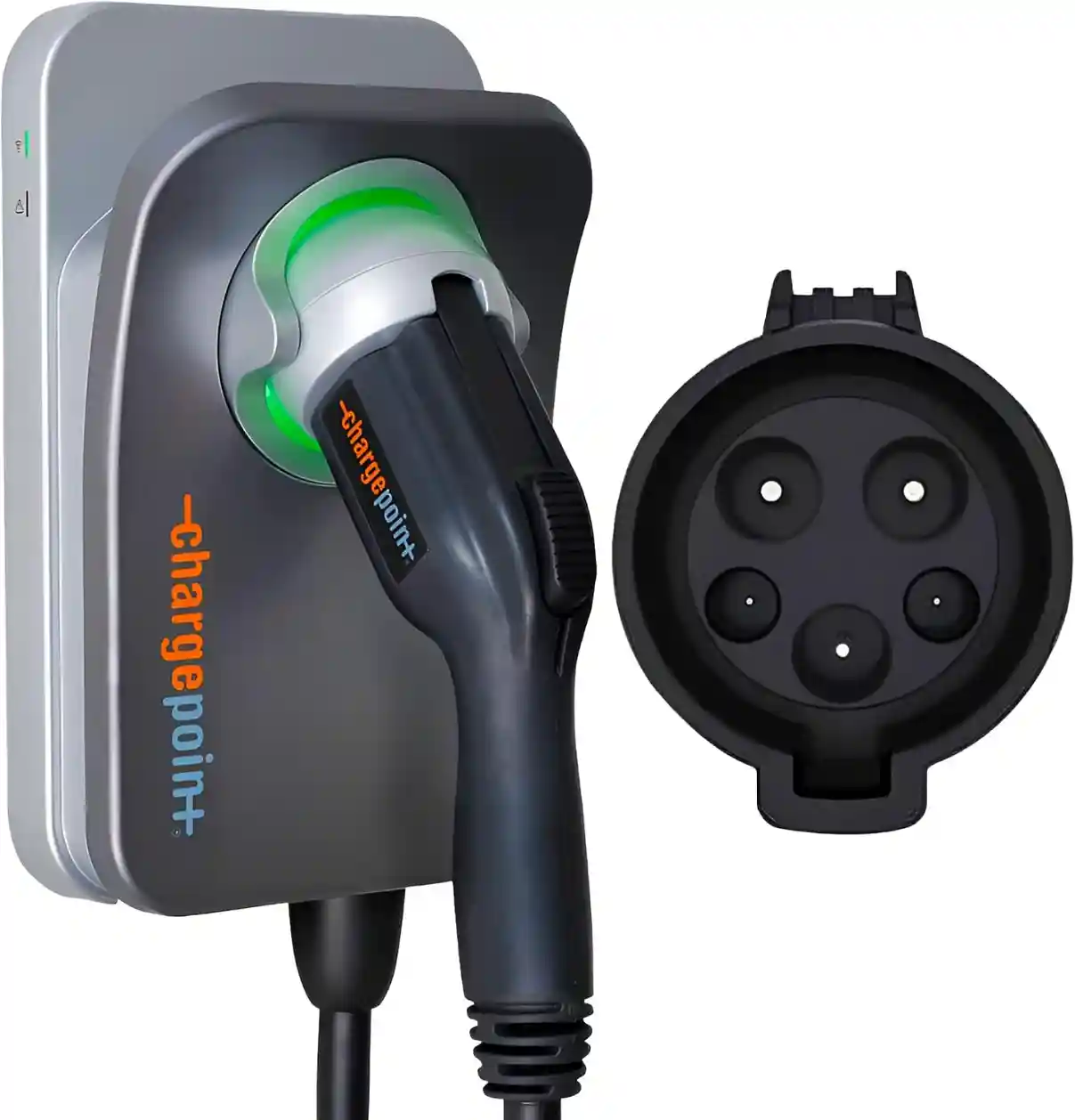
ChargePoint Home Flex Level 2 EV Charger (J1772)
Hardwired 240 V charging up to 50 A — as fast as most EVs can accept at home, with adjustable current and app scheduling.
- Up to 50 A on a hardwired 240 V circuit — around 12 kW, which adds roughly 30 to 37 miles of range per hour on an efficient EV, so an overnight charge covers the next day several times over.
- Adjustable current from 16 A to 50 A in 1 A steps — set it to match the capacity of the circuit you have, which makes an existing 240 V feed usable instead of requiring a service upgrade.
- J1772 connector — plugs directly into every non-Tesla EV; Tesla drivers use the J1772 adapter that came with the car.

EV charger adapter J1772 to Tesla
Unlocks Tesla destination chargers for non-Tesla EVs, rated up to 48 A.
- Tesla to J1772 connection — lets a non-Tesla EV use Tesla destination and home connectors.
- Rated up to 48 A — handles the full current of most destination chargers, so charging is not slowed.
- Compact and portable — small enough to keep in the car so it is there when you find a charger.
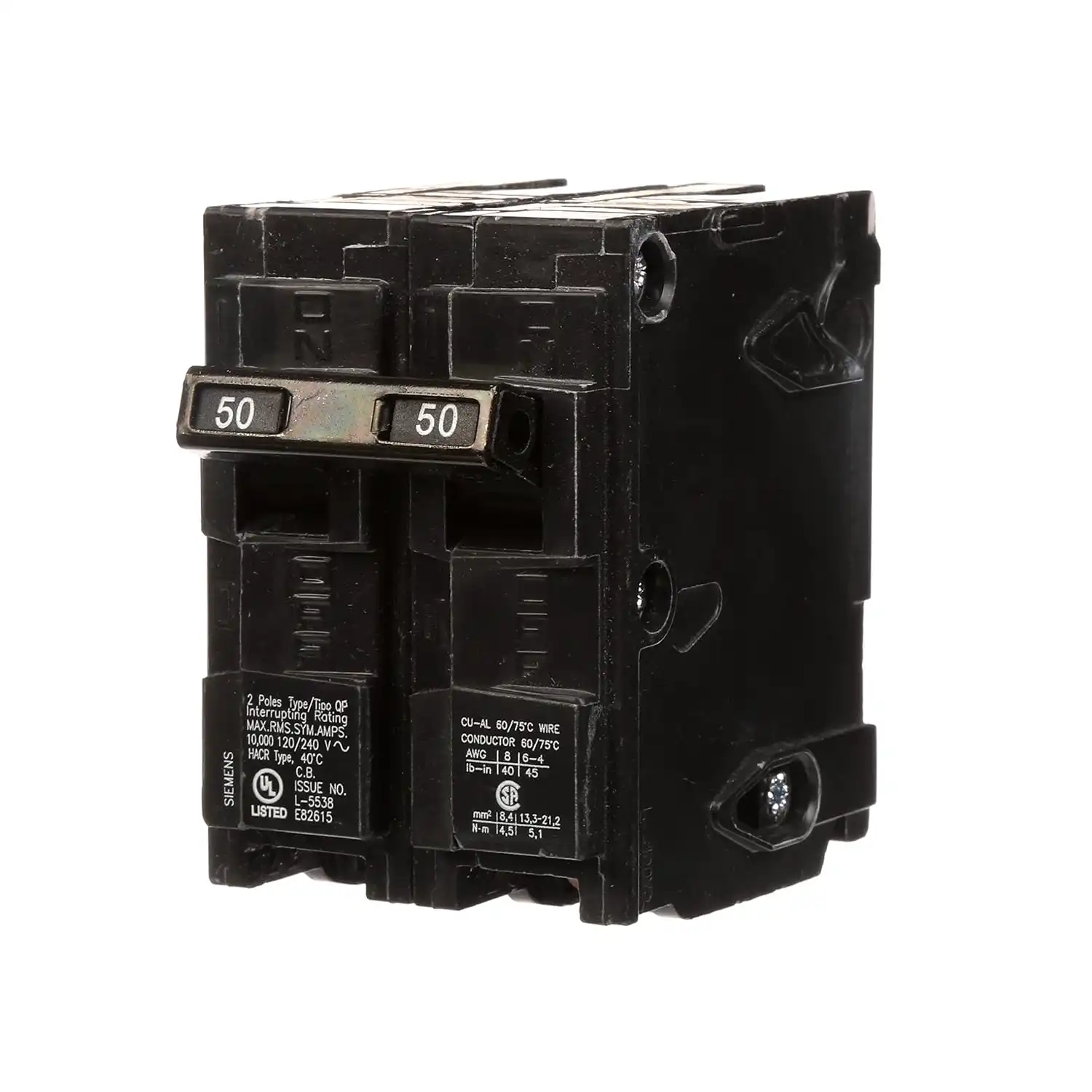
Siemens QF250A 50-Amp GFCI Circuit Breaker
A 50-amp two-pole GFCI breaker for hot tubs, pools and outdoor 240 V circuits that need ground-fault protection.
- Class A ground-fault protection — trips on a small imbalance between hot and neutral, protecting people rather than just wiring.
- 50 amps, two poles, 120/240 V — the standard feed for a residential hot tub or spa.
- Neutral pigtail and load neutral terminal — the breaker monitors the neutral so the imbalance can be measured.

Klein Tools CL800 Digital Clamp Meter
Wide-jaw auto-ranging clamp meter with inrush capture for motor and compressor starting currents.
- Inrush current capture — see the starting surge that trips breakers, not just the running current.
- Wide jaw opening — accepts larger conductors and bundled cables that slim clamps cannot.
- Auto-ranging true-RMS measurement — fast readings you can trust on non-linear loads.