ChargePoint Home Flex Level 2 EV Charger (J1772)
Hardwired 240 V charging up to 50 A — as fast as most EVs can accept at home, with adjustable current and app scheduling.
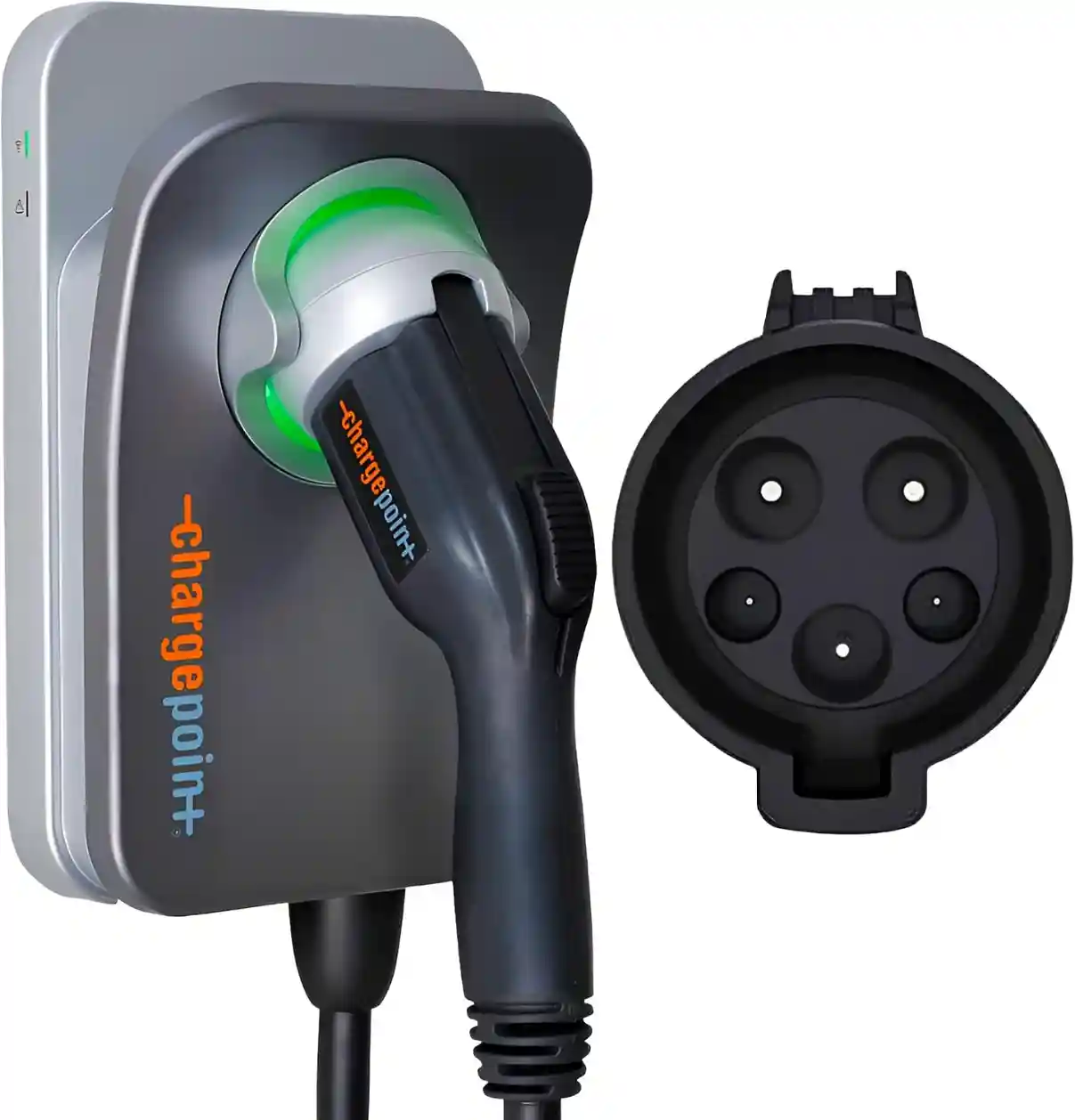
A hardwired Level 2 (240 V) home EV charger delivering up to 50 A / 12 kW through a J1772 connector, with adjustable current settings and app scheduling.
- Adjustable 16 A to 50 A (up to 12 kW)
- 23 ft cold-weather J1772 cable & holster
- Wi-Fi off-peak tariff scheduling app
Affiliate Disclosure: VoltCalc may earn a commission from qualifying purchases made through product links at no extra cost to you. Product specs and availability are for reference and may change.
Field Overview
The cable that comes with an electric car is a compromise, not a charging solution. Plugged into a normal wall socket it delivers roughly 1.2 kW, which adds only a few miles of range for every hour it is connected — fine for topping up a plug-in hybrid, hopeless for an EV that has to be ready for a commute every morning. A Level 2 charger on a dedicated 240 V circuit changes the arithmetic completely: at 50 A it delivers around 12 kW, which is more than enough to refill a typical EV overnight and often in a single evening. The ChargePoint Home Flex is built for exactly that job, with one detail that matters more than the headline figure — its current is adjustable, so it can be matched to the circuit you actually have rather than the circuit you wish you had.
Detailed Feature Breakdown
- Up to 50 A on a hardwired 240 V circuit — around 12 kW, which adds roughly 30 to 37 miles of range per hour on an efficient EV, so an overnight charge covers the next day several times over.
- Adjustable current from 16 A to 50 A in 1 A steps — set it to match the capacity of the circuit you have, which makes an existing 240 V feed usable instead of requiring a service upgrade.
- J1772 connector — plugs directly into every non-Tesla EV; Tesla drivers use the J1772 adapter that came with the car.
- Wi-Fi and the ChargePoint app — schedule charging into an off-peak tariff window, check whether the car is charging from inside the house, and get a reminder if it is left unplugged.
- 23 ft (7 m) cable with a holster — long enough to reach across a garage or down a driveway, and the holster keeps the cable off the floor instead of in a tangle.
- Rated for indoor and outdoor installation, ENERGY STAR certified — safe to mount on an outside wall, and it draws almost nothing when idle.
Performance & Practical Use
In normal overnight use the Home Flex is effectively invisible: plug in, walk away, and the car is full in the morning. Where it earns its price is the adjustable current. Many homes do not have a spare 60 A breaker slot, and a charger that can be dialled down to, say, 32 A on a 40 A circuit turns an expensive panel upgrade into a straightforward installation. Charging speed itself is often capped by the car rather than the charger — many EVs have a 7.2 kW or 9.6 kW onboard charger, so they will never draw the full 50 A, and on those cars a 40 A unit performs identically. The app is genuinely useful rather than decorative, particularly for shifting a charge into a cheap electricity window. The honest trade-offs are installation and cable weight: a hardwired unit needs an electrician and a dedicated circuit, and the heavy cable is a little more work to coil than a portable lead.
How It Compares
This is the fixed home installation — fastest, tidiest and hardwired. The J1772 to Tesla adapter is the opposite kind of tool: a small lead that lives in the car and unlocks Tesla destination chargers while you are away from home.
Pros
- Fastest home charging most EVs can use — up to 50 A / 12 kW
- Adjustable 16 to 50 A means it fits the circuit you already have
- Scheduling through the app makes off-peak charging automatic
- Long 23 ft cable reaches across a garage or driveway
- Rated for outdoor mounting and ENERGY STAR certified
Cons
- Hardwired installation needs an electrician and a dedicated 240 V circuit
- The plug-in variant is limited to 40 A, so hardwiring is required for full output
- Tesla owners need the J1772 adapter supplied with the car
- A car with a lower-rated onboard charger will not use the full 50 A
VoltCalc Verdict
Buy the Home Flex if you park in the same place every night and want charging to stop being something you think about. The 50 A output future-proofs the installation against a more demanding car, the adjustable current keeps the electrician bill sane, and the app makes cheap overnight electricity easy to use. If your EV has a 7.2 kW or 9.6 kW onboard charger, you can save money with a 40 A unit and lose nothing. And if you rent, or expect to move within a couple of years, the plug-in version is the smarter buy — a hardwired charger is a fixture you leave behind.