Best EV Chargers of 2026: Home & Field Guide
How we evaluate 2026 EVSE hardware
This 2026 update covers the EV charging hardware in the VoltCalc catalog alongside current North American and International installation rules. Everything is judged on three engineering questions: does it sustain its rated current continuously, does it match the regional connector and protection standard (North American SAE J1772 / NACS J3400 vs. International IEC 62196 Type 2), and can its current be configured to suit existing panel capacity?
Prices change constantly and vary by region, so VoltCalc never fabricates or quotes static prices. Check live availability on each product page.
Hardwired & adjustable EVSE: ChargePoint Home Flex
For a dedicated parking bay, a hardwired Level 2 EVSE remains the cleanest installation. The ChargePoint Home Flex (North America 120V/240V NEC model) supports 16 A to 50 A (up to ~12 kW at 240 V) in selectable steps, letting an electrician match the EVSE dip-switch/app limit to an existing 40 A or 50 A circuit without an expensive service upgrade.
Match your vehicle's onboard AC charger: Many EVs still cap AC intake at 7.2 kW (30 A) or 9.6–11.5 kW (40–48 A), while newer 2026 models transition natively to NACS (SAE J3400) inlets in North America or 11 kW / 22 kW 3-phase IEC 62196 Type 2 inlets across Europe, the UK, and Australia.
Connector compatibility: SAE J1772, NACS (J3400) & IEC 62196 Type 2
- North America (120/240 V 60 Hz): Vehicles use either SAE J1772 (5-pin single-phase AC) or the now-standardized NACS / SAE J3400 inlet. Adapters such as the Lectron Tesla to J1772 adapter (rated 48 A continuous AC) bridge destination AC chargers, though they never convert DC fast-charging protocols.
- International (230 V 1-ph / 400 V 3-ph 50 Hz): Public and residential AC installations use IEC 62196 Type 2 (Mennekes) untethered sockets or tethered leads, enabling up to 7.4 kW (32 A single-phase) or 11–22 kW (16 A / 32 A three-phase).
Code & protection requirements (NEC 2026 PCS vs. IEC RCDs)
- North America (NEC Article 625 & NEC 2026 Section 120.7 PCS): EVSE is a continuous load requiring 125% circuit sizing (e.g., 48 A EVSE -> 60 A OCPD & 6 AWG Cu). Receptacle-connected EVSE (such as NEMA 14-50 outlets) requires Class A GFCI protection per NEC 625.54 (a 50 A GFCI breaker for a 40 A EVSE). Where main service headroom is tight, NEC 2026 Section 120.7 Power Control Systems (PCS) allow dynamic load management (CT clamps throttling EVSE current) to prevent overloading the service bus.
- International (IEC 60364-7-722 / BS 7671 Section 722): Every AC charging point requires individual 30 mA RCD protection rated to handle DC fault leakage — either a Type B RCD or a Type A RCD paired with a 6 mA DC RDC-DD — plus PME/open-PEN fault detection in TN-C-S supplies or a local earth electrode (TT).
Side-by-Side Worked Examples: North America (NEC) vs. International (IEC 60364 / BS 7671)
North American (NEC 2023/2026) Worked Example
Installing a 48 A continuous (11.5 kW) hardwired J1772/NACS Level 2 EVSE on a 240 V split-phase dwelling panel 65 ft (19.8 m) from the garage.
- Continuous OCPD & wire size (NEC 625.40 / 625.41): 48 A × 1.25 = 60 A 2-pole breaker. Select 6 AWG Cu THHN in conduit (65 A at 75 °C; verify against NFPA 70 Table 310.16 & NEC 110.14(C) 75 °C terminals; 6 AWG NM-B at 60 °C is only 55 A and would not permit 48 A continuous). Alternatively, use NEC 2026 Sec. 120.7 PCS current monitoring if main panel demand approaches service capacity.
- Voltage drop check: On 6 AWG Cu (13.30 mm²), ΔV = 2 × 48 × (0.0175 × 19.8 ÷ 13.30) = 2.50 V (1.04%).
International (IEC 60364-7-722 / BS 7671) Worked Example
Installing a 22 kW (32 A, 400 V 3-phase) IEC 62196 Type 2 wallbox 25 m from the distribution board, clipped direct (Method C) in 30 °C ambient (C_a = 1.0, C_g = 1.0).
- Coordination & cable sizing: Dedicated 32 A 4-pole Type B (or Type A + 6 mA DC) 30 mA RCBO -> requires 6 mm² 5-core XLPE copper (typical Method C rating ~54 A ≥ 32 A, satisfying I_b (32 A) ≤ I_n (32 A) ≤ I_z (54 A); verify BS 7671 Appendix 4 Table 4Ab).
- 3-phase voltage drop & adiabatic PE: ΔV = √3 × 32 × (0.0175 × 25 ÷ 6) = 4.04 V (1.01% of 400 V). For a 1,800 A earth fault in 0.1 s (k = 143), adiabatic PE S = √(1,800² × 0.1) ÷ 143 = 3.98 mm², satisfied by a 6 mm² CPC.
Plan your circuit first
Model charging time, wire size, voltage drop, and tariff costs before ordering hardware:
Related Calculators
EV Charging Time Calculator
Estimate EV charging duration and range added per hour from battery kWh and power.
EV Charger Circuit Calculator
Size EV charger branch-circuit breakers, phase wires, and protective earthing.
EV Charging Cost Calculator
Calculate home and public EV charging session cost, wall kWh, and cost per mile.
EV Range Calculator
Estimate electric vehicle driving range in miles and km from usable battery kWh.
Related Unit Converters
Watts to Amps Converter
Convert active power in watts (W) to current in amps (A) for DC and AC circuits.
Amps to Watts Converter
Convert current in amps (A) to active power in watts (W) for DC and AC systems.
AWG to mm² Converter (American Wire Gauge to Metric)
Convert American Wire Gauge (AWG) to metric mm² area, diameter, and resistance.
Frequently Asked Questions
Recommended Tools & Equipment for This Guide
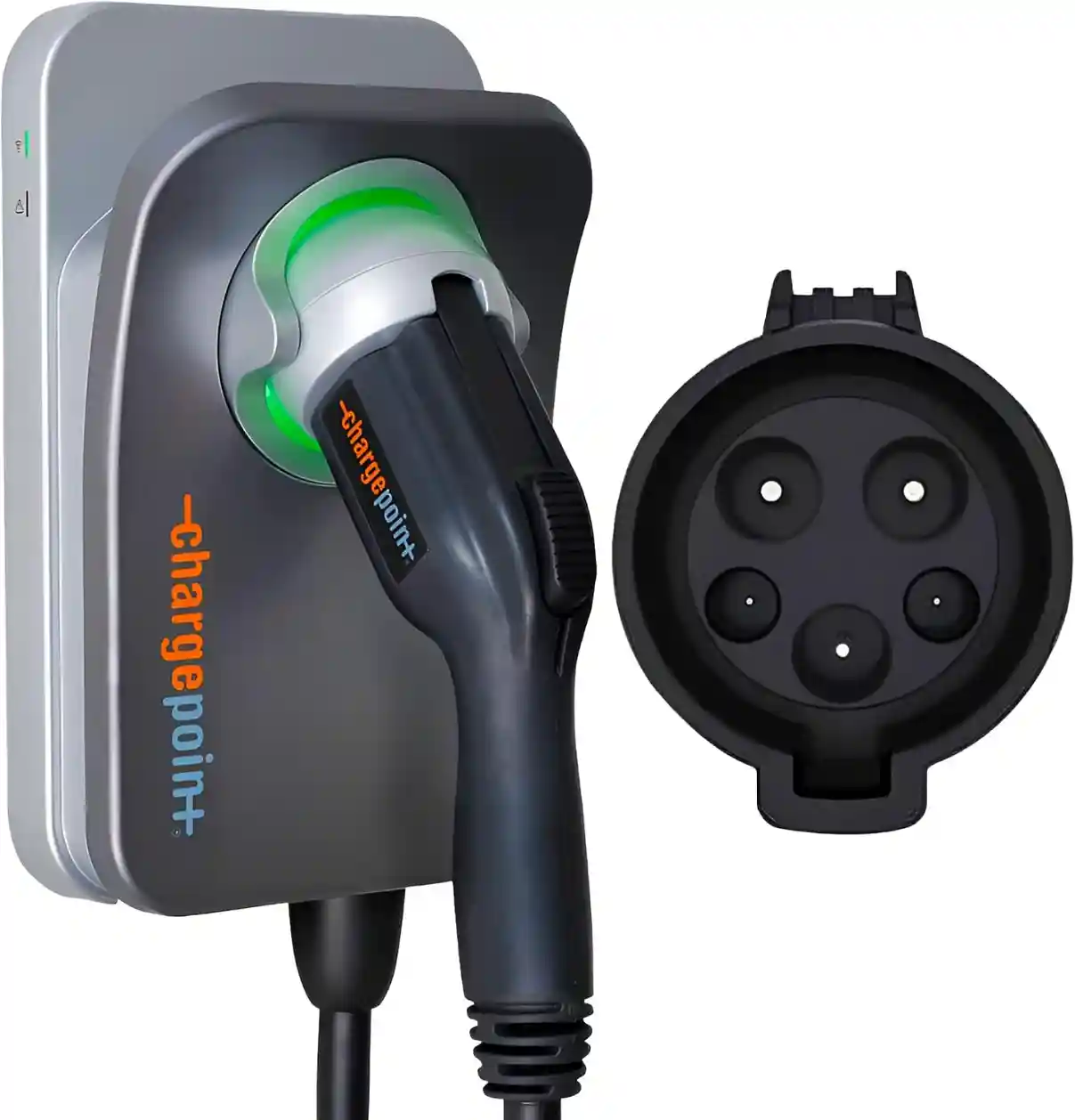
ChargePoint Home Flex Level 2 EV Charger (J1772)
Hardwired 240 V charging up to 50 A — as fast as most EVs can accept at home, with adjustable current and app scheduling.
- Up to 50 A on a hardwired 240 V circuit — around 12 kW, which adds roughly 30 to 37 miles of range per hour on an efficient EV, so an overnight charge covers the next day several times over.
- Adjustable current from 16 A to 50 A in 1 A steps — set it to match the capacity of the circuit you have, which makes an existing 240 V feed usable instead of requiring a service upgrade.
- J1772 connector — plugs directly into every non-Tesla EV; Tesla drivers use the J1772 adapter that came with the car.
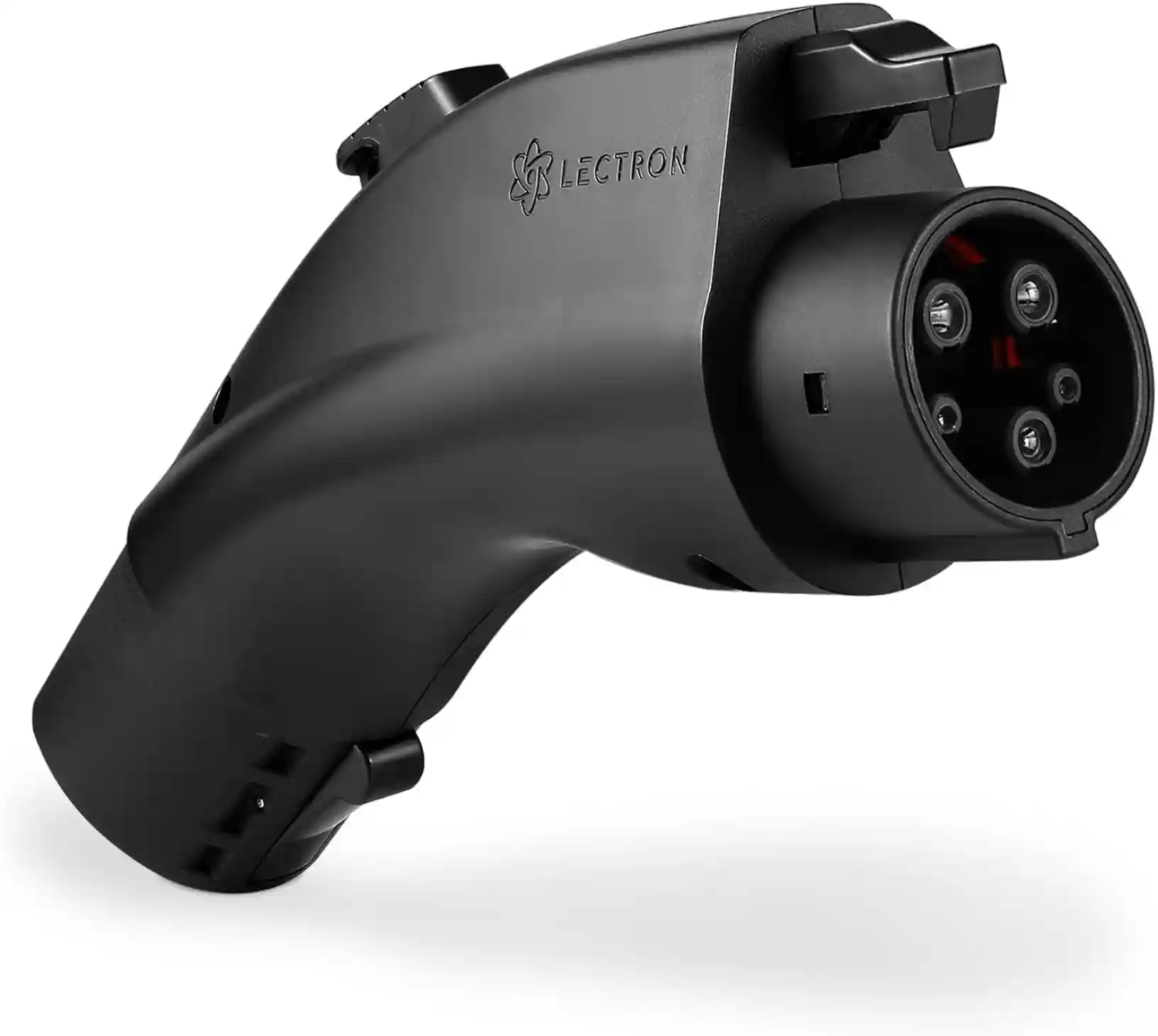
EV charger adapter J1772 to Tesla
Unlocks Tesla destination chargers for non-Tesla EVs, rated up to 48 A.
- Tesla to J1772 connection — lets a non-Tesla EV use Tesla destination and home connectors.
- Rated up to 48 A — handles the full current of most destination chargers, so charging is not slowed.
- Compact and portable — small enough to keep in the car so it is there when you find a charger.
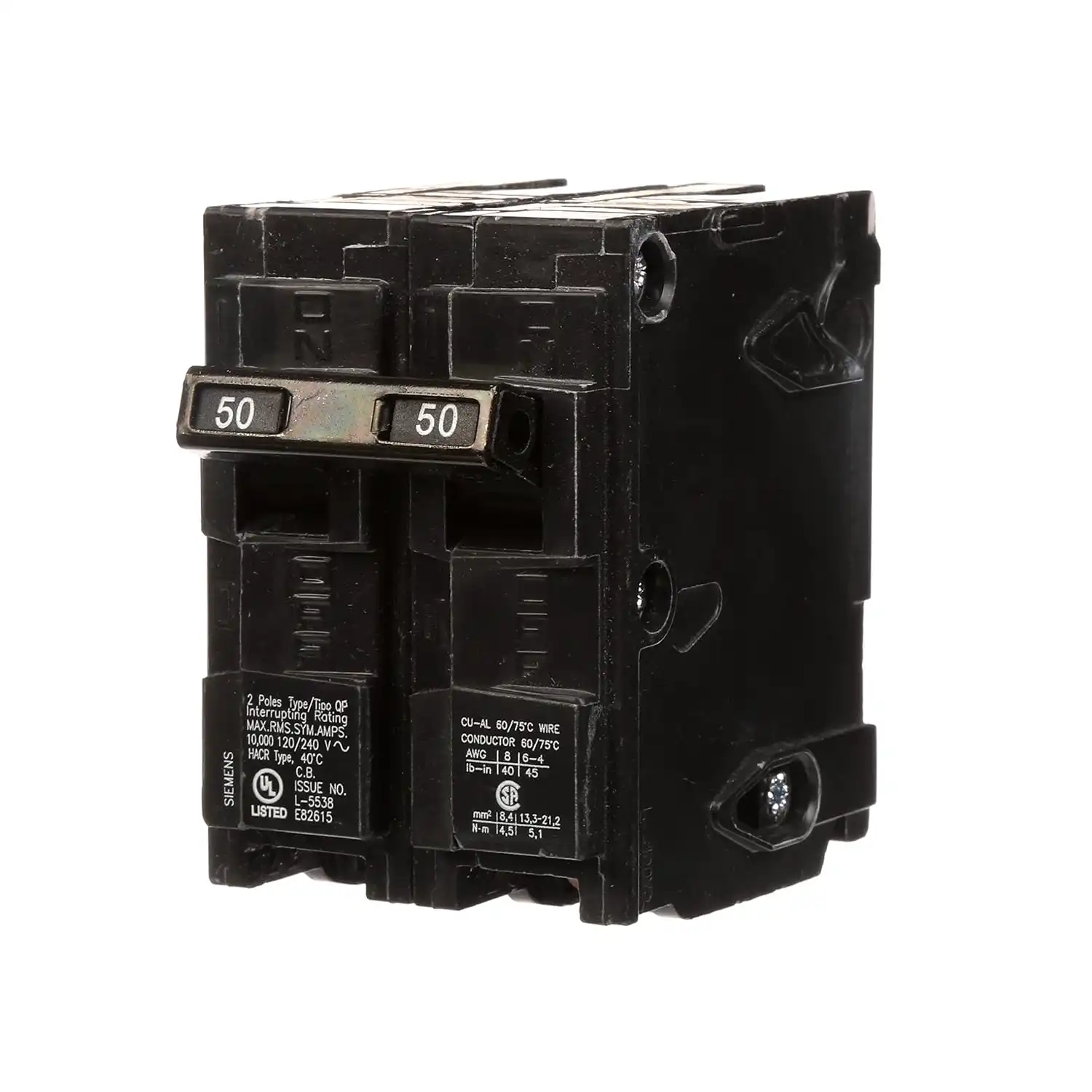
Siemens QF250A 50-Amp GFCI Circuit Breaker
A 50-amp two-pole GFCI breaker for hot tubs, pools and outdoor 240 V circuits that need ground-fault protection.
- Class A ground-fault protection — trips on a small imbalance between hot and neutral, protecting people rather than just wiring.
- 50 amps, two poles, 120/240 V — the standard feed for a residential hot tub or spa.
- Neutral pigtail and load neutral terminal — the breaker monitors the neutral so the imbalance can be measured.