How to Choose Electrical Components
The device protects the cable
The single most important idea in choosing protective devices: a breaker or fuse exists to protect the conductor and the installation, not the appliance plugged into it. Its rating is matched to the cable's current-carrying capacity in its installation conditions, which is why the cable and the device are always chosen together.
Get the order right: establish the load, size the cable for that load and its installation, then select a device that protects the cable and will disconnect the fault current in the required time. The Circuit Breaker Calculator and the Fuse Size Calculator cover the first half; the cable side is the Wire Size Calculator.
Breakers: rating, curve, poles, breaking capacity
- Rating — the continuous current the device will carry without tripping. Matched to the cable, after derating.
- Curve (B, C, D and equivalents) — how much inrush the magnetic trip tolerates. B for resistive and domestic circuits, C for motor and transformer loads, D for very high inrush such as large transformers or welders.
- Poles — one, two or three, plus switched neutral where required. Multi-phase circuits must disconnect all poles together.
- Interrupting capacity — the fault current the device can safely break. This must exceed the prospective short-circuit current at that point in the installation, which is the specification people overlook most often.
- Rated voltage and frequency — must suit the system.
A high inrush curve is only useful if the earth fault loop impedance is low enough for the device to trip within the required time. Curves and loop impedance are a pair; choosing one without checking the other is how circuits end up not disconnecting on a fault.
Fuses
Fuses remain the right answer in plenty of places: they are simple, they have a high interrupting capacity for their size, they do not suffer from mechanism wear, and they are cheap to replace. Their downsides are single use and the need to keep the correct spares on hand.
Match the fuse type, speed and breaking capacity to the circuit — a fast semiconductor fuse and a general-purpose fuse are not interchangeable. Also check the fuse holder is rated for the same breaking capacity as the fuse, otherwise the holder becomes the weak link.
Earth leakage: RCDs, GFCIs, AFCIs and RCBOs
Earth leakage devices detect current returning by an unintended path and disconnect quickly. They are the protection that saves lives on a fault to earth, and the numbers that matter are:
- Rated residual current. 30 mA is the usual figure for personnel protection; higher values protect equipment rather than people.
- Trip time. Faster is better, and the requirement varies with the device type and the standard.
- Type. Different types respond to different residual current waveforms — a DC component from a drive or a charger can blind some devices. Check the type suits the loads on the circuit.
- Selectivity. Where devices are cascaded, the upstream one must not trip before the downstream one, or you lose the whole installation for a single circuit fault.
Arc fault devices (AFCI, or the arc detection built into combined devices) add detection of the series and parallel arcing that a standard breaker or RCD will not see. They are increasingly required for socket circuits in some regions — check what applies where you are.
Matching brands, busbars and enclosures
Devices are tested as a system: the breaker, the busbar, the enclosure and the manufacturer's accessories together. That combination is what carries the declared short-circuit rating. Mixing brands may work and may not be approved — the safe route is one manufacturer's range throughout, including the busbar and the comb devices, or a written confirmation from the manufacturer that the mix is permitted.
What to look for when buying
- The device rating matched to the cable, not to the appliance.
- A curve chosen from the load and confirmed against the loop impedance.
- Interrupting capacity above the prospective fault current at that point.
- Earth leakage protection of the correct residual current and type.
- One manufacturer across devices, busbars and accessories.
- Legible markings, and certification appropriate to your region.
Our verdict
Choose the cable first, then the device that protects it, then confirm the curve and the loop impedance work together. Add earth leakage protection sized for people rather than equipment, check the interrupting capacity against the fault level, and stay within one manufacturer's system. If in doubt about the fault level or the protection settings, that is a question for a competent person rather than a catalogue.
VoltCalc provides calculations and educational information only. Protection settings and installation must follow the rules that apply where you are and be carried out or verified by a competent person.
Side-by-Side Worked Examples: North America (NEC) vs. International (IEC 60364 / BS 7671)
North American (NEC 2023/2026) Worked Example
Selecting breakers and branch components for a 120 V, 16 A continuous lab workbench receptacle run (55 ft / 16.8 m) in a commercial office.
- Breaker & AFCI/GFCI selection: 16 A × 1.25 = 20.0 A -> 20 A single-pole Combination AFCI/GFCI breaker (if required by NEC 210.8 / 210.12) rated at 10 kA AIR above the panel's fault level.
- Conductor & terminal check: Pair with 12 AWG Cu THHN (25 A at 75 °C; verify NFPA 70 Table 310.16, Table 310.15(B)(1)(1), and NEC 110.14(C) 75 °C terminal ratings; note NEC 310.12 reduced conductor rules are strictly for North American dwelling services).
International (IEC 60364 / BS 7671) Worked Example
Selecting DIN-rail components for a 230 V 50 Hz, 18 A (I_b) air-conditioning compressor circuit clipped direct (Method C) at 35 °C ambient with one adjacent circuit (C_a = 0.94, C_g = 0.80, non-normative planning defaults; verify against IEC 60364-5-52 / BS 7671 Appendix 4 Table 4Ab).
- Curve & coordination (I_b ≤ I_n ≤ I_z): Use a 20 A Type C 30 mA RCBO (C curve handles 5–10× I_n compressor inrush) with 4 mm² XLPE copper (typical Method C ~40 A × 0.94 × 0.80 = 30.1 A, satisfying I_b (18 A) ≤ I_n (20 A) ≤ I_z (30.1 A)) and ≥ 6 kA I_cn breaking capacity.
- Adiabatic PE & loop check: For a 1,200 A earth fault cleared in 0.1 s (k = 143), S = √(1,200² × 0.1) ÷ 143 = 2.65 mm² -> 4 mm² CPC, and verify measured Z_s trips the Type C magnetic element (10 × 20 = 200 A) within 0.4 s.
Related Calculators
Circuit Breaker Size Calculator
Select circuit breaker and MCB ratings for continuous loads and cable ampacity.
Fuse Size Calculator
Select UL and IEC fuse ratings for general feeders and motor branch circuits.
Electrical Load Calculator
Calculate residential and commercial service demand loads and feeder current.
Related Unit Converters
Watts to Amps Converter
Convert active power in watts (W) to current in amps (A) for DC and AC circuits.
Amps to Watts Converter
Convert current in amps (A) to active power in watts (W) for DC and AC systems.
AWG to mm² Converter (American Wire Gauge to Metric)
Convert American Wire Gauge (AWG) to metric mm² area, diameter, and resistance.
Frequently Asked Questions
Recommended Tools & Equipment for This Guide
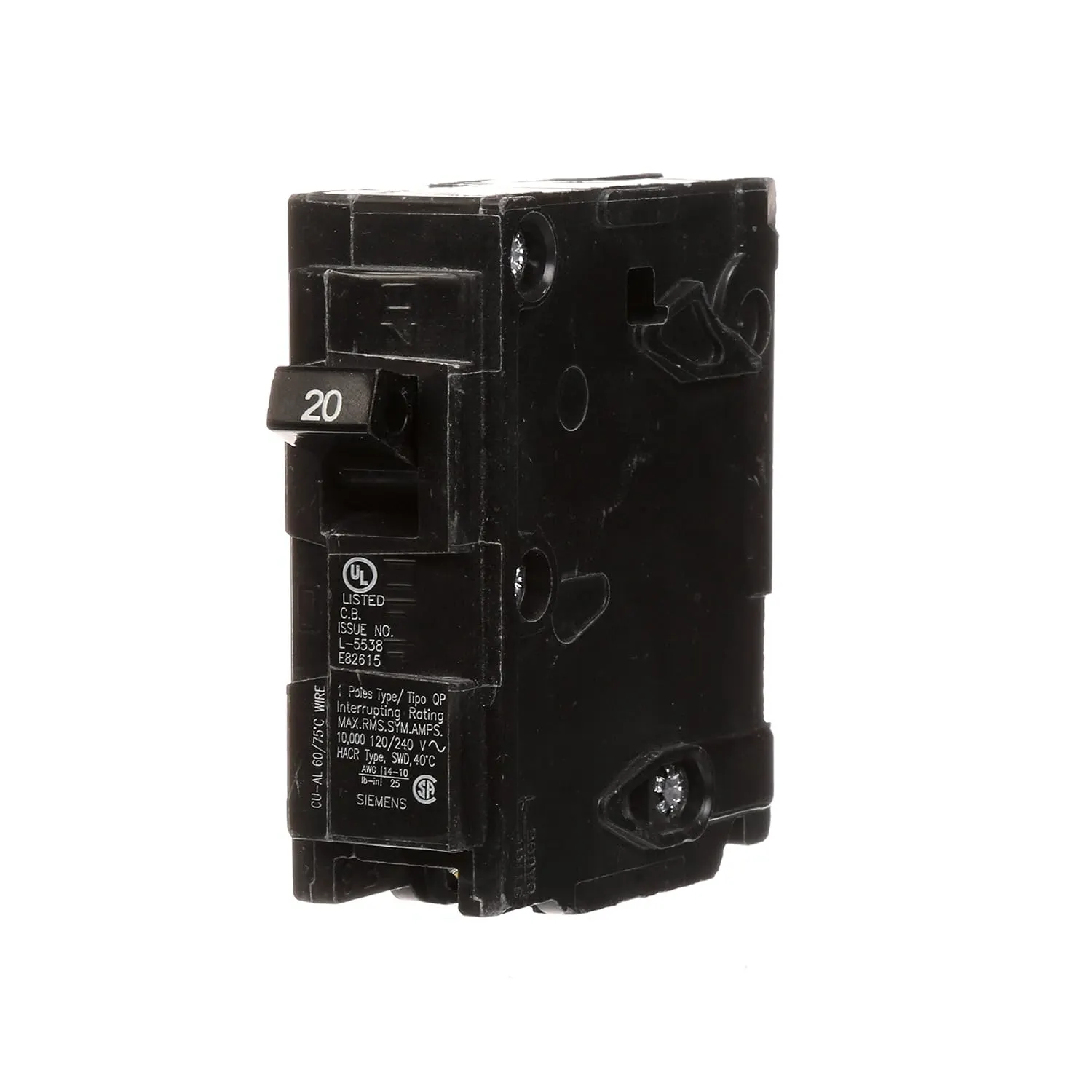
Siemens Q120 20-Amp Single-Pole Circuit Breaker
The standard 20-amp single-pole breaker for lighting, receptacles and small appliances on 120 V circuits.
- 20-amp single pole for 120 V circuits — sized for standard 12 AWG receptacle and lighting circuits.
- 10 kA interrupting rating — handles the fault current available in typical residential panels.
- SWD (switching duty) listed — approved for switching fluorescent lighting loads, not just overload protection.
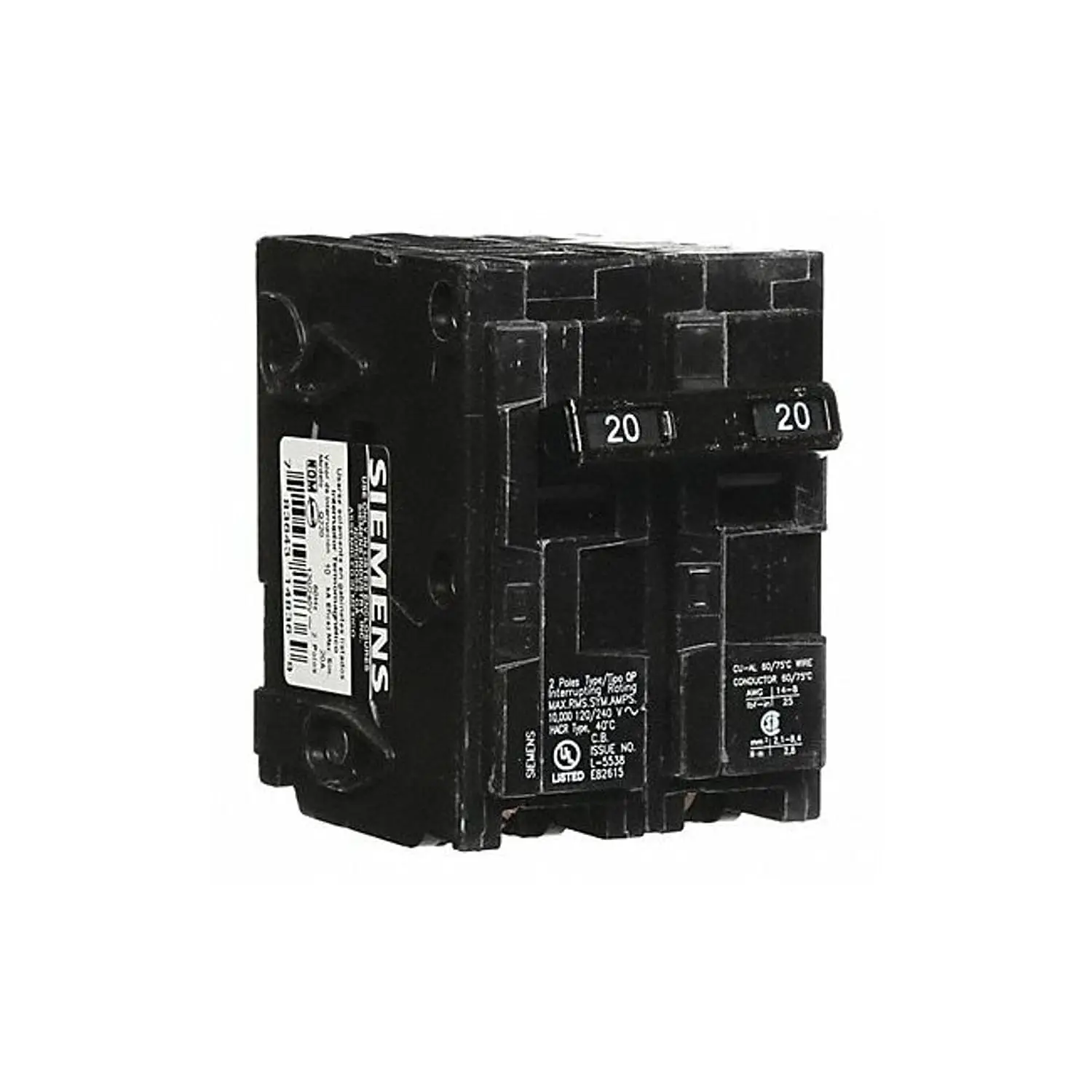
Siemens Q220 20-Amp Double-Pole Circuit Breaker
A 20-amp two-pole breaker for 240 V loads such as a small air conditioner, well pump or baseboard heater.
- 20 amps per pole at 120/240 V — supplies a 240 V load with a common-trip action.
- Common trip — both poles open together, so a fault cannot leave one leg live.
- 10 kA interrupting rating — appropriate for typical residential service fault levels.
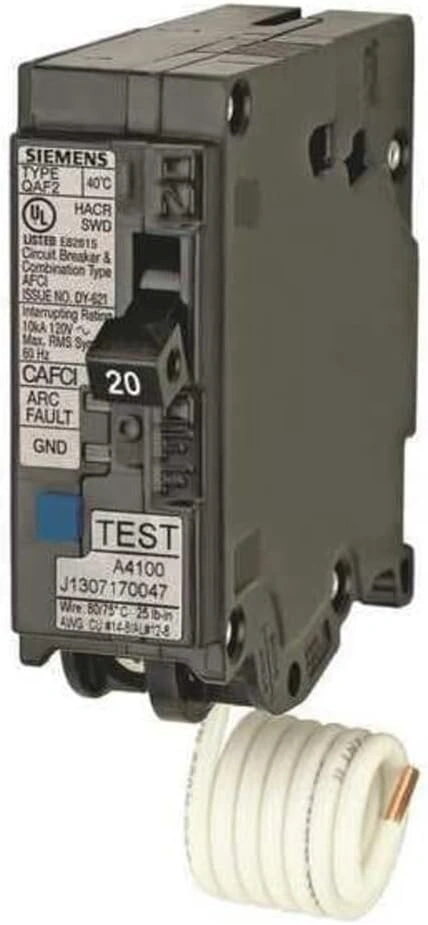
Siemens QA120AFC 20-Amp Combination AFCI Breaker
A 20-amp AFCI breaker that detects arc faults as well as overloads — required on many dwelling branch circuits.
- Combination AFCI protection — detects series and parallel arc faults, not just overloads and short circuits.
- 20 amps, single pole, 120 V — fits a standard 20-amp branch circuit with 12 AWG conductors.
- 10 kA interrupting rating and HACR listing.
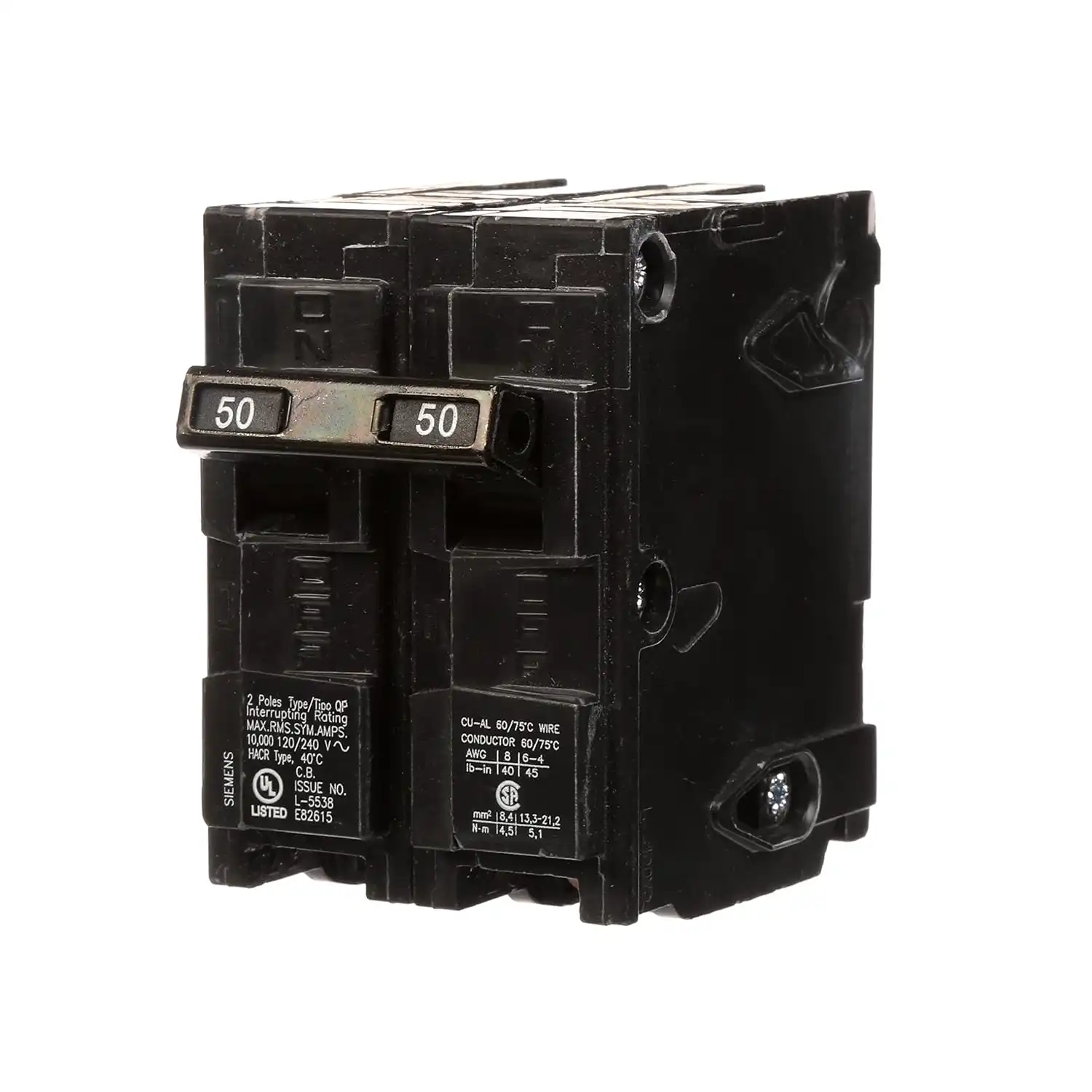
Siemens QF250A 50-Amp GFCI Circuit Breaker
A 50-amp two-pole GFCI breaker for hot tubs, pools and outdoor 240 V circuits that need ground-fault protection.
- Class A ground-fault protection — trips on a small imbalance between hot and neutral, protecting people rather than just wiring.
- 50 amps, two poles, 120/240 V — the standard feed for a residential hot tub or spa.
- Neutral pigtail and load neutral terminal — the breaker monitors the neutral so the imbalance can be measured.
Related Engineering Guides
Circuit Protection Basics: Breakers, Fuses, RCDs and Coordination
Coordinate miniature circuit breakers, fuses, and RCDs against faults and overloads.
How to Choose Cables & Wire
Select conductor sizes, insulation ratings, and cables for ampacity and drop limits.
How to Size a Circuit Breaker Correctly
Match breaker current ratings and trip curves to load demand and cable ampacity.