Siemens QA120AFC 20-Amp Combination AFCI Breaker
A 20-amp AFCI breaker that detects arc faults as well as overloads — required on many dwelling branch circuits.
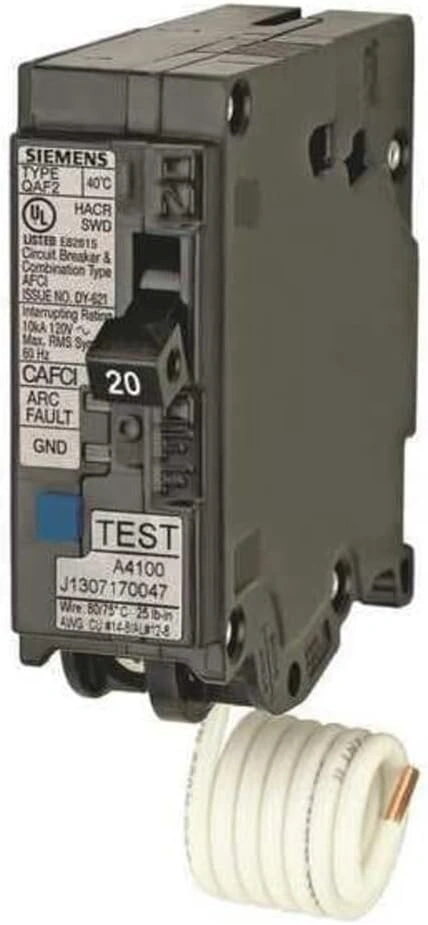
A 20-amp single-pole combination-type AFCI breaker with a 10 kA rating, for 120 V branch circuits requiring arc-fault protection.
- Detects both parallel and series arcs
- LED diagnostic indicator shows trip cause
- Meets NEC 210.12 AFCI requirements
Affiliate Disclosure: VoltCalc may earn a commission from qualifying purchases made through product links at no extra cost to you. Product specs and availability are for reference and may change.
Field Overview
An arc fault is a small, hot, sputtering discharge — often inside a damaged cable or a loose connection — that does not draw enough current to trip a normal breaker but is easily enough to start a fire. That is the failure mode AFCI protection exists to catch, and it is why so many jurisdictions now require arc-fault protection on branch circuits serving bedrooms, living areas and other dwelling space. The QA120AFC is a combination-type AFCI: it detects series and parallel arc faults as well as overloads and short circuits, in the same one-inch footprint as a standard 20-amp breaker.
Detailed Feature Breakdown
- Combination AFCI protection — detects series and parallel arc faults, not just overloads and short circuits.
- 20 amps, single pole, 120 V — fits a standard 20-amp branch circuit with 12 AWG conductors.
- 10 kA interrupting rating and HACR listing.
- Test button on the face — the required periodic function test is a press of a button.
- Pigtail neutral connection — the breaker monitors the neutral conductor as part of its detection.
Performance & Practical Use
An AFCI breaker does something you will never see working, which makes it easy to resent when it trips. And it will trip, especially on older wiring, on shared neutral circuits, or when a vacuum cleaner motor arcs at the brushes. That is the device doing its job, but it is also why nuisance tripping complaints are common. The usual culprits are multi-wire branch circuits, a neutral shared between two circuits, or an appliance with a genuinely arcing component. Work through those systematically rather than replacing the breaker with a plain one — the protection is there for a reason, and removing it is rarely acceptable.
How It Compares
The plain Q120 costs less and does the same overload job without arc detection. Where AFCI is required, the QA120AFC is not an upgrade — it is the compliant device.
Pros
- Combination AFCI covers series and parallel arc faults
- Same one-inch footprint as a standard single-pole breaker
- Simple test button for the required function check
- Meets modern dwelling branch-circuit protection requirements
Cons
- Costs several times more than a plain 20-amp breaker
- Can nuisance trip on shared-neutral circuits and older wiring
- Neutral pigtail adds a connection inside the panel
VoltCalc Verdict
If your circuit serves a sleeping area or living space and your code requires arc-fault protection, this is the correct breaker and there is no sensible alternative. Buy it and fit it properly, paying attention to the pigtail neutral and the panel neutral bar. If you are upgrading an older house, be prepared for a few nuisance trips while you track down shared neutrals — that is the price of the protection, not a fault in the breaker.