Siemens Q2100 100-Amp Double-Pole Circuit Breaker
A 100-amp two-pole breaker for feeding a subpanel or a very large 240 V load.
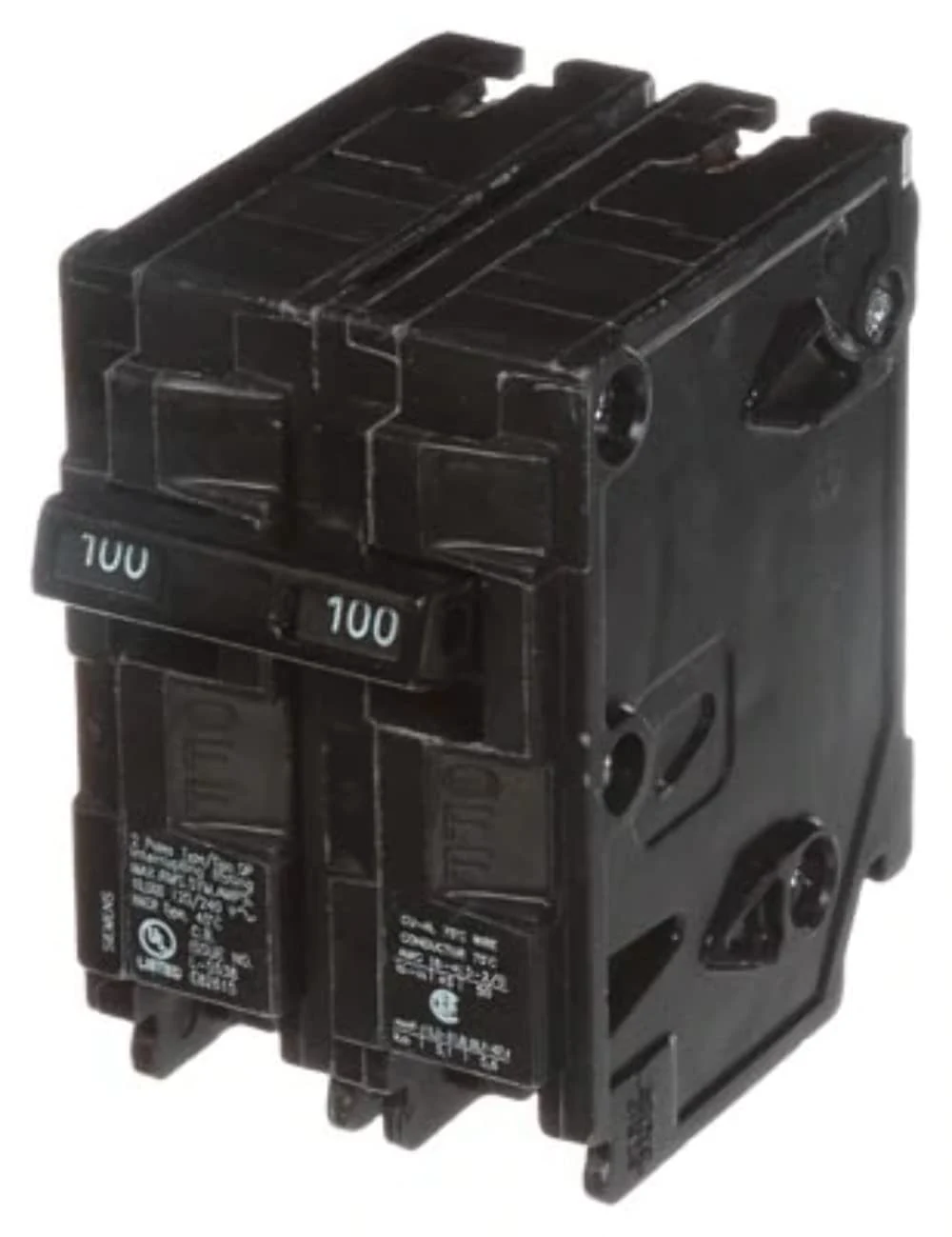
A 100-amp two-pole QP breaker for subpanel feeders and large 240 V loads, accepting conductors up to 4/0.
- 100 A 240 V heavy-duty subpanel feeder
- Box lugs accept #4 to #1/0 AWG wire
- 10 kAIC common-trip protection
Affiliate Disclosure: VoltCalc may earn a commission from qualifying purchases made through product links at no extra cost to you. Product specs and availability are for reference and may change.
Field Overview
A 100-amp breaker is not protecting a single appliance — it is protecting a feeder. In a house, that usually means a subpanel in a garage, workshop or outbuilding, or the main service disconnect in a smaller installation. That changes the job: the conductors are large, the torque values are higher, and the consequences of a bad termination are more serious. The Q2100 accepts conductors from 1 AWG up to 4/0, which is what a 100-amp feeder needs, and it uses the same two-pole QP footprint as the rest of the range.
Detailed Feature Breakdown
- 100 amps per pole at 120/240 V — sized for subpanel feeders and very large 240 V loads.
- Common trip — both poles open together, as a feeder protection device must.
- Accepts 1 AWG through 4/0 conductors, torqued to 35 or 50 lb-in depending on the conductor size.
- 10 kA interrupting rating, HACR rated, UL listed.
- Two-pole QP footprint — fits Siemens and Murray load centres with the correct busbar rating.
Performance & Practical Use
A 100-amp feeder is only as good as its terminations. Large conductors are stiff, they resist seating properly in a lug, and they are exactly where a loose connection will cook over a few years. Take the time to torque to the value printed on the breaker — 35 lb-in for the smaller range and 50 lb-in for the larger conductors — and re-check after the conductor has settled. On the load side, remember that the breaker protects the feeder, and the subpanel protects what is connected to it; both have to be sized to the conductor between them.
How It Compares
If the subpanel load is modest — a few tools and a light or two — a 60 or 70-amp feed may be enough and cheaper in cable. Run the load calculation before you commit to 100 amps of copper.
Pros
- Handles the large conductors a 100 A feeder needs
- Common trip for feeder protection
- 10 kA interrupting rating
- Same familiar QP footprint
Cons
- Large conductor terminations must be torqued correctly
- Panel busbar rating must be adequate for a 100 A branch device
VoltCalc Verdict
Buy the Q2100 when you are feeding a subpanel or a large 240 V load in a Siemens or Murray panel and the load calculation justifies 100 amps. It is a solid, straightforward device. The critical part of the job is not the breaker but the conductor sizing, the torque and the load calculation behind it — get those right and this breaker will sit quietly for decades.