
Skip to content

Klein Tools RT210 GFCI Outlet Tester

Reversed polarity is one of the most common wiring faults there is, and it is invisible in normal use — the socket works, the lamp lights, nothing seems wrong. It is also exactly the kind of fault that puts someone in danger later, because a reversed socket can leave the shell of a fixture live when it should be neutral. The RT210 finds that in seconds. You plug it into a socket and read the LED legend on the face: correct wiring, open ground, open neutral, open hot, hot and ground reversed, or hot and neutral reversed. It is the simplest way to check every outlet on a job without taking anything apart.

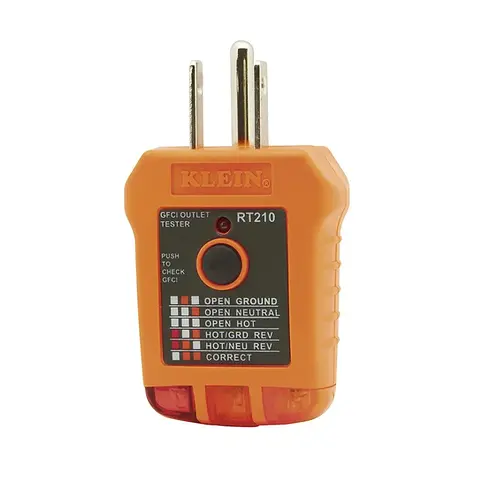
Orange Klein RT210 GFCI outlet tester with a three-prong plug and push-to-check button
Klein ToolsCable & Circuit Testers

Plug it in and the LED legend tells you the wiring fault; press the button to trip a GFCI and confirm it works.

Check the current price

The retailer sets the price and it changes often, so we link straight to the live listing rather than show a number that may be out of date.

Type
GFCI outlet tester
Checks
Open ground, open neutral, open hot, hot/ground reverse, hot/neutral reverse, correct
GFCI test
Push button
Power
None required — powered by the circuit under test

VoltCalc may earn a commission when you buy through links on this page, at no extra cost to you. Prices and availability are shown as a guide only and may change.
Key features and what they mean for you

  • Reads wiring faults from an LED legend — open ground, open neutral, open hot, hot/ground reversed and hot/neutral reversed, all identified at a glance.
  • Trips GFCI devices with a push button — confirms the device actually interrupts the circuit rather than simply being installed.
  • Three-prong plug with a two-prong adapter — reaches outlets without a ground pin in older wiring.
  • Rugged orange body with grip ridges — survives being knocked around in a tool pouch.
  • No batteries required — the tester takes its power from the circuit under test, so it is always ready.

Real-world performance

This is a tool you use constantly and never think about, which is the best kind. Plug it in, glance at the LEDs, move on — a whole room of outlets checked in a couple of minutes. The GFCI button is what separates it from a plain outlet tester: pressing it deliberately trips the device, so you find out whether the protection is actually working instead of assuming it is. The honest limit is that it reports wiring faults, not voltage or earth loop impedance, and it cannot tell you whether a ground is good or merely present. For a full picture you still need a meter and, on larger jobs, an earth loop tester.

Technical specifications

The specifications that matter when you compare the Klein Tools RT210 GFCI Outlet Tester against the alternatives.

TypeGFCI outlet tester
ChecksOpen ground, open neutral, open hot, hot/ground reverse, hot/neutral reverse, correct
GFCI testPush button
PowerNone required — powered by the circuit under test
IncludedThree-prong tester with two-prong adapter

Pros and cons

Pros
  • Identifies common wiring faults instantly from the LED legend
  • Push button trips GFCIs to prove they actually work
  • No batteries needed — powered by the circuit under test
  • Includes a two-prong adapter for older outlets
  • Very low cost
Cons
  • Reports faults only — no voltage or trip time readout
  • Cannot tell you whether a ground is good, only whether it is present
  • LED legend takes a moment to learn

Who should buy it

Checking every outlet on a job for wiring faults and confirming GFCIs trip.

Who should skip it

You want voltage and GFCI trip time displayed as numbers — that is the RT250.

How it compares

The RT210 is the straightforward fault-and-GFCI tester. The RT250 adds a screen that also reports the voltage and the trip time, which is useful when you want a number rather than a pass or fail.

Our verdict

At this price there is no reason not to own one. It catches reversed polarity, open grounds and dead GFCIs faster than any other method, and it needs no batteries so it works whenever you reach for it. Buy it for a fast check of every outlet on a job. Step up to the RT250 only if you want the voltage and GFCI trip time displayed as numbers.

Frequently asked questions

What faults does an outlet tester find?
The RT210 identifies an open ground, open neutral, open hot, a hot and ground reversal and a hot and neutral reversal, and confirms correct wiring. Those cover the faults that actually turn up in service work, and a reversed hot and neutral is the one worth catching early because a socket wired that way can leave a fixture shell live.
How do I test a GFCI with the RT210?
Plug the tester into the GFCI-protected outlet and press the button on the face. The tester deliberately creates a small leakage current to earth, which the GFCI should detect and trip. If the device does not trip, it is not providing protection and needs investigating. Reset the GFCI afterwards.
Does an outlet tester confirm the earth is good?
No. It confirms a ground is present, not that its impedance is low enough to clear a fault quickly. For that you need an earth loop impedance or ground resistance test. An outlet tester is a fast first check, not a substitute for proper testing on a new installation.

Alternatives to consider

Orange Klein ET310 circuit breaker finder with plug-in transmitter, socket adapters and case
Klein Tools

Klein Tools ET310 Circuit Breaker Finder Kit

A circuit breaker finder kit with a plug-in transmitter and a receiver that identifies which breaker feeds a socket, supplied with a light socket adapter, ground adapter and carry case.

  • Transmitter and receiver pair — plug the transmitter into the socket, then sweep the receiver across the panel to identify the matching breaker.
  • Wiring status indicator on the transmitter — the same open ground, open neutral, open hot, reversed hot/neutral and reversed hot/ground checks as a standard outlet tester.
  • GFCI test button — trips a GFCI device to confirm it is actually protecting the circuit, not just installed.
Pros
  • Identifies the correct breaker without switching circuits off
  • Includes light socket and ground adapters for older wiring
  • Transmitter also checks for common wiring faults and tests GFCIs
Cons
  • Signal can couple to adjacent breakers in crowded panels
  • Not a substitute for proving a circuit dead before working on it
Check PriceView details

VoltCalc may earn a commission when you buy through links on this page, at no extra cost to you. Prices and availability are shown as a guide only and may change.

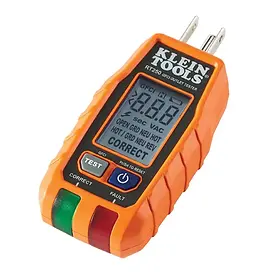
Orange Klein RT250 GFCI tester with a three-prong plug and a screen reading CORRECT
Klein Tools

Klein Tools RT250 GFCI Receptacle Tester

A GFCI receptacle tester with an LCD screen that displays the supply voltage and the time a GFCI takes to trip, alongside the standard wiring fault checks.

  • LCD screen showing the supply voltage — confirms what is actually at the outlet rather than assuming nominal voltage.
  • GFCI trip time displayed in seconds — shows how long the device took to interrupt, so a slow or marginal GFCI is visible rather than hidden.
  • Full wiring fault checks — open ground, open neutral, open hot, hot/ground reversed and hot/neutral reversed, on screen.
Pros
  • Displays the supply voltage at the outlet
  • Shows GFCI trip time in seconds
  • Full wiring fault checks on screen
Cons
  • Costs more than a plain LED outlet tester
  • Still cannot confirm ground impedance or insulation resistance
  • Screen adds bulk compared with a basic tester
Check PriceView details

VoltCalc may earn a commission when you buy through links on this page, at no extra cost to you. Prices and availability are shown as a guide only and may change.