Klein Tools MM325 Digital Multimeter
A budget meter with a trade-grade CAT III 600 V rating and a 1.5 V / 9 V battery test — the safety category is the reason to choose it.
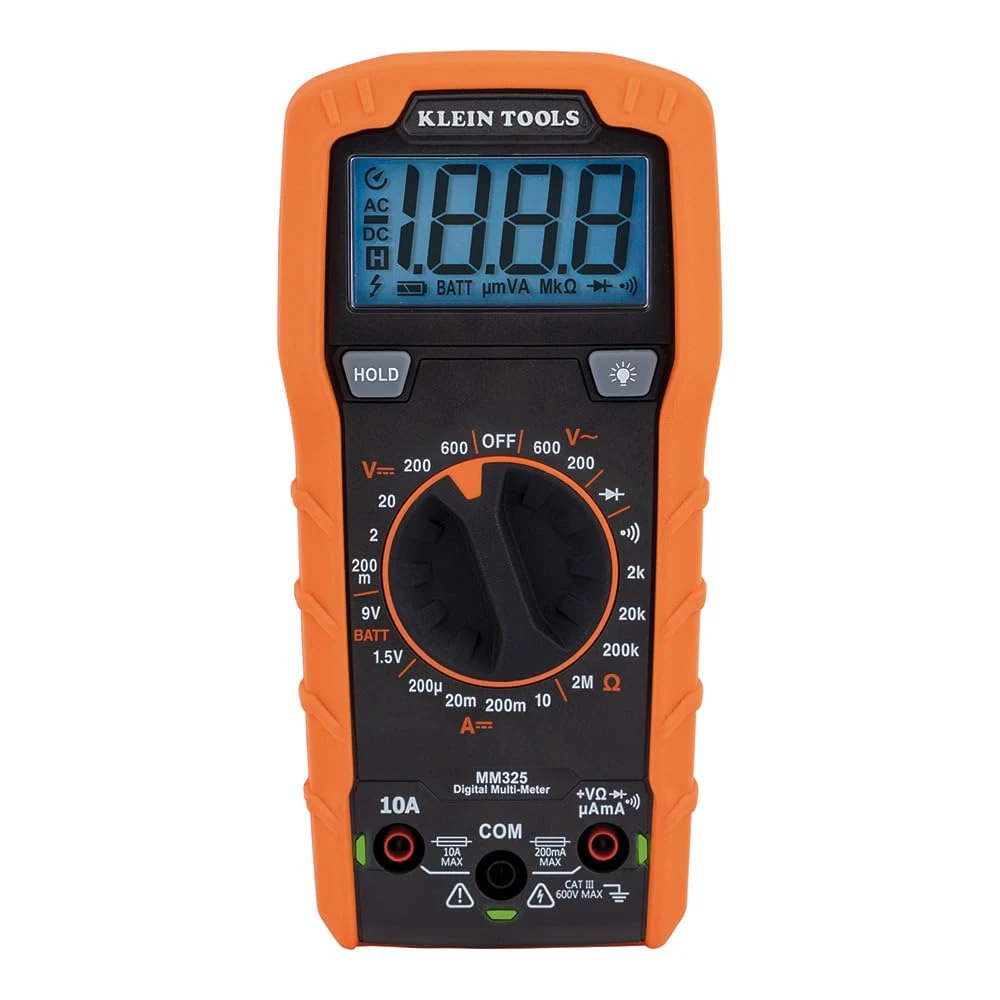
A manual-ranging digital multimeter with a CAT III 600 V safety rating, battery test, backlight and a protective rubber holster.
- Lead-alert LEDs prevent wrong jack use
- CAT III 600 V safety rating
- Tests batteries, diodes, and continuity
Affiliate Disclosure: VoltCalc may earn a commission from qualifying purchases made through product links at no extra cost to you. Product specs and availability are for reference and may change.
Field Overview
Plenty of cheap multimeters will measure voltage and resistance perfectly well. The problem is where they are allowed to do it. Almost every budget meter carries a CAT II rating, which covers appliance and socket-level testing and stops there. Step inside a distribution board — where the fault energy is far higher — and a CAT II meter is not rated for the job, whatever its display says. That is the gap the Klein Tools MM325 fills: a manual-ranging meter at a budget price that carries a CAT III 600 V rating, so it is rated for work at the panel as well as at the socket. Add a dedicated 1.5 V and 9 V battery test position and a protective rubber holster, and you have a sensible first meter for anyone who intends to work on real installation wiring rather than just test a few batteries.
Detailed Feature Breakdown
- CAT III 600 V safety rating — rated for measurement at the distribution board and on fixed installation wiring, not just at sockets and appliances. This is the feature that separates it from cheaper meters.
- Manual ranging with 200 Ω to 2 MΩ resistance ranges — five resistance ranges plus 200 mV to 600 V DC, 200 V and 600 V AC, and DC current to 10 A.
- Dedicated battery test positions — separate 1.5 V and 9 V settings with a load applied, so the reading tells you the state of the battery rather than just its open-circuit voltage.
- Continuity buzzer and diode test — an audible tone makes checking fuses, switches and cable runs quick, without looking at the display.
- Backlight and data hold — read a value in a dark cupboard or consumer unit, and freeze it while you write it down.
- Protective rubber holster with grip ridges — the orange sleeve absorbs knocks and gives the meter a secure grip with gloves on.
- 10 A fused current input — measures DC current to 10 A through the separate 10 A jack, with the mA/µA jack limited to 200 mA.
Performance & Practical Use
For everyday fault-finding the MM325 does the job cleanly. Continuity beeps loudly and unmistakably, resistance readings are stable enough to identify an open element or a shorted switch, and the battery test positions are more useful than they sound — a 9 V battery that reads 9 V open-circuit but collapses under load is exactly the fault this function catches. The holster is genuinely protective rather than decorative, and the backlight earns its place in a dark consumer unit. The honest limitations are those of any manual-ranging, average-sensing meter. You choose the range yourself, so a wrong selection shows an overload indication rather than a reading. AC measurement is average-sensing, so distorted waveforms from dimmers and switch-mode supplies read approximately rather than accurately. There is no temperature, capacitance or frequency measurement, and no true-RMS accuracy — if you need those, step up to the MM700 or a Fluke.
How It Compares
Against the AstroAI AM33D, both are manual-ranging budget meters — the Klein costs more and buys you a CAT III 600 V rating and a battery test function, which matters if you work on installation wiring. Against the Klein MM700, the MM700 adds true-RMS accuracy, auto ranging, temperature and capacitance for a higher price.
Pros
- CAT III 600 V rating at a budget price
- Dedicated 1.5 V and 9 V battery test positions
- Measures to 10 A DC current
- Backlight and data hold
- Protective rubber holster with grip ridges
- Continuity buzzer and diode test
Cons
- Manual ranging — you must select the range yourself
- Average-sensing, not true-RMS
- No temperature, capacitance or frequency measurement
- Resistance only reaches 2 MΩ, less than some rivals
- Costs more than a basic CAT II budget meter
VoltCalc Verdict
Buy the MM325 if you want a cheap meter that is genuinely rated for work at the distribution board. The CAT III 600 V rating and the battery test are what you are paying for over a basic budget meter, and both are real advantages rather than marketing. Buy the Klein MM700 instead if you need true-RMS accuracy, auto ranging, temperature or capacitance — those are worth the extra for electronics work. And if you are only checking batteries, fuses and whether a socket is live, a cheaper CAT II meter does that job perfectly well.